Planting
In March 2025, Statistics Canada estimated Ontario farmers intended to plant 2.3 million acres of grain corn, 5% higher than the 5-year (2020-2024) average seeded acres of 2.2 million acres (OMAFRA Crop Statistics).
Spring came early for many, but not all parts of the province in 2025. The first half of April delivered a lot of sunshine and some warm weather, but cool nights and the odd snow shower lingered through to the middle of the month. Corn planting started in earnest in some areas with lighter soils as early as the week following Easter Weekend (week of April 20). By the following week (April 27) ground preparation (manure, fertilizer, tillage) was well underway in many areas. Corn planting was well underway on lighter soils and starting in earnest for many others. Planting progress was delayed by the odd light rain event from late April through early May, but weather was generally conducive to field work, with the notable exception of Central Ontario, where persistent rains limited activity.
Planting was thought to reach 50% complete in many areas during the week of May 4 with many commenting that this was among the earliest planted springs in recent memory. By the start of the week of May 18, many areas were reporting that most corn was planted or being finished with exception of heavier textured soils and Central Ontario which continued to receive rain events.
The weather turned with a cold, wet weather system on May 21. Conditions remained very cool and damp for the remainder of May with limited opportunities for field work until warmer, drier weather returned the very end of May to early June. A large portion of corn in Central Ontario and heavier textured soils that were not fit prior to May 21 was not planted until this late May to early June window.
Final Ontario grain corn planting estimates were 2.2 million acres (OMAFRA Crop Statistics), slightly lower than the March planting intentions and similar to the 5-year average.
Early Season
Some very early planted corn on sand soils was reported to be emerging as early as the first week or two of May, but a large amount of earlier planted corn had emerged by the week of May 18. With the abrupt change to cool weather on May 21, growth was very slow. Emerged fields appeared yellow and pale (Fig. 1) and stalled until more seasonable weather returned in early June. Cold stress and unsettled weather made herbicide applications a challenge during this time. Corn planted just prior to the cold weather was slow to emerge. While not bad in all areas, there were reports of stand issues (poor emergence, leafing out underground) for some corn planted during this period, particularly on heavy clay soils. Heat unit accumulation was well below normal for most corn-growing areas by the end of May.
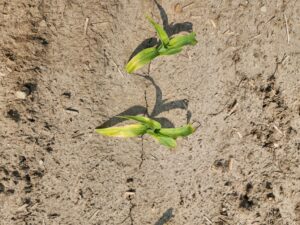
By the first week of June, corn that had been planted by early May was generally around the V2-V3 (2-3 leaf collars) stage. With a return to seasonable temperatures and sunshine, most corn quickly grew out of its yellow colouring.
Beyond the odd scattered rainfall event, June was conducive for field work. Side-dressing generally started the first week of June. Above normal temperatures dominated the latter half of June which resulted in many areas catching up to their 10-year average normals for heat unit accumulation. Many fields were closing rows by the week of June 22. In some areas that were not receiving rain, moisture stress (e.g. leaf wrapping) was starting to show up during the heat of the day, especially on knolls or areas with poor water holding capacity. Many later split nitrogen applications (e.g. spinner spreader, drop hose) were being made the end of June through the first week of July in corn that would have been around the V9-V12 (9 to 12 leaf collars) stage.
Pollination
July generally ranged from seasonal temperatures to periods of very hot and humid weather. Rainfall was generally limited to scattered thunderstorms and was highly variable with some areas receiving enough to prevent crop stress while other areas received very little. While corn generally looked very good in early July, moisture stress was starting to become very evident on lighter soils with poor water holding capacity.
Some of the earliest planted fields were just starting to push tassels the week of July 13. The peak of tasseling and pollination for most fields was likely the week of July 20 and into the week of July 27. With limited widespread rains and plants under some degree of moisture stress, tasseling and pollination appeared slow and drawn out in many fields.
Western Bean Cutworm peak moth flights generally peaked the first week of August. Trap counts submitted to the Great Lakes and Maritimes Pest Monitoring Network were much lower than normal for Ontario in 2025.
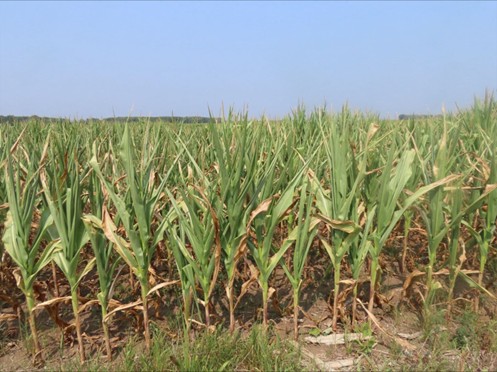
Continued dry conditions were becoming a concern as the corn crop was now in its peak water use stage and rainfall was still limited in many areas. Moisture stress (leaf wrapping, short or variable height, firing of lower leaves) was significant on soils with poor water holding capacity and was becoming very evident in other areas that had not been receiving rain as well.
Grain Fill
Dry weather continued through most of grain fill for most parts of the province. Most areas of the province were near their 10-year normal for CHU accumulation in August, but the weather shifted in late August and early September when periods of below normal daytime temperatures and very cool night temperatures prevailed for a couple weeks. At the Elora Research Station from August 25 to September 10 all daily low temperatures were below 10°C including 5 days below 5°C. Low temperatures during grain fill can be stressful for photosynthesis and delay development. By the September 18 crop report (https://bit.ly/48Lnscz), several Environment Canada weather stations were as much as 100-200 CHU (~3-7%) behind their 10-year average.
Well above normal temperatures took over from mid-September into early October. In many dry areas, lower and upper canopy leaves were showing a high degree of leaf firing and death by mid-September.
In Eastern Ontario, some light frosts occurred around September 19-21 while in Central and Southern Ontario first frosts did not occur until the October 1 to October 9 time frame. Killing frosts (-2°C or lower) occurred from late September to early October for parts of Eastern and Central Ontario but did not occur until around October 26 for most areas of Southern Ontario.
Tar Spot
Tar spot is a new corn disease in Ontario (first observed in 2020) and is a concern for its high yield loss potential. Tar spot was a major concern in 2024 with weather very conducive for development (moderate temperatures, prolonged leaf wetness). Pressure was heavy in traditional tar-spot areas (e.g. south and west of London and north shore of Lake Erie) while it was the first year where widespread pressure at yield-loss levels was observed in fields outside the traditional areas (e.g. Huron, Perth, Oxford, Brant counties). It was also the first year where stromata (black tar spots on leaves) were observed east of Toronto and into Quebec.
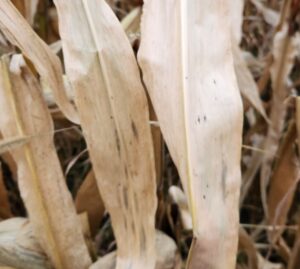
In 2025, hot and dry conditions resulted in significantly lower tar spot pressure in many areas (Fig. 2). Despite this, tar spot is well established in Ontario and is expected to continue to establish across the province. Growers (especially those in non-traditional areas) are encouraged to understand, monitor and manage tar spot going forwards. Tolerant hybrids and proper fungicide selection can limit yield losses in years that are conducive to high tar spot pressure.
Corn Rootworm
There were many comments that 2025 was one of the worst years for observing corn rootworm injury in corn-on-corn fields in Ontario in a very long time. A major concern has been the development of resistance to traits that have traditionally provided protection against root feeding from corn rootworm larvae. Injury in some fields has occurred at levels which has resulted in significant lodging, yield losses and harvest difficulties. Crop rotation is the best method of control, but there are some management guidelines where regular crop rotation may not be an option. Search “corn rootworm” at FieldCropNews.com for many articles around corn rootworm and resistance management.
Corn Silage Harvest
Corn silage harvest timing was highly variable. Some severely drought stressed corn was harvested as corn silage in August as it became clear grain yield potential was very low and the crop was stressed enough that whole plant moistures became suitable for ensiling.
Harvest in less moisture stressed areas was generally getting well underway in the first to second weeks of September and depending on area continued into the end of September. Some growers commented on whole-plant moistures being highly variable across fields.
An estimated 243,000 acres of corn silage was harvested (OMAFRA Crop Statistics), slightly higher than the 5-year average of 237,000. Average yields were 17.0 ton/ac, 89% of the 10-year (2015-2024) average of 19 ton/ac (OMAFRA Crop Statistics).
Ear Moulds and DON
The annual ear mould and DON (vomitoxin) survey was completed from September 22 to October 3. The purpose of the survey is to measure the relative levels of DON in the grain corn crop just prior to harvest to provide information for growers and industry. A total of 231 samples were collected across the province. Visual mould and DON levels were among the lowest in the last 10 years of the survey, with 2% of samples testing at or above 2 ppm (10-year average is 14%). Final report is available at Fieldcropnews.com (https://bit.ly/48z9Cva).
While only representing a minority of samples, insect feeding damage (Western Bean Cutworm, Corn Earworm) was present in some samples. Peak Western Bean Cutworm moth flights occurred the first week of August, generally coinciding with the end of tasseling and pollination in many areas. Trap counts submitted to the Great Lakes and Maritimes Pest Monitoring Network were much lower than normal for Ontario in 2025. Where feeding damage was present, visual mould symptoms were usually more apparent.
While grain corn DON levels were generally very low across most of the province at harvest, there were reports of some fields in some areas of the province returning elevated DON levels. Even in very low DON years, it is not unusual to have some regions or fields with elevated DON levels. This may be related to weather at key times in these regions (e.g. more moisture or canopy humidity and moderate temperatures during silking) or hybrids with characteristics that are more favourable for Gibberella Ear Rot establishment and development (silk infection susceptibility, husk cover). With large amounts of low DON corn, higher testing areas or fields were not expected to cause significant issues.
Corn hybrid selection has one of the most significant impacts on DON levels in grain corn (second only to weather) and is the greatest risk factor that growers can control. Some guidance around hybrid risks is now available through the Ontario DON hybrid trials. The 2024 DON trial results were released in February 2025 and are available in the corn section of gocrops.ca (https://bit.ly/4iQaFud). The 2025 report is expected to be released in early 2026.
Grain Corn Harvest
Grain corn harvest started around the first week of October in some areas, but despite well above normal temperatures from late September through early October, high corn moistures limited the pace of harvest. Progress was highly variable. By mid-October, some moisture-stressed areas were reporting lower grain moistures and more advanced harvest, while other areas were still reporting grain moistures in the high 20’s to low 30’s and very little progress. By the end of October to early November, harvest was starting in earnest in many areas. Grain Farmers of Ontario’s harvest progress survey estimated harvest was about 25% complete the last week of October. Progress was highly variable, with some areas barely started and others well over half complete. A number of rain and snow events occurred through the middle of November, which limited field activity. Harvest was about 50% complete by mid -November, and as of the first week of December, Grain Farmers of Ontario’s harvest progress survey estimated harvest over 90% complete.
High and variable moistures were a major topic of conversation during harvest. It is difficult to point to a single cause for why moistures were so high in fall 2025, especially with fall weather that should have been excellent for drying. Some possible factors which might have contributed to higher than expected fall moistures might include i) delays in corn development and grain fill from an extended period of very low temperatures from late August through early September, ii) below normal CHU accumulation through the middle of September and iii) finishing grain fill under much higher than normal high temperatures combined with very low soil moisture, challenging crop ability to properly finish grain fill.
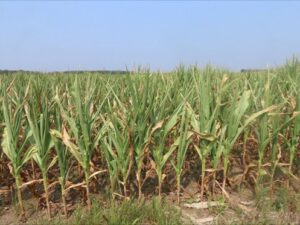
As is common in most dry years, yields were highly variable depending on rainfall and soil moisture holding capacity of soils. In some of the most drought-stressed areas, yields were significantly below normal, and in some areas, there are fields that struggled to develop cobs or pollinate at all and will yield nearly zero (Fig. 3). On the other hand, some growers in areas that received timely rains were reporting record yields in 2025.
Estimated 2025 grain corn yield for Ontario is 176 bu/ac (OMAFRA Crop Statistics), 5% higher than the 10-year average of 168 bu/ac (2015-2024). The 2025 Ontario hybrid corn performance trial results are available at the corn section of gocrops.ca (https://corn.gocrops.ca/). Several options exist for viewing data, including printable PDF, sortable spreadsheets (yield index, moisture, lodging, company or hybrid name etc.) and yield by moisture graphs demonstrating the trade-off between yield and harvest moisture of hybrids within each OCC table.
Things to Monitor in 2026 and Beyond
Tarspot
Very dry conditions limited tar spot growth in 2025. Growers are encouraged to continue to monitor and manage tar spot going forwards, especially as it spreads into areas of the province where it has not traditionally been an issue. Keep up to date with tar spot information at FieldCropNews.com or CropProtectionNetwork.org.
Corn Rootworm Resistance
There were many comments that 2025 was one of the worst years for corn rootworm injury in a very long time. There are increasing concerns about resistance as more cases of rootworm injury on corn with traits for corn rootworm protection have been observed in Ontario. Growers with corn-on-corn are encouraged to keep an eye for rootworm damage, understand resistance risks and know their management options.