Field peas (Pisum sativum) are a cool-season annual legume that are grown as a cover crop to fix nitrogen, complement other species in mixtures and to boost protein levels in mixtures seeded for forage production. Peas have viny above-ground growth (Figure 1) and shallow roots compared to other species. They germinate and grow best in cool conditions and pair well with cereal species that can support their vines. Field peas include forage varieties bred for high biomass and winter peas, which overwinter in certain regions. They can fix significant amounts of atmospheric nitrogen (N), but a consistent N credit following cover crop peas has not been established for Ontario. Field peas perform best on well-drained, loamy soils, but do not thrive in poorly drained or drought-prone soils. Peas are a popular cover crop: field/forage peas ranked fifth in a 2020 survey of 520 Ontario farmers, with Austrian winter peas coming in at eighth (Morrison and Lawley, 2021).
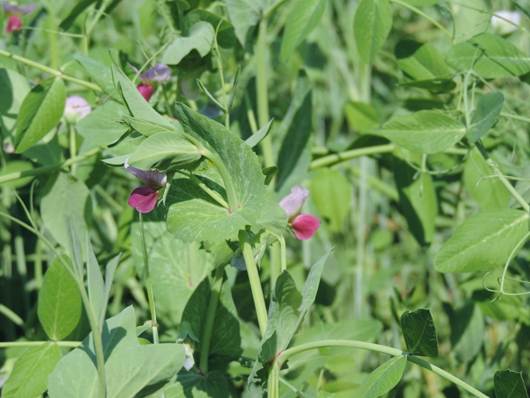
Figure 1. A flowering field pea cover crop grown in Middlesex County.
Establishment and growth
| Germination and emergence | Large, spheroidal-shaped seeds that germinate and grow best in cool and moist, yet well-drained, conditions. Seeds germinate at temperatures as low as 4.5 °C. Optimal germination at 24 °C, though seeds are at a higher risk of infection from soil-borne diseases at this temperature. |
| Top growth | Viney growth with weak stems; may reach a height (or length) of 1 metre. Requires a supporting crop to stand (Figure 2). Growth is rapid under cool conditions. |
| Root system | Shallow root system (Figure 3) that is susceptible to compaction, drought and poor drainage. |
| Overwintering | Field and forage peas can withstand freezing temperatures, but do not overwinter in Ontario’s climate. |
| Site suitability | Grow best on well-drained loamy and clayey soils. Do not perform well on poorly drained soils or on drought-prone sandy or gravelly soils. Peas generally prefer fertile soils and have an optimal pH range of 6 to 8. |
| Herbicide sensitivity | Field peas are highly sensitive to specific herbicides, including many of the ALS-inhibitors (WSSA Group 2). Carryover injury has also been reported from mesotrione, atrazine, clopyralid, among others. Visit the Ontario Crop Protection Hub to check re-cropping information. |
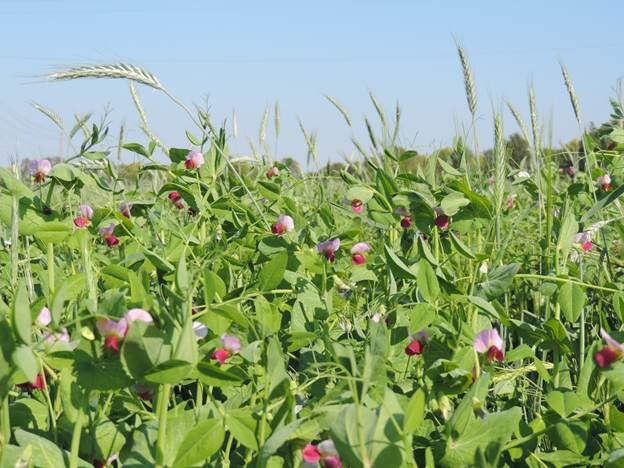
Figure 2. Peas growing with support from a small grain companion cover crop.
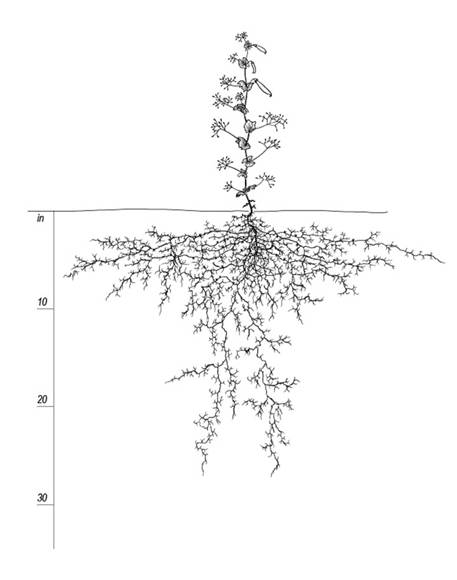
Figure 3. Representative root system of a winter pea cover crop. Credit: Erwin Lichtenegger, Wageningen University. Compiled by Conservation Cropping Systems Initiative.
Common uses in field crop rotations
- Field/forage peas sown in late summer as part of a mixture, often with a spring cereal such as oats and sometimes other species like daikon radish (Figure 4).
- Forage peas seeded following wheat harvest with a spring cereal, typically oats, as a fall-harvested forage crop to boost protein levels.
- Forage peas included as part of a mixture for fall grazing.
- Austrian winter peas included in commercial multispecies mixtures with other overwintering species.

Figure 4. A common, simple multispecies cover crop mix in Ontario: oats, field peas and tillage radish. Haldimand County.
Control options
Weather
- Field and forage peas are terminated by Ontario winters.
- Austrian winter pea stands are often significantly reduced or terminated by winter in Ontario. There is significant variation in winter hardiness by variety.
Herbicides
- Glyphosate with dicamba or 2,4-D is recommended for effective termination of Austrian winter pea (Wallace et al., 2024).
Mechanical
- If terminating with only tillage, multiple passes are often required. Less aggressive tillage can help maintain some of the tender plant material for soil cover.
- Terminated by mowing at full bloom.
Benefits and cautions
| Benefits | Cautions | |
| Nutrient management and organic matter | Peas fix atmospheric nitrogen. Fixation is maximized when termination is delayed until full bloom or later. Narrow carbon-to-nitrogen ratio results in rapid breakdown of pea residue. | Nitrogen transfer to the following grain crop is not guaranteed, and a consistent nitrogen credit has not been identified for field peas or Austrian winter peas in Ontario research. |
| Pest and disease management | Peas can release allelopathic compounds, such as beta-alanine, which has been documented to reduce growth in some grasses and in germinating lettuce (Schenk and Werner, 1991). Peas often have high aphid populations but can also provide cover for beneficial insects, including predatory mites and lady beetles. Bees are attracted to fields of flowering peas. | Peas are generally not as effective for weed suppression as grass cover crops, particularly under warm conditions. Use narrow rows, appropriate seeding depth and rate to establish a vigorous crop canopy quickly. Seed with a fast-growing cereal like oats for improved weed competition. Peas are an attractive host crop for several types of plant-parasitic nematodes. Vulnerable to a wide range of root-rot diseases. |
| Erosion control | When sown as a minority percentage with oats or other spring cereals with lasting residue, the mixture is considered very good for erosion protection. | Tender residue breaks down quickly and does not contribute greatly to surface soil protection when peas are seeded on their own. Tillage further reduces erosion protection benefits. |
Getting started
- Seed is readily available in Ontario.
- Ensure good soil moisture and seed-to-soil contact. Broadcast or aerial seeding without incorporation is not recommended.
- Seeding rates vary with seed size but are generally in the range of 50–110 kg/ha (45–98 lbs/ac) for peas on their own.
- Seeding rates for oat-pea mixtures vary depending on goals. If lasting residue, erosion protection and weed suppression are main priorities, proportion of oats should be higher. If nitrogen fixation or higher forage protein levels are desired, the pea rate may be boosted up to equal the weight of oats in the mix.
- Ensure effective and timely spring termination if growing Austrian winter peas.
Related resources
References
The Root Project. Conservation Cropping Systems Initiative. Based on drawings by Erwin Lichtenegger. Wageningen University & Research Image Collections (https://images.wur.nl). By permission: Plant Sociological Institute (http://wurzelforschung.at) via Creative Commons (CC BY-NC-ND 4.0). Compiled by Conservation Cropping Systems Initiative, Indianapolis, IN (https://ccsin.org). Produced by Big Picture Studio, Downingtown, PA (https://bigpicture.studio). https://www.ccsin.org/root-project/. Accessed May 4, 2026.
Schenk, S. and Werner, D. 1991. β-(3-isoxazolin-5-on-2-yl)-alanine from Pisum: Allelopathic properties and antimycotic bioassay. Phytochemistry. 30 (2): 467-470. https://doi.org/10.1016/0031-9422(91)83706-Q.
Sustainable Agriculture Research and Education (SARE). 2007. Managing Cover Crops Profitably, 3rd Edition. Field peas. https://www.sare.org/publications/managing-cover-crops-profitably/legume-cover-crops/field-peas/. Accessed March 11, 2026.
Wallace, J., Flessner, M., Lingenfelter, D., Singh, V., VanGessel, M., Vollmer, K. and E. Unglesbee. 2024. How to select herbicide programs. GROW Integrated Weed Management. https://growiwm.org/cover-crop-termination/. Accessed March 16, 2026.