Co-authored with Joanna Follings, Cereal Specialist – OMAFA
Some consultants and scouts have started to notice some cereal pest activity in fields this week. Some fields have cereal leaf beetle larvae starting up while many fields have some lower levels of cereal aphids. That said, cereals play a huge role in building up our natural enemy populations that other crops benefit from throughout the season (eg. soybeans and soybean aphids). So it is very important to only use insecticides when thresholds have been reached. Knowing that we are approaching T3 fungicide applications, it is important to not add an insecticide into the tank, just in case. This is what leads to resistance, as well as a crash of natural enemy populations, setting us up for more problems later in the season. With so few cereal insecticide products available, we need to use them wisely and only when necessary.
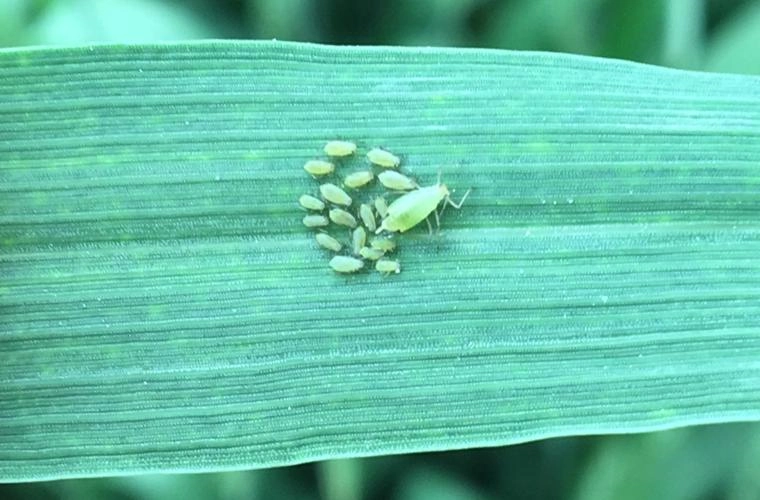
Cereal aphids have been spotted in much of southwestern Ontario but at low levels. Natural enemies like ladybeetles are also easy to find. Aphids are more likely to be found in the earliest planted fields and those with higher plant densities. Cereal aphids rarely cause direct yield loss in Ontario. Only when populations reach an average of 12 – 15 aphids per stem prior to heading is a foliar insecticide recommended. But some fields may build to those levels this year if temperatures remain cooler than normal, so scouting is advised. Once in heading, populations need to reach closer to 50 or more aphids per head to warrant control. More info on cereal aphids can be found in this link (CropIPM) and control options can be found in this link (Crop Protection Hub). A reminder that Cygon has a pre-harvest interval of 35 days.

Cereal leaf beetle (CLB) adults and larvae have been spotted at low levels in some of the YEN cereal sites being monitored this year. Best to scout fields with a known history of CLB activity soon and plan to check all cereal fields a few times over the next few weeks until the head is fully emerged to spot any infestations and injury.

CLB adults are metallic, blue-green in colour, with a reddish-orange head and legs. CLB eggs are yellow and football shaped and are laid flat on the upper leaf surface, close to the midrib. The larvae appear shiny brown to black, like a dirty drop of water on the leaf. The yellowish-beige humpbacked larvae are covered in their own fecal matter to stay moist and protect from predators. A good indication that you have CLB in your field is if you find black streaks across your pant legs after walking through the field.
Both larvae and adults feed on the leaf surface, chewing long scratches that run parallel with the leaf veins. Leaves become skeletonized or window-paned. Heavy infestations cause the field to look silver and similar to frost damage from a distance. Injury to the flag leaf is the most important to avoid.
Examine 20 plants in five locations across the field. It is important to scout various areas of the field, as CLB tends to be unevenly distributed across the field. Record the number of beetles and larvae found per plant. Scout every 5 days, as damage can increase dramatically within days.
If an average of three larvae per tiller are found before boot stage, spray is warranted. One CLB adult or larvae per stem warrants control after boot but prior to heading. Insecticides registered for cereal leaf beetle can be found on the Crop Protection Hub. A reminder that Decis has a pre-harvest interval of 40 days.
True armyworm larvae are expected to start showing up in some fields though there are no reports of finding them yet. Adult moth counts have been ramping up in some traps but Ontario’s levels have still been lower than some other states. It is still too early to tell if this might be a good armyworm year but we do tend to see an increased risk of infestations following a cooler, wet spring.
True armyworm feed at night, so the best time to scout for true armyworm is shortly after dusk. In cereals, examine 10 areas of the field, assessing the number of larvae per 30 cm x 30 cm (1 ft2). Pay particular attention to the border area directly adjacent to other grassy host crops. During the day, if it is cloudy and overcast, you might be lucky enough to see larvae on the head of the plant but on sunny days, they will be down on the ground among the crop debris, especially along tram lines or under soil clods. Brown frass may also be present on the plants and on the soil surface. If you find armyworm larvae, please contact us so that we can track whether this could become something more across the province. For now, this just a heads up to watch for any larval activity so we can alert of anything concerning.