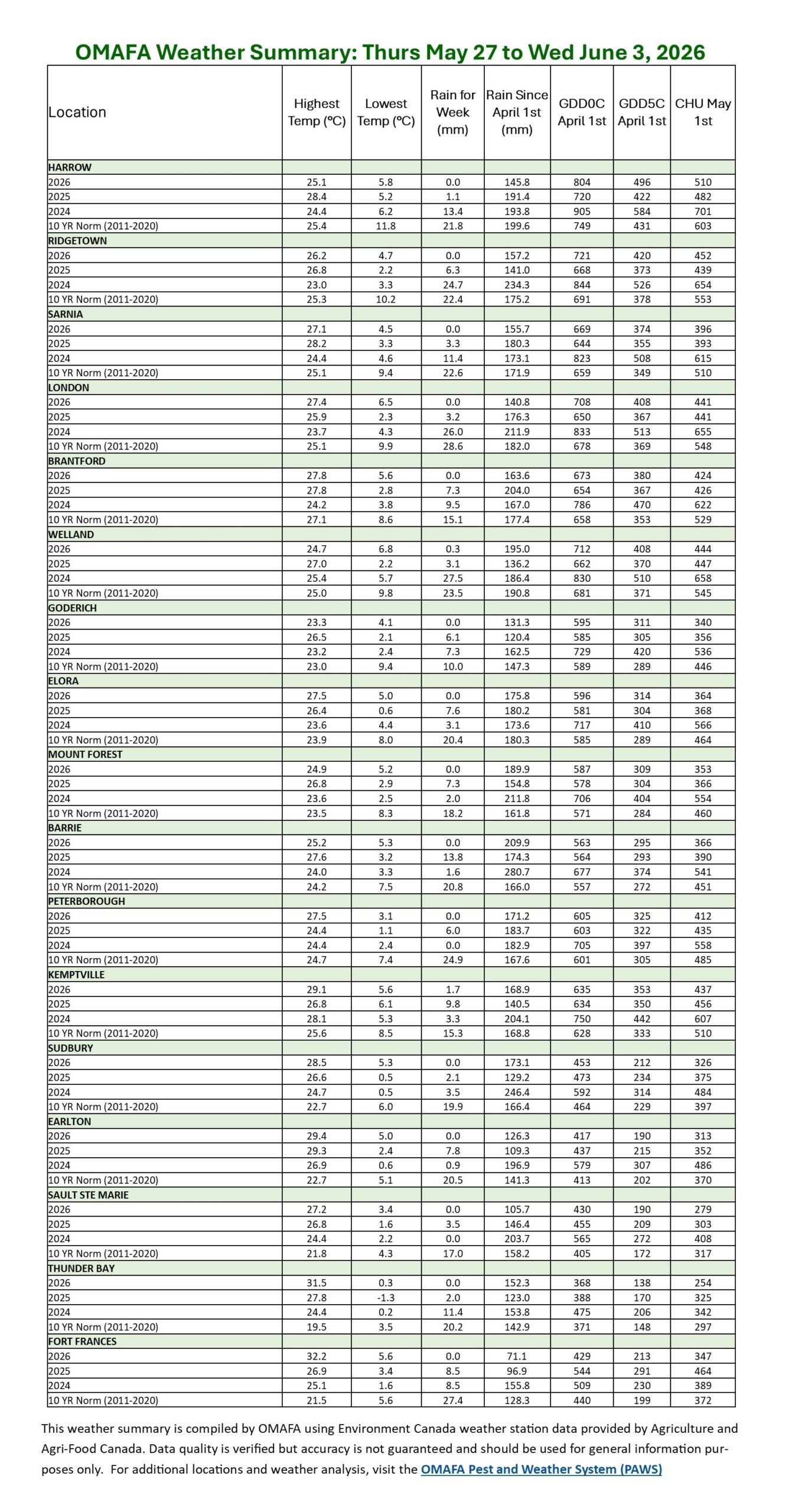
Crop conditions across Ontario reflect a generally positive start to the season, although variability in soil moisture and temperature has influenced planting progress, crop development and pest dynamics. Other key concerns moving forward include:
- Continued dry conditions in certain areas have limited herbicide activation
- Ongoing weed control challenges, particularly annual ryegrass and Canada fleabane
- Stripe rust management in wheat in the southwest
- Stand assessment and replant decisions in soybeans
- Cool soil conditions have likely slowed nitrogen mineralization, which may influence early season crop nutrient availability.
Corn
Corn emergence has been largely uniform with good early stand establishment with some localized replanting. Plant populations remain a key consideration for replant decisions. While yield losses are limited until populations drop below approximately 24,000 plants per acre, stands below this threshold warrant closer evaluation of replant economics.
Pre-emergence herbicides have performed well where applied. Fields lacking residual herbicides are beginning to show increased weed pressure. Growers are advised to apply residual herbicides even under dry conditions, as activation will occur with rainfall. With some corn fields reaching the V5 stage, post-emergence weed control options are becoming more limited.
Soybeans
Soybean planting is essentially complete across much of the province, although progress remains limited on heavier clay soils. Emergence has been slower than normal, and seed quality issues from 2025 (dry, cracked seed) are contributing to uneven stands in some fields. Later planted soybeans (after May 20) are still emerging, and replant assessments should be delayed. Fields planted prior to mid-May should be assessed now, with a general replant threshold of:
- 90,000 plants/acre on medium-textured soils
- 110,000 plants/acre on heavy clay soils
Slug damage has been reported, with isolated replanting required. Canada fleabane pressure remains high in identity-preserved (IP) soybeans, reinforcing the importance of planned herbicide programs. Multiple herbicide passes are often necessary in IP systems.
Winter Wheat
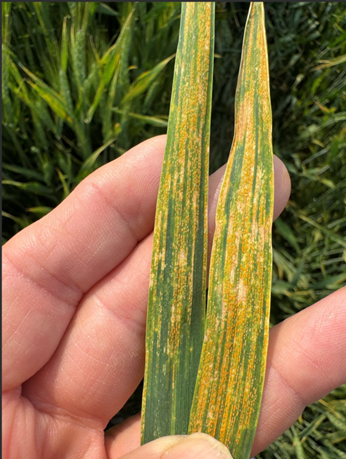
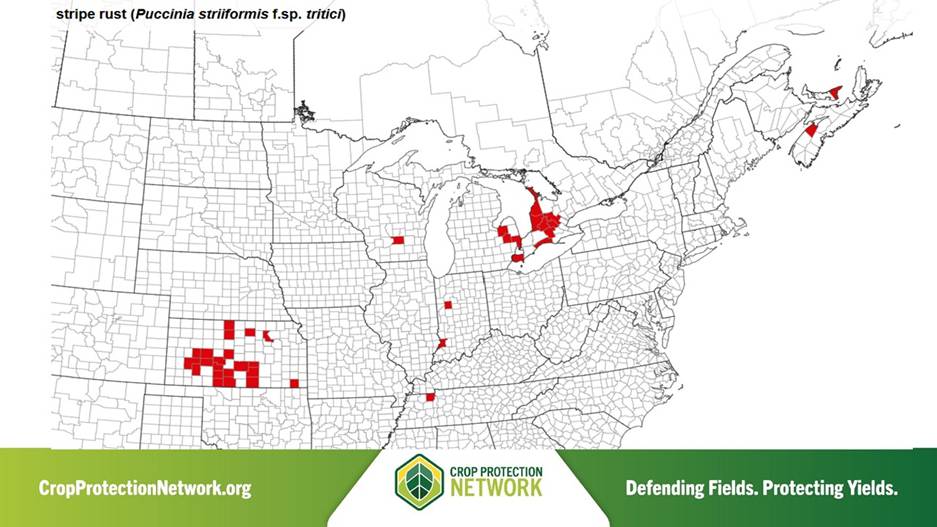
Powdery mildew and viruses been reported in fields across the province. Stripe rust (Figure 1) has now been confirmed across multiple counties including Huron, Bruce, Perth, Wellington, Oxford, Waterloo, Essex and Elgin. Frequent scouting is critical, particularly leading up to T3 fungicide timing (Figure2). Even under low fusarium head blight (FHB) risk conditions, a T3 fungicide is recommended to protect against stripe rust.
Management recommendations for stripe rust in impacted areas include:
- Apply a fungicide immediately in susceptible varieties if T3 timing is 7–10 days away and stripe rust is present
- Proceed with T3 fungicide 4–6 days after full head emergence, if an earlier application is made to protect against stripe rust
- If within one week of T3 timing, applications can be timed accordingly depending on variety susceptibility
Insect pressure varies across the province so scouting is important to access your risk. Cereal aphids are present but typically do not require control unless thresholds are exceeded while cereal leaf beetle levels are rising in some fields and may require control depending on growth stage. True armyworm larvae have been detected in isolated fields, though overall risk remains uncertain.
Edible Beans and Canola
Planting is well underway, ranging from 20% to 90% complete depending on location. Most acres are expected to be planted by early June. Early seeded kidney beans have begun emerging.
Soil moisture conservation remains important. Practices such as nighttime tillage and rolling shortly before or after planting can help maintain soil moisture. Incorporation of soil-applied herbicides may improve herbicide efficacy under dry conditions.
Winter canola is progressing well, with strong yield potential anticipated. Cooler temperatures have supported extended flowering periods, extending the critical seed-filling window. Flowering varies widely, from completion in Essex County to approximately 20% in more northern areas such as Dundalk. Insect pressure remains minimal. Variability in crop maturity may complicate desiccation timing in some fields.
Forages
Winter cereal forage harvest is complete in the southwest, and ongoing throughout the province. Later seeded fields are not yet at boot stage, so the harvest window is still open on those fields. A sunny, dry forecast for the first week of June has encouraged many growers to try for dry hay. This is a little earlier than usual, and with cool spring conditions slowing crop growth, yields may be slightly lower than normal.
The Canadian Wildland Fire Information System has flagged that most of the province is at a high, very high, or extreme risk of fire due to dry weather conditions. Growers are encouraged to carry fire extinguishers on tractors and forage harvesting equipment. Make sure all extinguishers are charged. Consider leaving a tractor hooked up to tillage equipment nearby so a firebreak can be created quickly.
Alfalfa weevil has been found in low numbers in the southwest. Growers should scout for alfalfa weevil at least once per week until 7-10 days after first cut. Weevil larvae thresholds change with alfalfa height and are available on FieldCropNews.com.
Weed Management
Volunteer corn, particularly Enlist types, continues to be a management concern. Clethodim applications at higher rates and early growth stages (<4 leaf collar) provide the most effective control. Annual ryegrass continues to challenge growers, particularly along field edges. Control is complicated by the presence of multiple biotypes and herbicide resistance. Effective management requires:
- Early intervention targeting small, actively growing plants.
- Use of 2 L/ac glyphosate (540 g/L formulation) alone is effective on glyphosate-susceptible biotypes. Tank-mixing glyphosate with other effective herbicides such as clethodim or nicosulfuron can reduce selection pressure for glyphosate-resistant biotypes. Application of pyroxasulfone in the Fall can provide control of annual ryegrass into the Spring.
- A long-term, integrated (multi-year) control strategy incorporating strategic tillage if possible in cropping system.
Agricorp
Please check the Agricorp website for regional planting deadlines. Reminder to report final planted acreage as soon as planting is finished, since the phone lines get very busy near the deadline. Farmers can also report their final planted acreage online.
Upcoming Events
Mark your calendars for the following events:
- July 7 & 8, 2026 – Southwest Crop Diagnostic Days – University of Guelph, Ridgetown Campus
- Please visit the event site for more details or https://www.uoguelph.ca/ridgetown/diagnostic-days.
- The Winchester Research Station is hosting a Field Day June 30th at the station. Details & registration can be found at eocac.ca. Registration closes June 22nd.
- July 28, 29 and 30, 2026 – Northwest Ontario Ag Tour and Diagnostic Days (Emo, Rainy River, Thunder Bay)
Exeter Breakfast Meeting – June 2, 2026
Corn
- Overall stands are emerging nicely and there are not a lot of issues with corn emergence. There are some replants reported in the south in the Sombra area as well as in north Huron. There are issues particularly on lighter ground that went in early and the soils got a little too cold. There have also been some instances where growers planted too low of a population. Once populations get down to 24,000 there is a yield impact but not as much as you think. There is a balance between the cost to tear up a stand and plant a new one versus keeping the stand you have. If a stand gets below 24,000 then the decision to replant should be made.
- Pre-emergent herbicides are performing nicely where they were applied. Those that do not have any herbicides on are starting to see higher weed pressure. If there are no herbicides down, growers should put their residuals down despite the drier conditions. The herbicides will activate once the rain comes. In come cases corn is now at the 5-leaf stage so weed control options are starting to get limited in some places.
Soybeans
- Soybean planting is considered complete for this area. Heavy clay areas of Niagara, Lambton and Essex are just getting started with estimates at less than 20% seeded in those areas.
- Dry seed last year has resulted in splits and cracks in some beans. Those fields need to be watched carefully. Beans are slow to emerge this year. Anything that was planted the first half of May should be walked this week and replant decisions made. Anything planted after May 20th is still emerging and the replant decision should be delayed. 90,000, uniform plants in a good soil is still the cut off for replant decisions. On heavy clay soils the cut off for replants is 110,000.
- Intercropping some additional beans can often appear to bring more yield but the early seeded beans act as competition to and interplanted beans. In a trial conducted at one location, adding an extra bag of seed where a stand was 90,000 yielded 1 bu/ac more (70 bu/ac) than 90,000 with no seed added (69 bu/ac). Soil type plays a huge role in terms of replants or filling in a stand. Planting date also plays a role.
- Slugs have been reported in some fields with one field needing to be replanted.
- There is lot of Canada fleabane reported in IP soybeans. Despite drier conditions, growers should stick to their plan and apply their residual herbicides. They will be activated once the rain comes. Growers are reminded that more than one pass of herbicide is often need in IP soybeans.
- Enlist volunteer corn is a challenge in some fields. It is important to keep good records of what was grown the previous year. If dealing with volunteer Enlist corn, clethodim at the high rate when the corn is small (<4 leaf collar) will provide the best control. If trying to control non-Enlist volunteer corn, can continue to use Fops (aryloxyphenoxypropionates or AOPPs).
- Crusting has been reported in some fields. If at the hook stage it is too late to do anything as a lot of damage can be done. If rain comes this weekend it will help.
Wheat
- Stripe Rust has now been found in Huron, Bruce, Wellington, Perth, Oxford and Elgin Counties. Fields should continue to be monitored closely up until T3 fungicide application. If stripe rust is found and a T3 fungicide application is 7-10 days away and a susceptible variety is being grown, a fungicide should be applied as soon as possible. A T3 fungicide should then follow on day 4-6. If less than one week away from a T3 fungicide and growing a moderately susceptible variety then a fungicide can wait until the normal T3 timing. If less than one week away from day 2 and growing s susceptible variety, a T3 fungicide should be applied in the earlier window of T3 fungicide application window (day 0 to day 2).
- Even if FHB risk is suspected to be low with drier conditions and low humidity, a T3 fungicide is recommended to protect against stripe rust. If tank-mixing products with a T3 fungicide the surfactant load needs to be watched to avoid injury and abortion of flowers. Sprayers should be thoroughly cleaned, including endcaps, prior to any T3 applications. Coarse to very coarse droplets, nozzles positioned 8-10 inches (0.2-0.25 meters) above the heads, forward and backward nozzles angled 30 to 45 degrees down from horizontal and lots of water (18-20 gal/ac) are recommended for T3 fungicide applications.
- Seeing more injury in some fields due to late applications of 28%. It is suspected that with the cool, cloudy spring weather the wheat cuticle is thin and more prone to leaf burn or injury. In most cases the penultimate leaf was impacted but the flag leaf was unaffected. The yield impact in those fields is expected to be minimal.
- Cereal leaf beetle and aphids are being found at high levels in some fields. Cereal aphids rarely cause direct yield loss in Ontario. Only when populations reach an average of 12 – 15 aphids per stem prior to heading is a foliar insecticide recommended. Once in heading, populations need to reach closer to 50 or more aphids per head to warrant control. If an average of three cereal leaf beetle larvae per tiller are found before boot stage, spray is warranted. One CLB adult or larvae per stem warrants control after boot but prior to heading. Growers are reminded to watch pre-harvest intervals if they are applying into the heading stages.
- True armyworm larvae have also been found in one field. Adult moth counts have been ramping up in some traps, but Ontario’s levels are lower than surrounding states. It is still too early to tell if this might be a good armyworm year but there tends to be an increased risk of infestations following a cooler, wet spring. Fields should continue to be monitored to determine if control is warranted.
Edible Beans
- Edible bean planting started at the end of last week and is progressing into this week. Some areas are 80-90% complete while others are at about 20-30% complete. Most are expected to be planted by the weekend. Some early seeded kidney beans have emerged.
- Overall conditions have been great; however, soil moisture has been a bit of a concern for some. Doing tillage at night or rolling beans shortly after planting can help to conserve soil moisture.
- Rather than waiting for rain, incorporation of soil applied herbicides can also help get that product into moisture while still being available for weed uptake.
Canola
- Overall the winter canola is progressing nicely and yield potential is expected to be high as cooler temperatures are conducive for extending the flowering period.
- Flowering ranges from complete in Essex County to 20% complete in Dundalk.
- There is very little insect pressure to note.
- Desiccation timing in some fields may be a challenge due to some variability in the stand.
- June 15th is the order deadline for 2027 winter canola seed.
Forages
- Winter cereal forage harvest is complete. There has been lots of alfalfa coming off in the area and manure being applied.
Soil samples
- Soil sampling is now complete for the most part. With the cool spring and cool soils, it is expected that mineralization of N has been slow.
Weed Control
- Annual ryegrass continues to be a challenge in fields. There are different biotypes out there which makes control a challenge. The key to managing it is knowing the biology and staging of the weed. There is no magic bullet but the full 2L/acre rate of glyphosate will kill it if it is not resistant. It is now moving into stem elongation so not as responsive to herbicides. A multi-year weed control program is needed to manage it.
- It establishes on perimeters for the most part and also emerges early. Early emergence can make it difficult to control if you are not able to get equipment across the field.
Exeter Attendance:
- All attendees are encouraged to invite someone from retail to the next meeting on June 16th.
Winchester Breakfast Meeting – June 3, 2026
Winter Cereals
- Heads are just emerging in some varieties and most fields are expected to be fully headed out by end of the weekend.
- Timing is coming next week for T3s after forecasted rainfall this weekend.
- Some reports of Powdery Mildew in the Iroquois and Morrisburg area.
- Some wheat streak mosaic virus – mostly in the early planted wheat.
- Some stripe rust reported – infections have been patchy and not the whole field.
- Cooler overnight temperatures would encourage stripe rust, while heat would slow it. Fungicide works better preventatively, so if you’re seeing patches, and are more than 7-10 days away from a T3 fungicide application, a fungicide should be applied as soon as possible, followed by a T3 fungicide application 4-5 days after head emergence.
- Make sure you’re identifying stripe rust properly – it has to have a powder rub off, not just lesions.
- There are no insects reported locally as of yet.
Spring Cereals
- Most herbicide applications on, emergence is nice and even, spring cereal fields look good overall.
Forages
- 40-50% cut already or started the last few days.
- Grasses are advanced, alfalfa is budding but not flowering yet – timing for cutting is on par with where it should be.
- Yields are lower than expected – stands are shorter and not as thick as some years.
- Cool weather held grasses back and reduced overall volume.
- Most rye/triticale is done, wrapped up last few days.
- Lots of growers saw good yields on triticale and are happy with what they got, but fields that were borderline for winterkill were tougher yield wise.
- There are reported height differences in triticale varieties, so that will likely lead to some yield differences with that too.
- Feed inventories are quite tight, especially in Stormont & Leeds Grenville counties, so an increase in annual forages is planned/starting this week. It will likely take more than just this year to recover from a low feed inventory year like last one.
- Southerly winds the last few days will likely bring potato leafhopper, so it’s recommended to be watching new seeding fields closely, as they are still a while from cutting.
- New seeding overall looks really good
Corn
- 99.5% planted – still a few acres going in yesterday.
- Emergence is pretty even and stands look good, but some fields that went in while the weather was cool weren’t as happy emerging.
- Very few reports of crusting, but overall emergence is very good – soil conditions were often good even with cool temperatures.
- 1-4 leaf corn, some fields on light soils at 5-leaf. Herbicide windows on these fields are closing rapidly.
- Some of the early planted corn lost 2-3 leaves on Saturday with localized frost, but plants survived and have rebounded well.
- Estimated 50% corn sprayed, custom work is probably higher in terms of overall acres sprayed – more like 75%-80% acres covered to date.
Soybeans
- Some additional acres going in with a lack of rainfall, some acres that weren’t expected to be planted are now able to be planted.
- Some soybeans are planned to go in after first cut.
- Estimated that most growers are 95% planted on soybeans.
- Emergence is slow but fairly even – the early planted beans took a long time to come up
- Some frost damaged beans in lower lying areas, corn residue heavy fields. Not total replant, just a reduced stand.
- Corn residue is still a problem, even with lower yields and dry weather last year. Growers are finding it hard to get seed planted to depth and consistently with high corn residues.
- A reminder to anyone making spray recommendations or spraying that any dicamba products are at a very high risk for drift in the forecasted hot weather. Growers can use the Engenia Spray Tool here to help with some decisions.
- Keep water up with all Enlist products, no matter if they are tank mixed with glyphosate (15+ gal/ac) or Liberty (20+ gal/ac).
IPM
- Wireworm is a little heavier than previous years.
- Some black cutworm just at threshold.
Agricorp
- A reminder that the deadline for corn planting locally is June 15th, and soybeans is June 30th.
Events
- The Winchester Research Station is hosting a Field Day June 30th at the station. Details & registration can be found at eocac.ca. Registration closes June 22nd.
Simcoe Breakfast Meeting – June 3, 2026
Overall
- A stretch of sunny and warm, but not overly hot, weather since May 23rd has enabled clay soils to dry out and field prep and planting to begin in earnest. Soils are reportedly drying in the top inch or two, but still fairly gummy underneath. Heavy clay soils can progress from too wet to too dry quickly, which may be a risk in some parts of the region depending on whether forecasted rain from the weekend materializes. Crop emergence on medium and light-textured soils is good. Much of the corn planted during the first two week of May all emerged within the same few days. Forage harvest is in full swing on dairy farms taking full advantage of the near-perfect conditions this week. Manure application is following closely behind
Corn
- Corn planting progress estimated at 30 to 50 % complete depending on timing of previous rain events, with much of the corn reduced to 95-day maturity due to planting delays. Corn acres are down compared to normal due to crop price, and the cool, wet spring is reported to have further reduced acreage. If forecasted rain for the region occurs this weekend, it is commented that it will close any cash crop corn planting; remaining intended acres will go to soybeans. Only those requiring corn for feed will plant later if the window this week is missed.
- There have been crop insurance claims and re-plants on a relatively small percentage of acres that were seeded in the range of May 18-21 ahead of the May 22/23 rainfall. These are on soils that are not the heaviest clays in the region and that had an earlier planting window. In some cases, the cause was sidewall compaction; in others, it was a heavy crust, resulting in poor emergence and leafing out underground.
Soybeans
- Soybean planting is progressing quickly on the clays, especially no-till soybeans. Estimates of up to 30% of intended acres have been seeded. Some growers are prioritizing soybeans ahead of corn to enable timely winter wheat seeding this fall.
- The importance of planting into fit soils was emphasized, given the negative outcomes of pushing too early and the capacity of modern seeders to get the crop in quickly once conditions are right. The comment was made that an effective approach employed by some clay farmers in the area is to perform a vertical/light tillage pass ½ to ¾ inch deep to open up the crust to enable faster soil drying at seeding depth and below.
Winter wheat
- Wheat is coming into head and sprayers may be in demand simultaneously in the coming days for T3 fungicide applications and burndowns for corn and soybean fields. There was limited discussion on wheat.
Horticultural crops
- Plenty of transplanting has occurred in recent days for horticultural crops now that frost risk appears to have passed. Should all be wrapped up by this weekend. The first planting of cucumbers is in. Potatoes are emerging well.
Weed control
- There are lots of calls coming in regarding control of annual and perennial ryegrass, which has become a widespread problem. It is very difficult to get out early enough to control it before it elongates and becomes very difficult to control with herbicides.
- Growers are reminded that Liberty and Dicamba should not be tank-mixed in soybeans (doing so increases the volatility of dicamba).
- Growers also reminded that some residual herbicide options are lost once soybeans emerge. It is important to get advice from a knowledgeable CCA to work through options.
- For identity preserved soybeans, if no residual herbicide is down and Canada fleabane is present in field, growers are advised to consult past trials conducted by Mike Cowbrough, OMAFA.
- Growers and crop consultants also reminded that waterhemp, if identified in field, must be aggressively managed to prevent spread. This is the time of year to scout. For more information on waterhemp ID, see this article on field crop news.