Rain
Rainfall from mid June through mid July is strongly related to corn yields, and in some cases, optimum nitrogen rates.
It’s the time of year when high clearance applicators might be gearing up to do late nitrogen (N) applications on corn. Like traditional sidedress applications, moving N supply closer to N demand can be a way of increasing fertilizer efficiency – reducing the likelihood of fertilizer N losses and ensuring more N ends up in corn plants. However, one of the greatest benefits of late N applications in corn may be the ability to adjust rates for the growing season.
A research trial at the Elora research station conducted by former Cropping Systems Professor Bill Deen and then grad student, Caleb Niemeyer provided a lot of insight towards the relationship between rainfall, corn yields and optimum N rates. This trial was a long-term corn-on-corn trial conducted in the exact same spot from 2009-2018. This is important – any differences observed across years were most likely due to weather and not associated with changes from moving to different fields or research plots year-to-year.
Rain Makes Grain. Particularly during corn’s late vegetative period.
It seems obvious that “rain makes grain”, but when is rain most important? Deen and Niemeyer looked at rainfall during various points in the growing season:
- early vegetative (planting to V4, or 4 visible leaf collars)
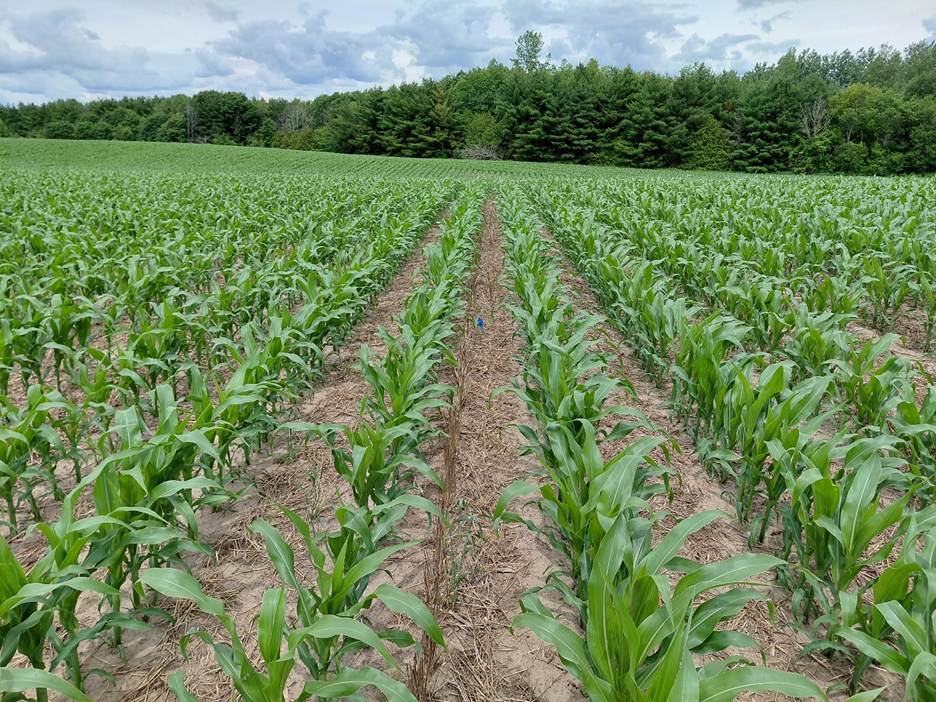
- late vegetative (V5-V12) (Fig. 1)
- tasseling and silking (VT and R1)
- grain fill (R2 or blister to R6 or black layer/maturity)
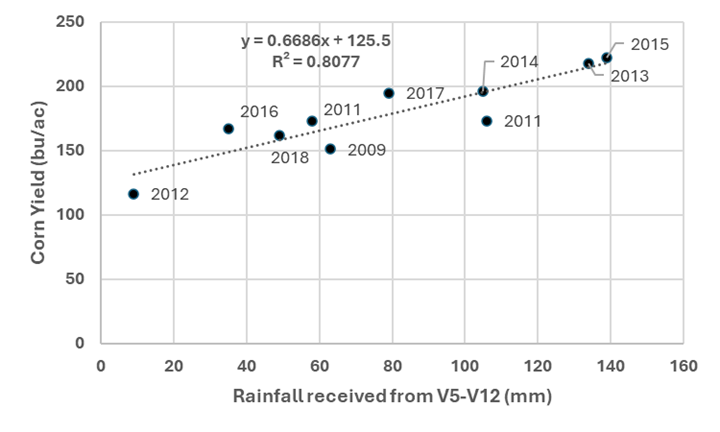
In their work, rainfall during the late vegetative stage (V5-V12) was overwhelmingly the most important for yield – the greater the rainfall during this period the greater the yield, a very strong correlation across the years of the study. On average, every additional millimetre of rain received during this period was associated with an additional 0.67 bu/ac at the end of the year (Fig. 2).
Rainfall received during the other periods or measured across the whole growing season had little correlation to yield. This may be surprising as crop stages around tasseling and silking are known to be most important for yield as crop growth rates during this period determine kernel number. Crop stresses (drought, defoliation) also have the greatest negative impacts on yield at this stage. Deen and Niemeyer offer a couple suggestions for their findings for the importance of rainfall from V5-V12 timing:
- ear formation and potential kernel number are starting to be set and could be influenced by any stresses at this stage
- this period is setting the stage for the sensitive tasseling/silking period – ensuring soil water supply is good before the crop transitions into the tasseling/silking period is likely important for minimizing stress and maximizing kernel number and yields
Hasn’t Rain Always Made Grain?
Of course, it’s not true that rainfall has never been required to make grain, but Deen and Niemeyer’s work shows that the impact of rainfall for driving yields is much more important today than it was decades ago.
They evaluated historical N response data from long-term N trials at Elora and performed the same exercise above – compared yields across years to rainfall received during the four corn growth periods during those years. They then separated data into two eras –
- the era before the year 2000 (trial data from 1971-1999)
- the era after 2000
For the pre-2000 era, yields were not strongly influenced by rainfall during any of the corn growth periods or across the whole growing season, suggesting rainfall was not the same driver for yield in the past.
For the post-2000 era at Elora, the data was consistent with the long-term N response trial above –rainfall during the V5-V12 period was strongly related to yields while there was little relationship during other periods. They also evaluated post-2000 era data from Ridgetown College, and like Elora, there were strong relationships between V5-V12 rainfall and yields, but planting to V4 rainfall also had a significant relationship.
Why does rainfall as a strong yield driver appear to be a newer phenomena? Deen and Niemeyer offer a couple suggestions:
- with higher yields and less yield loss to other factors (genetics, nutrients, pests), yield potential is more likely to be impacted by water becoming a limiting factor
- climate change can increase yield sensitivity to drought by creating conditions for more water transpiration losses from plants, reducing water storage
- simplification of crop rotations over time has likely reduced soil water storage capacity, a buffer against times of low precipitation
Rainfall Drives Yields Which Can Drive Optimum Nitrogen Rates
Across 10 years of the long-term N trial at Elora, optimum N rates varied widely from 140 lb-N/ac to 244 lb-N/ac. Two things could drive this variability:
- differences in soil N supply (difference in N mineralization and N loss from soil)
- differences in N demand as driven by yield
Deen and Niemeyer point out that differences in soil N supply (mineralization and losses) year to year were likely very low at Elora, and perhaps not surprising for corn-on-corn production on a medium textured soil:
- Zero N plot N-uptake and yields and pre-sidedress nitrate tests were low and consistent every year, suggesting low supply
- Yield and N efficiency differences between preplant and sidedress timings were also low, suggesting low losses.
They also provide good evidence that yield and N demand are strong drivers of optimum N rates at Elora, as yields and crop N demand (e.g. N uptake in the non limiting rate plots) were well related to optimum N rates.
Give the relationship between rainfall and yield, rainfall between V5-V12 was shown to be a good predictor of optimum N rates at the long-term N trial at Elora. Correlations were not observed with other growth periods.
Overall, Deen and Niemeyer conclude
- rainfall from V5-V12 can be a strong predictor of corn yields
- corn yield is a driver for N demand
- in an environment with low potential for producing mineralizable N and low potential for N losses, N demand is a strong driver for optimum N rates
- rainfall from V5-V12 can thus be a strong predictor of optimum N rates in a low supply, low loss environment
- in environments with mineralizable N (e.g. legumes in rotation) or high loss potentials (fine or coarse textured soils), soil N supply variability would make rainfall and yield driven estimates of optimum N rates much murkier