Reflection On Spring Planting Season-Did Patience Payoff in 2026?
Every spring and in each field, we are faced with the question of whether the soil is “fit” to begin tillage and planting. When you consider the size, speed, and weight of equipment today, starting a couple of days or even a half a day too early can cause a lot of damage that we now must live with that for the rest of the season. Most of us are driven by all the “plant early” talk which is important but the original saying was always “plant as early as possible when the soil is fit.” We seem to forget that last part too often. We only have one chance per season to get all these steps right, so we really need to understand the impact of timing decisions.
Ontario has considerable differences in farming situations including soils, landscapes, weather conditions, and crop systems that can present different challenges in establishing field crops.
Being patient is hard! The sun is shining, rain is in the forecast, the equipment is parked & ready, the people are itching to go and “the seed is in the bag” – where it is not doing you much good. But there is a saying that when the “seed is in the bag,” it has the highest yield potential it ever will have. Once planted it is exposed to a plethora of stresses that continuously challenge each seed’s yield potential. Those stresses are both nature and human induced. It is hard to do much about natural stresses, like weather and soil type, field slope, and many others. We can try to mitigate against those factors with timely and thoughtful decisions about the agronomy of crop production. Thoughtful management decisions can help mitigate some of nature’s stresses. Farmers make hundreds of decisions on every field each year. As operations become larger and more complex, success depends on making those decisions thoughtfully and intentionally.
Now is the time to look back and evaluate the decisions we made. This means being both reflective and observational. When crops start their rapid growth phase is when they reveal impacts of decisions made earlier in the season. In other words, think about the decisions you made earlier in the season and get out in the fields and explore the crop.
For many of us, frequent rainfall events are hiding most of the mistakes we made by starting too early, but if it dries out those mistakes will become obvious. This “in season” reflection and observation are important components of crop management that are often overlooked by farmers. What did I do, and what was the result are important in helping to make decisions next planting season? The tools needed for this reflection are your eyes and hands (sight and feel), a good tile probe and a small shovel (Figure 1). Fields are getting bigger and walking them to make these observations can be hard and time consuming. A new tool to support scouting are these small drones. Flying over the fields can help you quickly identify where problems are occurring. Once identified these areas can be checked by “boots on the ground” and observations made to determine the cause of problems. When plants are not performing well, it is important to compare affected areas with nearby healthy areas using a tile probe and shovel. Look for differences in compaction, rooting, soil conditions, and other stress factors. Record your observations for use in planning next year’s planting season. Using one of the many digital apps for your smart phone can make finding these notes in 6-8 months easier, however paper records work too. You may want to consider backing these notes and observations up somewhere, as cell phones can often get lost.
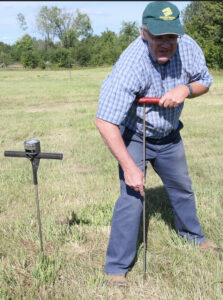
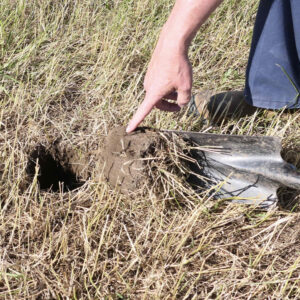
Figure 1, 2 & 3 – Tools and methods for Field Scouting Spring Planting Issues including compaction and root issues.
Consider that overall crop management is about problem solving. Asking yourself, “what are the problems I need to address or plan to avoid for this field”? Once you identify problems you are better prepared to explore and implement solutions. Those problems and solutions can be simple and complicated but if you do not identify the problem, it is hard to choose the best solution.
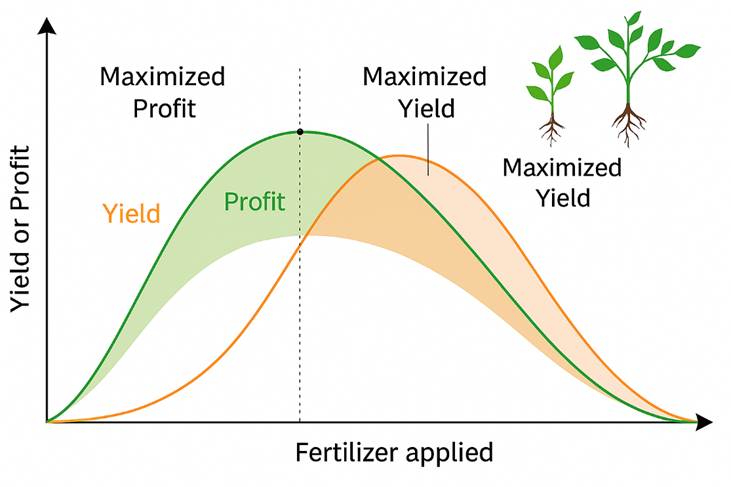
Consider what the goal is. For most its profit or should be. Sometimes we lose sight of this and associate it only with maximizing yield. The path to high yields is the decisions we make on crop inputs. Inputs should be added only while the added value exceeds the cost. Beyond that point, profitability declines as illustrated by Figure 2.
In conclusion, review and understand the impacts of the choices you make and continuously tweak the system to make it stronger, more forgiving, and more profitable in the long term.