The Corn Rootworm Trap Network is 5 years old! We have learned a lot about corn rootworm populations here in Ontario and we value the efforts of all trap participants who have monitored sites each season. A special thanks goes to Dan Bihari, Senior GIS Specialist, OMAFA for maintaining the trap network platform and to our sponsors including Grain Farmers of Ontario (GFO), Agricultural Biotechnology Stewardship Technical Committee (ABSTC) and OMAFA for funding trap supplies.
Five Year Trends
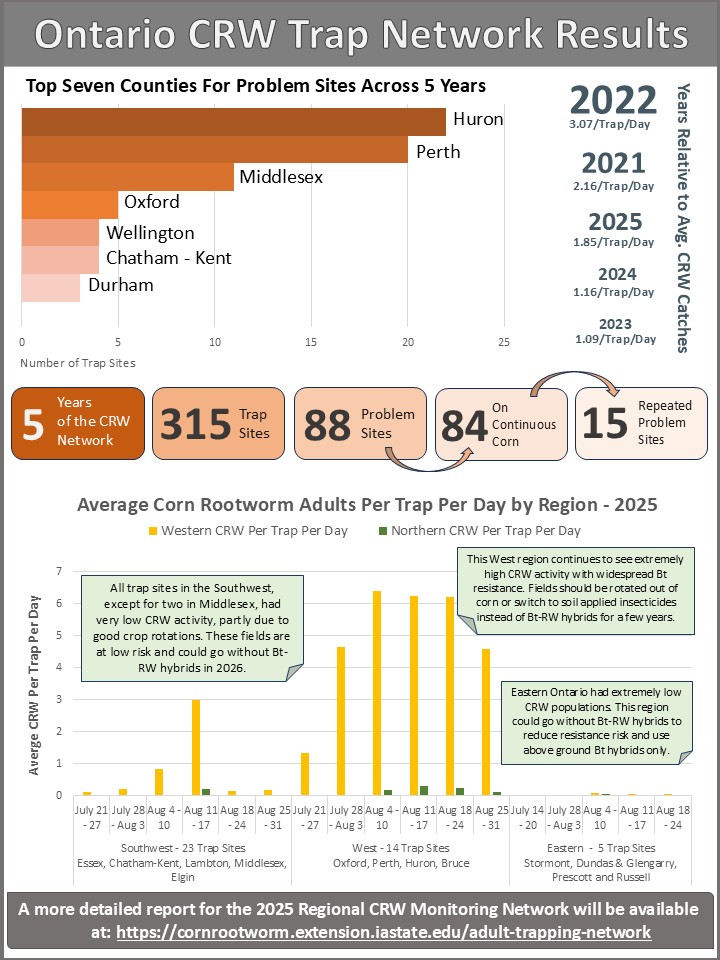
Looking across the five years of CRW trapping in Ontario, we had 315 trap sites monitored, with 88 problem fields identified where corn rootworm reached or exceeded the trapping threshold of 2 beetles per trap per day (Figure 1 and 2). 84 of these problem sites were in continuous corn fields. The counties with the most problem sites over the five years include Huron County at 22 sites in total; Perth, a close second at 20 sites and Middlesex in third at 12 problem sites. 2022 had the highest level of rootworms per trap per day, with 2021 coming in second and 2025 landed in third place with an average of 1.85 CRW beetles per trap per day.
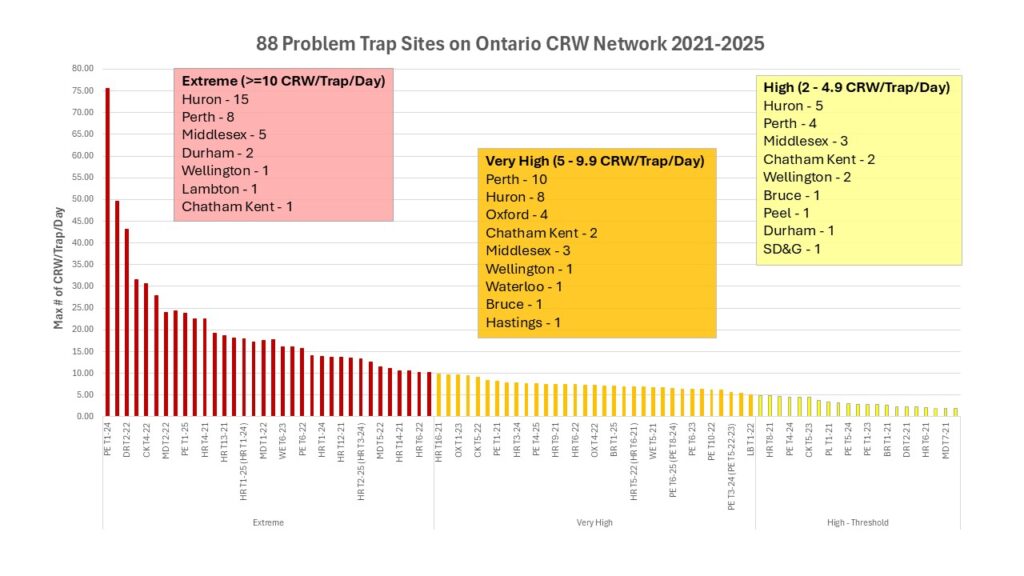
Continuous corn fields in these top counties tend to rely heavily on Bt hybrids and more recently, the addition of RNAi in hybrids to manage corn rootworm. Seeing rootworm populations continue to climb in these fields suggests we are seeing widespread Bt resistance in heavy corn on corn regions. This places the RNAi trait at high risk of rootworm developing resistance to it, given that the RNAi trait is the only functioning mode of action working against corn rootworm when planted in these fields.
29 of the trap sites on the network have been monitored for more than one year. Some of these repeated sites rotated out of corn for a year and showed a significant drop in rootworm populations the following year, while others continue to see rootworm populations climb as they stay in continuous corn production.
Forty percent of the sites over five years had only western corn rootworm on traps. Thirty-eight percent of trap sites had both western and northern corn rootworm present, while less than 2% of the sites had only northern corn rootworm beetles captured. Twenty percent (55 sites in total) captured no rootworm; most of these sites had good crop rotation and had fewer continuous corn fields in the area.
2025 Trapping Season Results
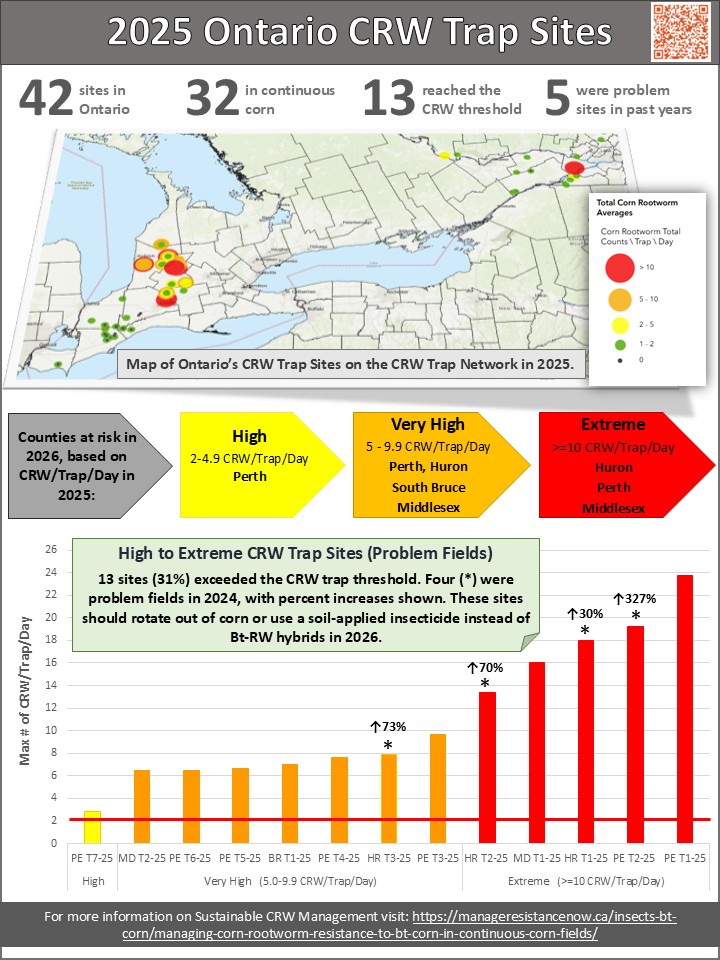
2025 was another big rootworm year. Though CRW populations were not as high as in 2022 and 2021, there were 13 trap sites that reached or exceeded threshold, 12 of which landed in the Very High to Extreme categories. Huron, Perth and Middlesex counties, in particular, continue to see extremely high levels of rootworm adults. This matches with the reports to CFIA of unexpected damage on Bt hybrids. More efforts will be placed in this area over the next few years to try to encourage more sustainable rootworm management practices in efforts to delay resistance to the RNAi trait.
Fields in southwestern Ontario, especially Essex experienced significantly low rootworm populations. This is likely due, in part, to a higher percentage of fields rotated out of corn, keeping rootworm populations down. Eastern Ontario also experienced extremely low populations of rootworm. These two regions are likely safe to consider using above ground Bt hybrids only in 2026, reducing the risk of Bt resistance development.
Western corn rootworm was the dominant species in 2025 with 81% of the sites having only western corn rootworm found on traps. 17% of sites this year had no corn rootworm trapped at all. As usual, these sites are in rotated fields and are in areas not dominated by continuous corn production.
High risk counties for rootworm in 2026 based on trap results include Perth, Huron, South Bruce, and Middlesex. These counties should consider changing up their rootworm management practices to reduce the spread of Bt resistant populations. Rotating fields out of corn is the best solution, though if not possible, switching to soil applied insecticides instead of Bt hybrids for a few years can help cut the rootworm population down, reducing the risk of extreme populations spilling into neighbouring fields. Switching the hybrids with the RNAi trait in these problem counties increases the risk of RNAi resistance developing. Studies have shown that when the RNAi trait is the only functioning mode of action against CRW, resistance can develop within 3 years to the RNAi trait.
A more details 2025 report for all trap sites across North America will be made available soon on the Iowa State University CRW website at: https://cornrootworm.extension.iastate.edu/adult-trapping-network
Click here for a downloadable pdf version with Alt Text of the 2025 Ontario CRW Trap Network Infographic.
Some have found that trapping for corn rootworm helps provide context to growers when discussing rootworm management practices. Setting up traps at least ensures that someone is scouting the field more than once, and often will result in them coming across goosenecked or lodged plants in problem fields while walking to the traps. These sites also result in unexpected damage reports to the trait providers and CFIA, if resistance is suspected. We are always happy to add more trap sites and participants to the network and would especially like more in Central Ontario, as we haven’t had many sites n that region since 2022. Given a few sites reached threshold in that region, it would be beneficial to follow up and see what the rootworm activity is like now.
Trap supplies will be made available to anyone who is interested in trapping at sites in 2026. Reach out to Tracey Baute to be added to the trap participant list.