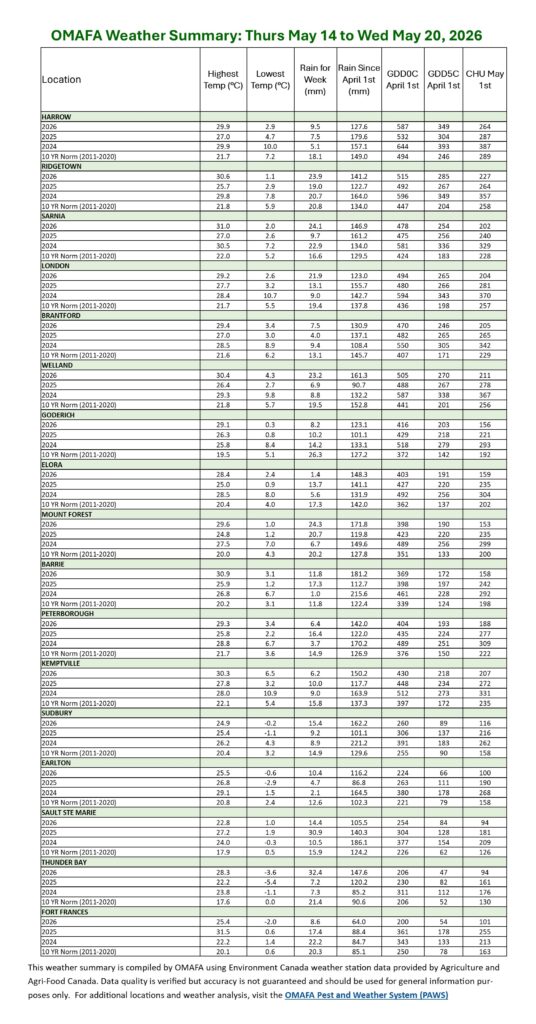
Summer weather arrived suddenly over the Victoria Day weekend. Hot temperatures and sunshine created good conditions, and a lot of field work was accomplished quickly. Soil temperatures have also been rising, which will speed up germination. Violent storms moved across the province on Tuesday evening ahead of a cold front, which will bring temperatures back down to a more normal range for May.
Winter Cereals
Many winter wheat fields that were approaching GS 31-32 last week had fungicide, herbicide and plant growth regulators applied ahead of rain. Nitrogen applications are still ongoing in eastern and northern Ontario. Warm weather over the long weekend brought the crop on quickly: in central and south-central Ontario, winter wheat is approaching GS 37-39, and in the deep southwest some early seeded fields are reaching boot stage (GS 41-45). Powdery mildew is being found at high levels in some fields, particularly where a susceptible variety is being grown. A T2 fungicide application may be needed at full flag leaf emergence (GS 39) where powdery mildew pressure is high and is moving up the crop canopy. Stripe rust has also been detected in fields in Oxford and Huron Counties as of May 21, 2026 so fields should continue to be monitored closely through scouting. Winter barley is beginning to head out in the most southern regions and should be monitored for timely T3 fungicide applications. Cereal leaf beetle adults and egg masses are being easily found in some fields. Growers should continue to monitor fields for feeding once larvae emerge.
Spring Cereals
Seeding is wrapping up in many areas, except in Grey, Bruce, Dufferin and Simcoe counties as well as northern Ontario. Many early planted fields have emerged and are approaching 1-2 leaf stage. Growers should scout fields ahead of herbicide applications. Weeds will also be growing quickly due to warm weather, so application windows may arrive sooner than anticipated.
Forages
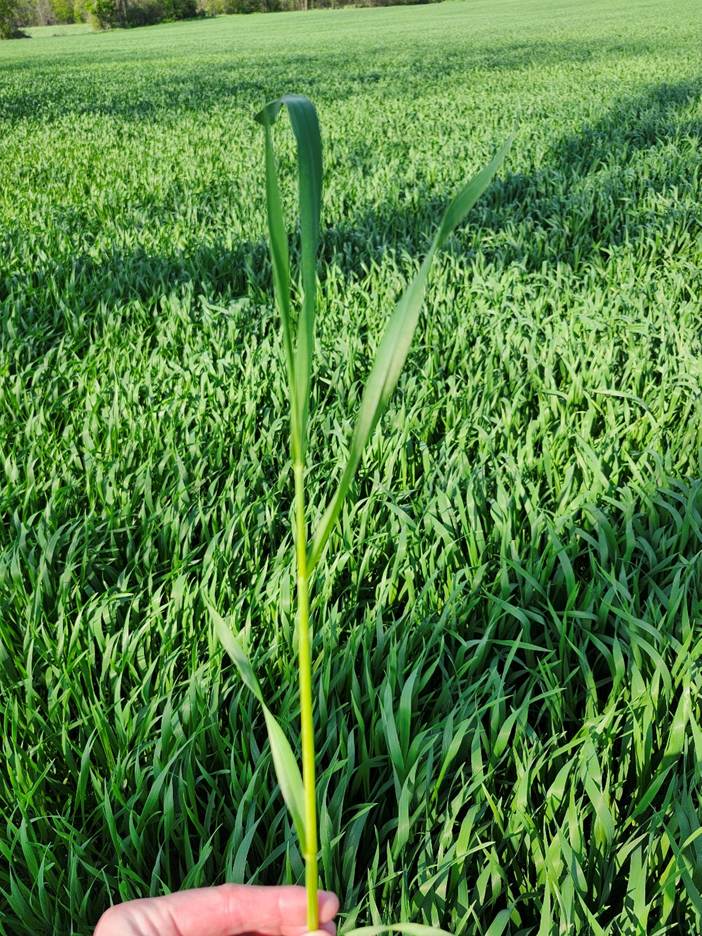
Fall rye and winter triticale forage harvest is underway in the southwest and yields have been highly variable. Fields planted during the optimum dates for winter wheat, and that did not have heavy snow mould pressure, have normal or above-normal yields. Later planted fields are reporting lower yields. Harvest is expected to start within the next week in eastern Ontario (Figure 1).
New seeding is nearly complete, except on fields with wet soils.
Reports indicate slow alfalfa development and likely a later first cut. Growers should scout their fields frequently ahead of harvest to cut when it balances their yield and quality needs, rather than relying solely on the calendar date or a GDD model. Watch for alfalfa weevil, as larvae over threshold could trigger an early harvest.
Canola
Winter canola is at 10% flower to nearing the end of flowering depending on location. Fortunately, the cold weather last week did not significantly damage the winter canola as the buds are relatively frost tolerant. High temperatures (>30C) occurred over the long weekend in some areas. Canola is sensitive to high temperatures during the reproductive stages; however, the high temperatures were short in duration and likely will have minimal impact on yield. Spring canola planting continues, with early fields starting to emerge.
Corn
Early planted corn has emerged. Lots of pre-emerge herbicides went on prior to rainfall late last week. Planting progress in most areas is estimated to be 80% or more complete except in Grey County and northern Ontario, where growers are still waiting for warmer soil conditions. Areas with heavier clay soils have not started or have just begun planting, as it remains too wet to plant.
Soybeans and Edible Beans
Soybean planting progress is variable across the province. It is estimated that 50% of beans are planted in the east, and anywhere from 10 to 85% complete in the southwest. Fields planted during the first week of May are just starting to emerge but represent less than 1% of the crop. Growers are reminded to scout fields before applying any pre-emerge herbicide products, to ensure soybean plants have not emerged. Growers who are planting multiple trait packages (Enlist, Xtend, etc.) should keep excellent records and flag or sign their fields to prevent spraying mishaps, or select a herbicide program that can safely be applied to the different varieties. It is also stressed that there are no post-emergent herbicide options in IP soybeans for glyphosate-resistant Canada fleabane.
Very few edible bean acres are planted, although there were reports of some kidney and adzuki beans having been seeded. There is no extra seed supply, so good soil conditions are important before edible beans are planted.
Agricorp
Please check the Agricorp website for regional planting deadlines. Reminder to report final planted acreage as soon as planting is finished, since the phone lines get very busy near the deadline. Growers can also report their final planted acreage online.
June 15, 2026
- Production Insurance – Report unseeded acreage for spring-seeded grains and oilseeds.
- Risk Management Program – Call Agricorp to report unseeded acres for the unseeded acreage benefit (USAB).
June 30, 2026
- Production Insurance – Report your final planted acreage for spring-seeded grains and oilseeds; and seed corn. Report acreage for spring-seeded new forage.
- Risk Management Program – Report your acres if you haven’t already through Production Insurance.
Exeter Breakfast Meeting – Tuesday, May 19, 2026
Cereals
- Winter wheat looks good in the area. Large differences in growth stage and overall stand counts are being noticed between early and late planted wheat. The earliest planted wheat in the Woodstock area has the flag leaf emerging. In the deep south fields are at the boot stage. In Huron county fields are at GS 37. In the Palmerston area wheat is at the second node (GS 32) stage.
- Wheat north of Hwy 86 does not look as good, especially if it was planted in October. Agricorp damage reports continue to be low with less than 2% of acres reported as damaged. More fields were taken out in eastern Ontario. Overall eastern Ontario progress is slightly behind this area, and Quebec is behind in terms of field work.
- Lots of fungicides and PGRs were applied last week on wheat in this area. Those fields that did not receive a T1 should be scouted for disease – powdery mildew is moving up in canopies – particularly in susceptible varieties. There have been a few reports of leaf rust and some suspected stripe rust, but nothing has been confirmed as stripe rust yet. The stripe rust ag monitor does show that it has been found in a few places in Kansas and in one location in Tennessee. Stripe Rust – Wheat Ag Pest Monitor. If there is a suspected case flag the area to see if it spreads. Stripe rust spreads quickly.
- Northwest Ohio is reporting increased levels of black cutworm and armyworm catches. Some alfalfa weevil has been found. True armyworm moth trap counts this past week in Ontario were zero.
- Cereal leaf beetle adults and egg masses are easy to find in wheat fields. Be on the lookout for feeding/ “window paining” once larvae emerge – some growers did have to spray last year because pressure was so high. Will move into spring cereals – particularly oats later this season.
- There are more reports this spring of barley yellow dwarf virus in winter barley fields – including those fields that used an insecticide seed treatment. Some fields severe enough that plants are stunted – aphids are also easy to find.
- Flag leaf in rye and triticale is emerging and forage harvest is underway. There is a lot of variability and low yields in some early harvested fields. Soil compaction is really showing up this year. Late planted fields look much worse as well. It may be a result of a very dry fall last year. Not all fields are low.
Soils
- A large number of soil samples have now come into the lab. This would be a good year to conduct a nitrate soil test considering the cool spring and high nitrogen costs.
- Some growers are asking for a sulphur soil test. Keep in mind that the soil test used presently has not been calibrated for Ontario so a “low” test does not mean a yield response can be expected with the application of S fertilizer. An S soil test has little predictive value. The U of G is conducting research to establish an accredited test. S is taken up in the sulphate form by plants. This also means it can leach in the soil. However, it behaves differently than N in the soil and does not leach as much. It’s important to use a 12” core taken in the spring. North Dakota uses a 2 ft sample. A 6” core taken in the fall has little value.
- Most crops need 20 lb/ac of sulphur at most and can get 5-10 lb naturally without fertilizer. There is still deposition from the atmosphere so focus on sandy soils and crops that are the most likely to respond to S fertilizer.
- Boron soil tests seem to be coming in low this year. Application may make sense for root vegetables, canola, alfalfa, and sometimes for corn. Soil levels of 0.5 ppm are considered low, 1 ppm is high, and 2 ppm can be toxic. Keep in mind that the B soil test has also not been calibrated for Ontario.
- Dr. Tom Bruulsema is conducting a survey of soil test results from labs across North America. The last time this report was published it showed a very high percentage of soil tests were below critical values.
Soybeans and Edible Beans
- Planting progress is variable ranging from 35 to 85% complete. 50% in the St Mary’s area was reported. In Brant and Norfolk, some growers have finished while others are just starting.
- Fields planted in this area during the first week of May are just starting to emerge. This represents less than 1% of the crop. Recent warm weather (May 17-19) has been a tremendous benefit to soybean seedlings.
- Although switching from corn to soybeans has not been necessary in this area some growers are considering that option on clay soils in Lambton, Niagara, etc. The economics on late planted corn are not good, especially on clay soils.
- Some growers wait for soil conditions to be more favourable before seeding IP soybeans, so those acres are less than GMO soys.
- It was stressed that no post emergent herbicide options for IP soybeans for glyphosate resistant Canada fleabane are available.
- Some growers choose to use 2-4,D ester with the burndown in IP soybeans.
- There is a production insurance plan available specifically for IP soybeans, sometimes growers are not aware of this program.
- Seedcorn maggot has been seen in some soybean fields.
- Very few edible bean acres are planted, although there were reports of a field of kidney beans seeded and some adzuki beans. There is no extra seed supply, so good soil conditions are important before edibles are planted. Edible bean seeding will start as soon as soybeans are finished up, weather permitting.
Corn
- Corn planting is essentially finished in this area with a few fields still going in here and there. Much less progress has been made further north. Grey county might be 50% planted. Bruce County is wrapping up corn and getting soybeans planted.
- Farmers may switch fertilizer plans to urea instead of UAN based on logistics and price.
Canola
- Winter canola is at 10% flower to nearing the end of flowering depending on location.
- The cold weather last week did not seem to significantly damage canola. The buds are relatively frost tolerant.
- Less than 1000 acres of damage reports so far to Agricorp.
Tillage
- There has been a significant wind erosion this spring, often because of high-speed disc tillage. Although surface conditions may be relatively dry some fields are still wet below the surface. A high-speed disc may cause a significant compaction layer if run when the field is too wet. Yield losses will occur if these units are run too wet.
Simcoe Breakfast Meeting – Wednesday, May 20, 2026
Synopsis
- Heavy winds and variable rainfall came through the area May 19th. Between 50 and 75 mm rainfall has been recorded over much of the area during the past few weeks. Very little planting progress on the clay soils of Haldimand and Niagara in the past two weeks as soils remain too wet. Planting in Norfolk is in full swing with corn planting all but completed and earliest fields beginning to emerge. Soybeans planting is about 50% completed and tobacco, tomato and pepper transplants are just beginning. May 20th is National Bee Day.
Cereals
- Winter wheat in the area is approaching flag leaf and most intended herbicide, and fungicide application has been completed. Applications ahead of the frost generally did not result in leaf damage.
- Powdery mildew and some septoria are present in the canopy and should be monitored for potential fungicide applications. Stripe rust has not been detected.
- Some growers cut back on N rates for wheat, in part as cost savings and in part from lower expected yield potential from thinner stands. The difference between September and October planted fields remains evident.
Forages
- Flag leaf in triticale is emerging, and forage harvest is underway with 4-4.5 ton/ac yields and good quality. Some cut but not yet harvested fields were rained on, and some fields could reach full heading before harvest is possible, resulting in reduced quality.
- Alfalfa stands are variable or thin and until the warm temperatures over the long weekend, were not actively growing. Some fields will have 1st cut harvested before being planted to corn.
Corn
- Patience is a virtue being practiced by producers on clay soils. Best yields traditionally come from fields with uniform emergence and stand, where soils were fit for planting. and often when planted into warmer soils in late May or early June. Clay soils never work up better than the 1st time they’re worked and this year re-plants have not been part of the vocabulary. Some hybrid switching from 3000 to 2800 CHU is planned.
- Corn planted two weeks ago in Norfolk is beginning to emerge. Some fields are less uniform and have more “skips” than ideal.
- No changes in nitrogen rates for corn are planned, probably since much of the N was pre-paid, however phosphorus and potash rates are being pulled back for budget purposes by some growers.
- In some areas where corn harvest of the 2025 crops is still occurring simultaneously to planting preparations, the retail-elevator facilities are challenged with labour requirements at both ends of the spectrum.
Soybeans and Edible Beans
- In Norfolk, Brant and parts of east Elgin some growers have finished planting while in Haldimand and Niagara planting has hardly started. As conditions permit, burndown weed control and tillage are progressing so that when soils are fit, planting can progress rapidly. Tillage with high-speed disk is leaving “tacky” soil conditions resulting in increased compaction potential.
- Switching from corn to soybeans is being considered on some clay soils in Haldimand and Niagara. The economics on late planted corn are not good, however the economics of crop rotation as well as rotation of pest control options are often also considered.
- Burndown herbicides with residual activity have been applied in preparation for IP beans. Kidney bean seed supply is limited, so growers are careful to plant into ideal conditions to avoid requiring replants.
Canola
- Winter canola growth is variable with many wet spots and thinning stands as plant crowns succumb to wet roots. Fields have been too wet to apply inputs or to switch to an alternate crop.
Resistance Strategies for Weed, Insect and Disease Control
- Observations around the increase in disease or insect damage from poor crop rotation initiated the discussion about resistance strategies.
- Testing weeds that aren’t controlled with herbicides as would be expected.
- It’s easy to forget the power of rotation — Having a diverse crop rotation with as many crops as possible
- Switching chemistries for pesticides (consider full rotation and traits)
- Don’t cut rates on pesticides to save money
- Don’t expect to get multiple rotations from new traits – many have a shorter longevity than products introduced in the 1990’s
Winchester Breakfast Meeting – Wednesday, May 20, 2026
Winter Cereals
- Some fields approaching flag leaf, expecting most to be there by the end of this week.
- No reports of diseases or pest pressures in any cereals yet.
- A few more winter wheat acres were terminated in the last 7-10 days, with cool, wet weather keeping stands from thriving. Growers made the decision to terminate and plant into corn.
- Some second pass of nitrogen is going on this week.
Forages
- Forage rye isn’t at flag leaf yet, so likely a week or more to cutting/chopping.
- Triticale is closer to the chopping window, and early fields will likely be ready for early next week.
- Estimated to be 2-3 weeks from first cut, as grasses and alfalfa are slow to develop.
- Still some new seeding acres going in but estimated to be 95% planted. Early planted fields are established and growing well.
Spring Wheat
- Some fields just emerging, while others are approaching 1-2 leaf. Earliest fields will likely be ready for herbicide by this weekend or early next week.
Corn
- Estimated to be 75-80% planted in most areas. Any fields not planted are the slower drying fields/heavier soils that are typically planted later.
- Some growers pushing fields that are a bit wet, looking at the calendar and forecast. Most long season hybrids are in, and now is the push to get mid-season hybrids planted on time.
- Closer to the St Lawrence is likely a little closer to 50% planted, having caught more rains the last few weeks.
- It’s estimated 3 good days of planting would wrap up corn planting in the east.
- Corn is just at spike/poking through the soil, but most has still not emerged.
- There is a lot of herbicide to go on yet, with growers focused on planting. Annual weed flushes are coming on aggressively with frequent showers and warm temperatures. A reminder that smaller, younger weeds are easier to kill.
- Any acres that got pre-emerge or pre-plant incorporated herbicides are holding really well – herbicide pass was quite effective.
Soybeans
- Estimated 50-70%, generally a bit behind corn for the localized areas. Still a lot of acres to go in.
- Some April 27th planted beans just emerged on Monday.
- There is no reported crusting in soybean fields, however some fields have been planted for 3+ weeks.
Weed Control
- Higher than normal amounts of giant ragweed, with suspected resistance in places. Control options can be found on the Ontario Crop Protection Hub.
Pests
- The Winchester Research Station has found European corn borer populations in their trial fields. Populations are lower than anticipated but are still present.