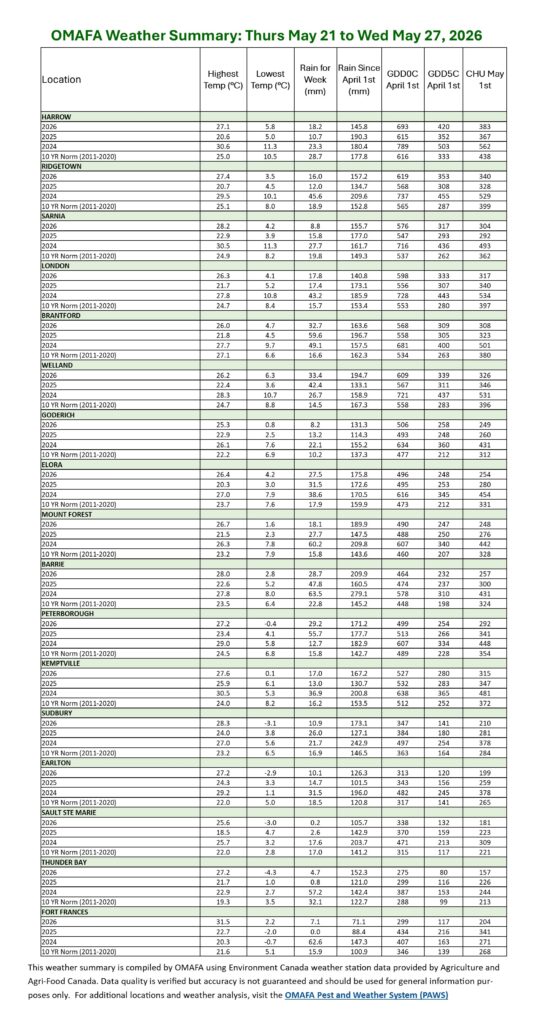
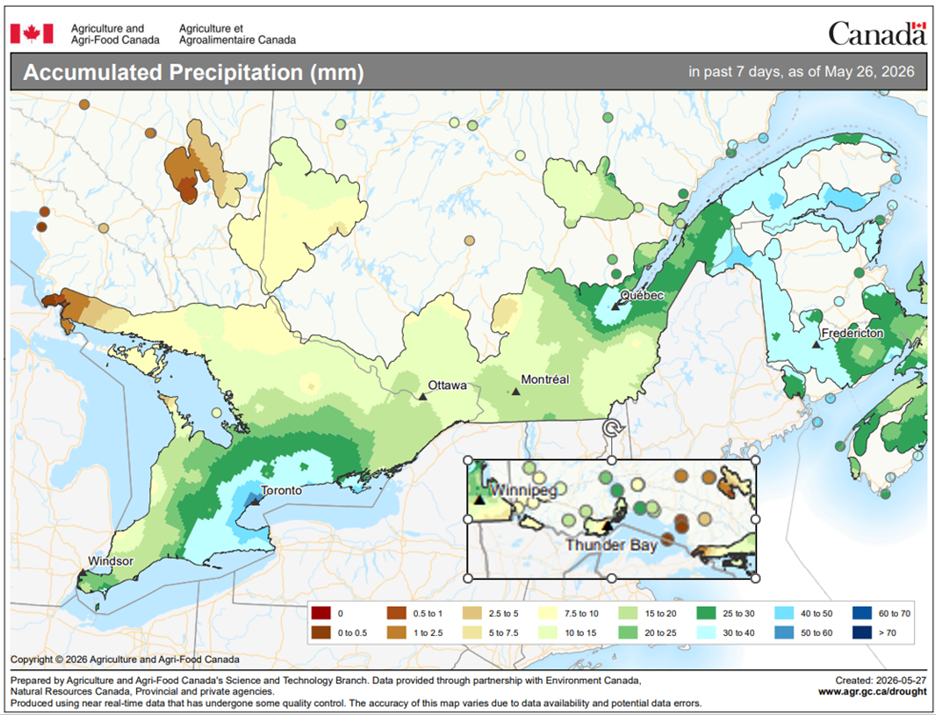
Wet conditions stalled many field activities with significant rainfall received over much of the province over the weekend. Field drying weather has occurred since and will allow for remaining crop acres to be planted with continued warm and dry weather in the forecast.
Winter Wheat
The most advanced fields of winter wheat are at head emergence with many fields following close behind at flag leaf. Disease pressure continues to be increasingly observed, including powdery mildew and septoria in the lower canopy, while stripe rust has been identified at low levels in some southern Ontario fields in Huron, Oxford and Wellington Counties. Fusarium head blight risk is currently moderate to high so a T3 fungicide application should be considered. Once 75% of wheat heads on the main stem reach GS59 (head emergence complete) this is known as “day 0”. The optimum fungicide application timing is shortly after this on “day 2”. Day 2 is the beginning of pollination when anthers are visible on the middle of the wheat head. This timing is critical because this is when the peak number of florets are open and susceptible to infection. If temperatures are warm during this period it could result in the wheat crop moving quickly through these growth stages so it will be important to track the staging of your wheat crop as it approaches heading (GS59). A strobilurin fungicide should not be applied once wheat has reached the boot stage. Low levels of wheat streak mosaic virus have been confirmed. Cereal aphids and cereal leaf beetle are also being found in fields. True armyworm larvae have also been found in one field. Adult moth counts have been ramping up in some traps, but Ontario’s levels are lower than surrounding states. It is still too early to tell if this might be a good armyworm year but there tends to be an increased risk of infestations following a cooler, wet spring. Fields should continue to be monitored to determine if control is warranted. If insecticide applications are applied at or during heading, ensure pre-harvest intervals for the specific product being applied are followed.
Spring Cereals
The earliest seeded spring cereals are approaching stem elongation while others are just emerging. The most advanced fields will receive herbicide and plant growth regulator applications as weather conditions allow.
Corn
Corn planting is largely complete on light- and medium-textured soils, while heavier clay soils remain unplanted due to wet conditions. The delay in planting is and will continue to trigger some switching of hybrids to shorter maturities as planting extends to June. Planting progress ranges from about 80 to 95% across regions. The emerged corn ranges from VE to V3. Overall, the plant stands reported are strong with relatively even emergence. Some uneven emergence is expected on earlier-planted fields planted in marginal conditions.
Soybeans
Soybean planting progress varies widely depending on soil type, ranging from about 50 to 80% complete. Some heavy clay soils have seen limited activity, while lighter soils are further ahead. Early planted soybeans have emerged with good stands, and no significant frost damage has been reported. Farmers are reminded to properly identify the herbicide tolerance traits of their soybean fields and maintain accurate records to prevent herbicide misapplication. Proper weed control planning is especially important for IP soybean production, as postemergence options are limited or ineffective to control troublesome weed biotypes like multiple-herbicide-resistant Canada fleabane.
Forages
Forage crops have progressed rapidly with warmer temperatures. Rye and triticale harvest is underway and near completion in the southwest, with yields generally better than expected. Alfalfa harvest has begun in Oxford County and is expected to start this week in other parts of the southwest. Alfalfa harvest in other areas of the province is expected to start in about a week.
Edible Beans
Few edible bean acres have been planted. Planting is expected to accelerate this week with warmer temperatures in forecast.
Canola
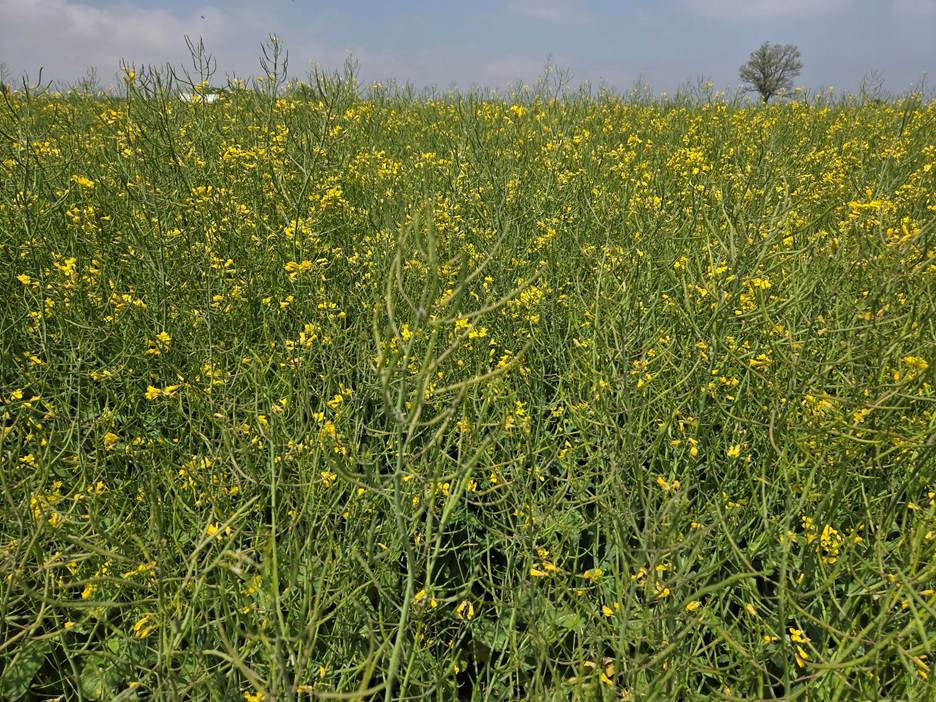
Spring canola seeding is underway in northern and eastern Ontario. Spring canola emergence has been strong in many areas. Some early planted canola fields received severe frost damage, and replanting is anticipated where losses occurred. Assess the kill rate of the canola plants by monitoring for regrowth of frost-damaged plants over following few days after the frost event. If the plants that resume growth are at an acceptable plant stand and are consistent throughout the field, a re-plant may not be warranted. Winter canola is progressing through flowering with some fields at the end of flowering. Planning for next year’s winter canola crop is underway, with seed orders due by June 15.
Weed Control
Previous cool temperatures slowed weed emergence and the activity of foliar-applied herbicides. Annual weed emergence is expected to increase as temperatures have increased. Farmers are encouraged to apply postemergence herbicides in a timely manner to limit weed competition with the crop and improve overall weed control targeting small actively growing weeds. Application of soil-applied herbicides continues to be critical even in the absence of forecasted rainfall. Efficacy may be reduced if an activating rainfall is prolonged; however, some control will be provided and will reduce reliance on postemergence chemistries.
Agricorp
Please check the Agricorp website for regional planting deadlines. Reminder to report final planted acreage as soon as planting is finished, since the phone lines get very busy near the deadline. Farmers can also report their final planted acreage online.
June 15, 2026
- Production Insurance – Report unseeded acreage for spring-seeded grains and oilseeds.
- Risk Management Program – Call Agricorp to report unseeded acres for the unseeded acreage benefit (USAB).
June 30, 2026
- Production Insurance – Report your final planted acreage for spring-seeded grains and oilseeds; and seed corn. Report acreage for spring-seeded new forage.
- Risk Management Program – Report your acres if you haven’t already through Production Insurance.
Ridgetown Breakfast Meeting – Tuesday, May 26, 2026
General conditions
- Wet, cool conditions have continued through the past weekend until early this week
- More rain received in a band closer to Lake Erie
- Heavy clay soils in the area (south Kent and Essex) have still not seen much field activity as they remain wet
- Some activity on clay soils prior to last week’s rains on Lambton County clay
- Soils have remained wet due to cool conditions more so than excessive rains in some parts – areas with less rain are showing cracks in the soil in winter wheat fields
- Forecast finally looks favourable for the next couple of weeks with some warm, dry weather
Corn
- Corn planting has mostly wrapped up on lighter soils, while heavy soils remain further behind
- In the southwest, 80% of intended corn acres are estimated to have been planted
- Corn growers are beginning to switch to shorter maturity hybrids if it doesn’t look like planting will occur before June 1
- Earlier planted corn looks great – 90-95% stand and relatively even emergence
- Large portion of crop has emerged, currently at VE or V1 stage, while earliest crop is V2-V3
- No issues with emergence from crusting to this point
- Anecdotal differences in emergence noted next to windbreaks in some locations
- Soil stayed 2-3°C warmer closer to windbreak than through middle of field and emerged quicker because of this difference
Soybeans
- Close to 50% planted overall, although very dependent on soil texture as well
- Clay ground in some locations haven’t gotten started yet
- Earliest planted soybeans have emerged and look to be good stands
Cereals
- Winter wheat in the southwest is in very good condition
- Heads are emerging from earliest planted wheat; later planted wheat is following close behind
- Staging is slightly ahead of normal from GDD accumulation
- Fusarium risk is currently moderate to high – T3 fungicides will reduce the risk of infection and are expected to be widely applied to the crop
- Stripe rust has been found in two fields so far in southern Ontario at very low levels
- Neighbouring US states do not have high levels of infection, although it has been confirmed in both PEI and Nova Scotia
- Overall risk is still low – T3 fungicide will offer control
- IMPORTANT NOTE: DO NOT USE A STROBILURIN FUNGICIDE ON WHEAT ONCE IT HAS REACHED THE BOOT STAGE
- Yellowing, flecking in wheat with similar symptoms to some viruses has been noted in several fields, seeming to infect single plants instead of patches
- Difficult to determine cause, but wheat streak mosaic virus has been confirmed in some cases
- Aphids and cereal leaf beetle populations have been identified in high numbers in some locations
- Economic threshold numbers:
- Aphids – prior to heading: 12-15 per stem
- Post heading: 50 per stem
- Cereal Leaf Beetle – prior to boot stage: 3 larvae per stem
- After boot stage but prior to heading: 1 adult or larvae per stem
- Aphids – prior to heading: 12-15 per stem
- Decis is now registered for control of cereal leaf beetle. If making an insecticide application at or after heading, be sure to check the Pre-Harvest Interval (PHI) of the specific product you are applying. PHIs vary depending on the specific product and active ingredients and exceeding these windows increases the risk of chemical residues in the grain.
- Economic threshold numbers:
- Winter barley is in head in the southwest
- Imperfect nitrogen application patterns are showing up drastically this year
- Broadcast, airflow applications of dry N & S fertilizer sources are not as even as liquid fertilizer applications
- Dr. Gursahib Singh (University of Guelph – Ridgetown Campus) is conducting a wheat disease survey and is requesting samples from farm fields that are exhibiting disease symptoms. Samples are requested of infected plants to aid with provincial pathogen monitoring and diagnostic confirmation.
- Please see details at the bottom.
Forages
- Triticale and rye forage harvest is ongoing
- Yields are generally better than expected, even in fields that had infection of snow mould
- Alfalfa harvest has started as well, although it is early according to crop growth stage
Canola
- Winter canola is ending the flowering stage
- Seed orders for fall planting are due by June 15 with C&M Seeds
Weed Control
- Wild carrot noted as difficult to control with glyphosate this year
- Cool temperatures have led to slow control especially
- Spring tillage will often not control unless it’s very aggressive tillage
- Important reminder that IP soybeans require a detailed weed control plan ahead of planting – limited or no post-emerge control options for some problem weeds such as glyphosate-resistant Canada fleabane
- Slow weed emergence noted in some fields so far, may be due to cool conditions
- However, critical that fields need to stay clean early in season
- Residual herbicides should not wait for weeds to be emerged
- In some cases, this may reduce control
- Do not wait for an activating rainfall to apply residual chemistries
Wheat Disease Sample Collection and Submission Protocol
Collaborators are requested to collect wheat plant samples exhibiting disease symptoms to support provincial pathogen monitoring, disease surveillance, and pathogen characterization efforts. Whenever possible, collect infected plants or leaves displaying clear and representative disease symptoms. Submission of the entire infected plant is preferred, as it provides greater flexibility for tissue selection, pathogen isolation, diagnostic confirmation, and additional downstream analyses that may support collaborative research and disease monitoring activities.
Each field or sampling location should be placed into a separate paper sample bag or paper envelope. Plastic bags should be avoided, as moisture accumulation can promote tissue degradation and secondary microbial growth during shipment. If samples are wet from rain or dew, allow them to air dry before packaging.
Collaborators are encouraged to submit samples containing any wheat disease symptoms of interest, including stripe rust, stem rust, leaf rust, Septoria, tan spot, bacterial leaf streak, powdery mildew, Fusarium head blight, common root rot, viral symptoms, or other unusual or unidentified disease symptoms observed in the field.
The following information should be clearly written on each sample bag or included with the submission:
- Collaborator/surveyor name
- Collection date
- GPS coordinates or nearest town/location
- Crop species and variety (if known)
- Growth stage (preferably Zadoks scale)
- Previous crop and tillage system (if known)
- Fungicide application history (product and timing if known)
- Disease observed
- Approximate disease severity/incidence
- Any notable field observations (e.g., drought stress, lodging, mixed infections)
This information is important for tracking pathogen distribution and disease development across production regions. Samples should be shipped as soon as possible after collection to preserve pathogen viability for isolation and characterization work.
Sample Submission information
Shipping Address:
Gursahib Singh
University of Guelph – Ridgetown Campus
120 Main Street East
Ridgetown, ON N0P 2C0
Note: Please clearly label the package with “Plant Samples – Wheat Disease Survey” to ensure proper routing upon arrival.
Sample Drop-Off Information
Animal and Poultry Science Building
University of Guelph – Ridgetown Campus
Phone: 437-430-8682 (Elham Pourkhorshid)
Email: zpourkho@uoguelph.ca
Note: Please contact us a few hours in advance if you are planning to drop off samples.
Arnprior Breakfast Meeting – Tuesday, May 26, 2026
Winter Cereals
- Window is closed or closing rapidly for PGRs and herbicides. T2 timing is right about now, but there is not a lot of T2 planned locally.
- No reports of diseases at all in winter wheat, fields look clean.
Spring Cereals
- Most fields are just approaching the window for herbicides and PGRs; most herbicide applications will probably go later this week if the weather holds
- Spring cereals are more likely to see a split app of PGRs, with a lower rate twice. This allows for growers to reduce the amount of PGR applied if the weather turns hot and dry (often acts as a PGR, so a second application isn’t required)
Canola
- Frost on spring canola last week wiped out much of the early planted crop. Damage seems to be dependent on soil type. Replants of spring canola are anticipated this week.
- Canola Council of Canada has an article on monitoring spring canola after a frost, with some tips and tricks on marking potentially damaged plants and then monitoring recovery. That article can be found here.
Forages
- Grasses are finally coming ahead with the heat over the last few days.
- It’s still estimated first cut will be another 7-10 days, with most alfalfa not even at bud stage yet.
- Most of the rye is ready, or will be ready end of this week. Some cutting has begun after rainfalls on Saturday and Sunday.
- Triticale will likely be ready end of the week too. Yields are lower than anticipated.
Corn
- 95% planted, last few acres are finishing up this week in warm weather.
- Lots of fields are at spike leaf, while some are approaching 2 collar.
- Some leaf tips were frosted on Friday morning, but there has been no reported damage; all acres are smaller than 5 leaf.
Soybeans
- Estimated 80% planted, with some regions being lower if they received more rain.
- It’s not expected to see any frost damage on the soybeans – the earliest ones were just poking through the soil when the frost occurred.
Weed Control
- Annuals have really come on with the heat the last week, growers are urged to scout and spray as weather permits. Smaller weeds are easier to manage than larger ones.
- Most areas got between 0.5-1” of rain over the weekend, some a little less locally
Fall Planning
- Use your soil tests to know where the fertilizer needs to go
- This is a very good year to manure test – manure is worth more than it’s ever been before with increasing fertilizer costs. Using it to its full extent of effectiveness will ensure nutrients are where they need to be, at the right time.
Cobourg Breakfast Meeting – Tuesday, May 26, 2026
Winter wheat
- Overall, stands look excellent.
- Winter wheat is at or approaching GS 39.
- Diseases have started showing up in the lower canopy in the last two weeks. Powdery mildew and septoria are most prevalent.
- Stripe rust has been found in the southwest, and was present in central Ontario in the last 3 years, so growers should be scouting for it.
Forages
- There are dairy farmers in the region who are harvesting very impressive triticale yields. This is a crop that responds to management.
- Some perennial grasses are starting to head out, so dairy farmers are gearing up for first cut on mixed haylage.
- Alfalfa seems to be about a week behind normal. Winterkill levels were significantly higher on alfalfa than winter cereals. It’s likely that inadequate fertility last fall, combined with the prolonged dry weather and aggressive harvests contributed to alfalfa winterkill.
- An early fall application of N on grass hay and pasture fields would have encouraged tillering to thicken up stands thinned by drought. Nitrogen at green-up will increase leaf size (and therefore yield), which is helpful in hay, but can be tough to keep up to on pasture.
- Sulphur helps forage crops produce protein and is most likely to be deficient in early spring. A sulphate fertilizer at green-up can address this, but it is often more economical to apply elemental sulphur in early fall with P & K.
Corn
- Harvest 2025 is ongoing.
- Overall, 80-90% planted. Some acres are still too wet. Some growers will plant corn after taking first cut and terminating the hay.
- The earliest-planted fields in the region have emerged. Some of that corn was in the ground for four weeks or so. No reports of problems yet but anticipating uneven emergence on some of those early fields.
Soybeans
- Estimates are 50-60% of acres planted across the region
- Not aware of any frost damage since last meeting. It seems to have been colder further east.
- Growers still need reminders to clearly flag/sign their Enlist and Xtend fields to prevent mis-sprays. Good record keeping is essential with these varieties.
Upcoming Events
- June 30: Eastern Ontario Diagnostic Day and Ontario Crops Research Centre – Winchester station tour
- July 9: Forage Expo, Peterborough County
Northern Ontario Breakfast Meeting – Wednesday, May 27, 2026
Christine O’Reilly (OMAFA Forage & Grazing Specialist) shared some tips on spring seeding perennial forages.
- OMAFA Publication 30: Guide to Forage Production and Forage U-Pick are both good resources to narrow down species for a custom seed mix.
- Seeding dates are more flexible than grain crops, but good soil conditions and rain in the forecast are important.
- Seeding rates and depths vary depending on crop species, so check before you go! Many forages have small seeds. Seeding depths are shallow, and equipment calibration is key.
- Take a soil test, manage weeds up front, and don’t forget to use a packer.
- Companion crops boost inventory, but they compete with the perennial forage crop. If you need the feed, keep seeding rates down and harvest them early. If the companion crop suppresses weeds, it has reduced the lifetime yield potential of your hayfield.
Overall, a lot of progress has been made in fields across northern Ontario since our last meeting. Tracey Baute (OMAFA Field Crops Entomologist) and Joanna Follings (OMAFA Cereals Specialist) reminded growers to scout for insects and diseases, since pest pressure is building in neighboring states and southern Ontario. True armyworm in forage crops and cereals, and stripe rust in wheat are two major issues to monitor for.
Cochrane
- Temperatures have been in the teens and low 20s. It’s very hard to find snow now.
- Field conditions are excellent, even on untiled fields, and the 14-day forecast looks dry.
- Estimates that the district is about 60% planted.
Temiskaming
- Reports that 50-67% of acres are planted.
- Soybeans and canola are being seeded.
- Intermittent rain has meant for a stop-and-start planting season.
Manitoulin
- Some planting has started on the island.
Thunder Bay
- Planting progress is 33 to 67% done. Most growers are expected to finish by the weekend.
- Winter wheat has received nitrogen and herbicide. Overall, it looks excellent.
- Despite intermittent rain, tile contractors have started work for the season.
Rainy River/Kenora
- Planting has progressed quickly since last call. Estimate 80% of acres seeded.
- Temperatures were in the low 30s the last couple of days.
- Early-seeded crops have emerged.
- The area is very dry. There have been forest fires already this spring around Emo, Mine Centre, Ignace, and Atikokan.
Mt. Forest Breakfast Meeting – Wednesday, May 27, 2026
Cereals
- Staging
- Locally, mid-September planted wheat is pushing the flag leaf through collar now, not quite emerged, expect to be emerged by weekend
- In more southern areas of the range covered by reps (e.g. London) flag leaves have emerged
- Bit of tip injury from recent sprays (mostly from fertilizer, largely cosmetic, surface burn)
- Disease
- Stripe rust is on the radar – difficult to find at this point, but has been observed in a few fields in Oxford and Huron Counties – not progressing in fields that have recently received a fungicide application
- Last year, Strip Rust progressed very quickly in early May (will depend on weather)
- Fungicide timing research will be looked at more closely with new fungicides in more depth at Ridgetown College with Dr. Gursahib Singh
- Many growers have expressed interest in still applying herbicides to wheat – important to weigh benefits and costs
- for most weed species the benefit of applying herbicide now is very low, wheat is very competitive
- the costs (crop injury) can be high once flag leaf is starting to emerge, few herbicides include emerged flag leaf on label
- safest to avoid herbicide applications once flag leaf has started to emerge
- some growers are going after perennial weeds for other crops in rotation (e.g. thistles for IP soybeans), would be better to control these weeds after wheat is harvested, control is also much better later in summer
- While there has been great improvement in the past decade or two, some growers are still missing the opportunity to manage wheat like a cash crop as they do with corn and soybeans, yields reflect management
Winter Canola
- Winter Canola is in full bloom locally, in thinner stands plants appear to be branching out to help compensate
- Most winter Canola grown in Ontario is the variety Mercedes supplied through C&M seeds, June 15 is C&M seeds order deadline to guarantee supply for this fall’s planting
- orders may be received after this date, but supply is not guaranteed
- seed comes from Germany and is eventually distributed into Ontario
- Another variety is being screened for Ontario, supply very limited at this point
Corn
- Many growers who left corn out over the winter were surprised at how good standability and yields were
- there are some hybrids where standability is known to be poor and these fields have suffered from significant yield loss – weak standing hybrids should never be left out over the winter
- Planting progress
- corn planting is essentially complete in the local region (95% or more)
- corn still being planted to the east of this territory (Durham, York) where they are struggling with rain (estimated at 70% planted), some growers have started to reduce hybrid maturities or switch to soybeans
- planting also slow in SW and Niagara areas on heavy clay soils
- corn also being planted as forages are being harvested (rye, triticale)
- Early planted corn (e.g. late April) looks good – emergence is what one would expect for early planted corn, extended period of cool weather did not have an impact on early planted corn
- Reductions in stand appear more related to soil fitness (unfit areas of fields) than seed issues
- Some hybrids known for early season stress susceptibility maybe a little tougher, but still look good
- Very small amount of frost injury in some of the earliest planted fields on more frost prone areas (sands, muck soils in Huron County) – yellowing, scarring of leaves, very minimal expectations for any issues
- Few cases of replants have surfaced at this point, may still be a little early
- When corn is replanted, it is best to remove existing standing with herbicide before replanting
- Waiting to apply herbicide a day or two after planting is likely OK provided slot closure is good, but waiting longer than this can significantly increase injury risks for the replanted stand
Soybeans
- Planting progress
- soybean planting is wrapping up, local area likely 75-80% planted, a lot of soybeans were planted last week, many expect to be done by weekend
- slower progress in areas where planting has been delayed by rains
- Soybeans are now just starting to emerge, too early to make any comments on stands
- IP soybean acres are up a lot this year given crop prices and premiums
- there will be some fields where weed control will make IP soybeans a challenge, especially if growers are not on top of weed control
- Some growers were rained out planting soybeans before applying burndown herbicides that are not safe in-crop, asking about continuing with burndown herbicides
- applying a burndown herbicide a day or two after planting can present some small risks
- waiting longer than a couple days after planting significantly increases risks and is not recommended
- Do not use 2,4-D on soybeans once crops have emerged
- Some questions about nightshade control in IP soybeans
- there are chemistries with very good control
- significant issue is nightshade can emerge in July long after the herbicides run out and fields can still be a struggle at harvest
- Volunteer corn expected to be more of an issue in soybean fields where corn stood over winter
- Assure II is one of the best options for volunteer corn control in many fields
- Where PowerCore hybrids were grown, Assure II will not control volunteer corn, clethodim herbicides are a better choice in these fields
Forages
- More alfalfa winterkill than expected, some fields or parts of fields have lost a lot of alfalfa whereas grass portion looks OK, bigger issue in fields with the opportunity for standing water
Dry Beans
- Some planting has just started in Huron County, others expecting to start over the next couple days
Weeds
- Screening tough to control or resistant ryegrass, clethodim has provided decent control for some samples
- Warmer season weeds (Lambsquarters, Pigweeds) have really started to emerge this last week
- Given the dry forecast, some have asked if they should hold on applying pre-emerge herbicides given expectations that control will be less than normal
- Applying pre-emerge herbicides ahead of a long stretch of dry weather will likely have lower control (e.g. 80% instead of nearly 100%), but it will still be much better than where no pre-emerge herbicides are applied
Events
- Elora Weeds Tour – July 16, Elora Research Station