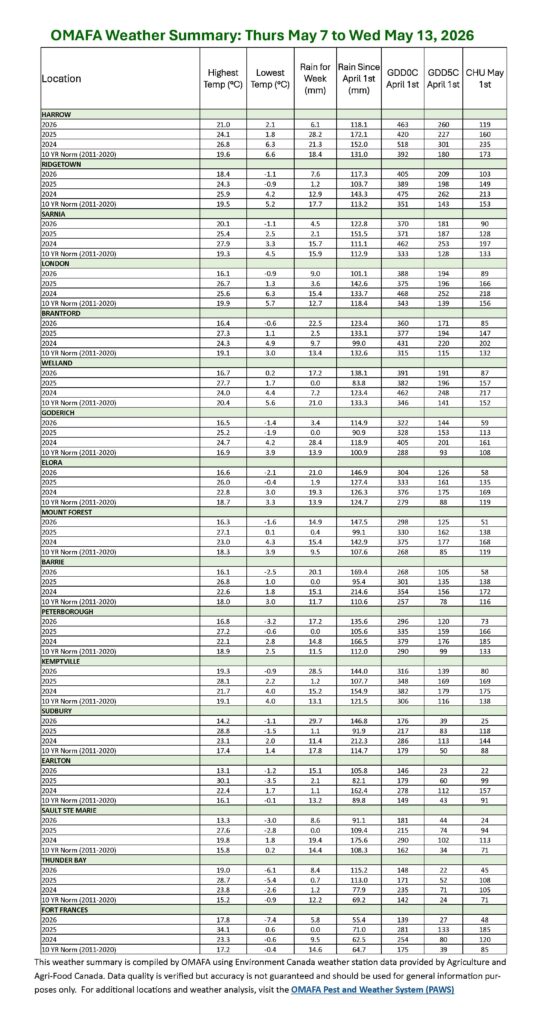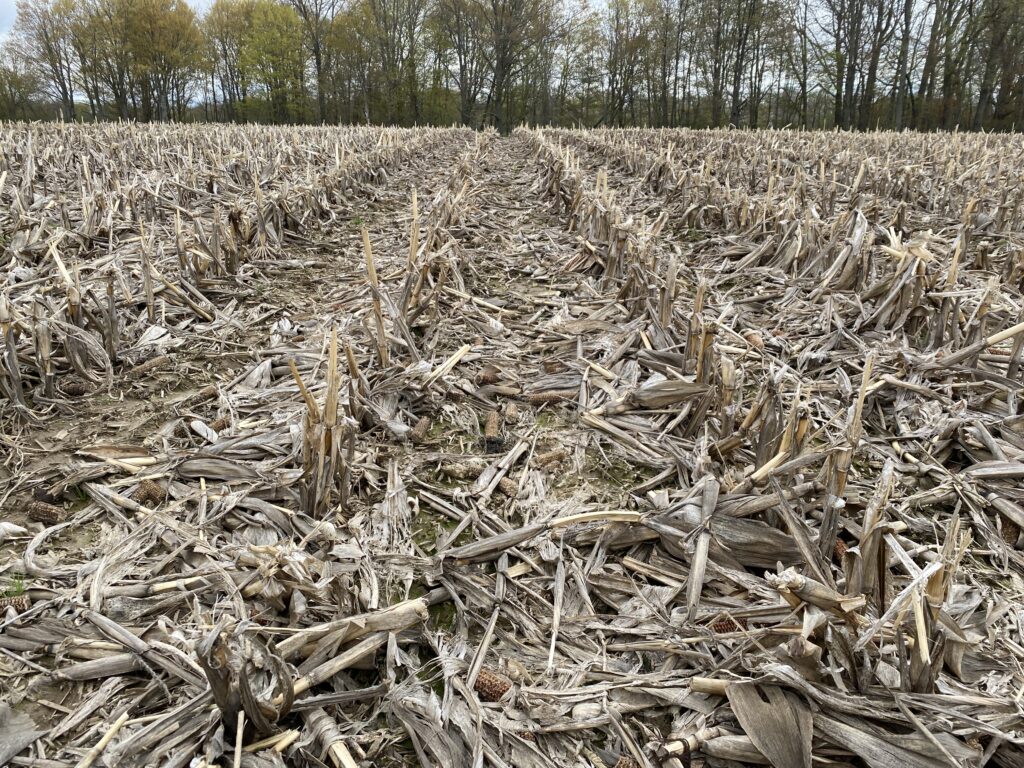
Cool temperatures have influenced the start of the growing season across Ontario. Despite this, fieldwork has advanced steadily where soils are fit. Soil moisture and temperature variability across the province are driving differences in planting progress – with significant activity on loam soils in relatively drier areas and no activity to date on clay soils in wetter regions such as Haldimand and Niagara. Parts of northern Ontario have experienced drier than normal conditions and some seeding is taking place in the northwest. (Please see Figure 1).
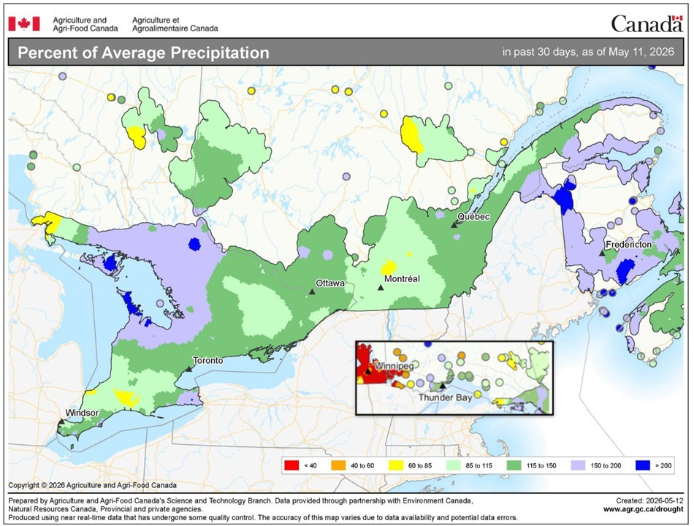
Figure 1. Percent of average precipitation, showing above normal rainfall amounts for the Niagara Peninsula, parts of Grey, Bruce and Simcoe Counties, and below normal rainfall amounts for Rainy River and Kenora Districts, and drier conditions in Algoma and Cochrane.
Winter Wheat
Winter wheat development continues to progress under cool conditions, with crop stage ranging from GS 30 to GS 32 in much of the southwest, east and central parts of Ontario. In the deep southwest, fields are nearing flag leaf emergence (GS 37), while fields in the north are still in the tillering stages. The vast majority of fields have received nitrogen, and uneven application is becoming more noticeable in some cases. In isolated instances, winter wheat fields that received late nitrogen applications more than one week ago are still showing deficiency. Warmer weather in the forecast is expected to turn this around.
Cool, windy conditions have limited herbicide, fungicide and PGR application windows, and low overnight temperatures have restricted opportunities for applications of tank mixes. Delayed crop development have extended the window for T1 fungicide applications in many regions. Disease pressure is being monitored, with powdery mildew and septoria present and low levels of leaf rust reported in Essex County. As more advanced fields approach T2 (flag leaf) timing, timely fungicide applications will be important if disease is moving up the crop canopy.
Spring Cereals
Spring cereal planting is now largely complete in eastern Ontario, with only a small number of intended acres left to be seeded. Early-planted crops are just beginning to emerge, although cool soil and air temperatures have slowed development. Some spring cereals have been seeded in Temiskaming District.
Corn
Corn planting progress varies widely across the province. In the southwest, planting is approaching the halfway mark, with greater progress on lighter soils and planting into heavier soils just getting underway. Huron, Perth and Oxford Counties are estimated at 90% complete, with Bruce, Grey and Simcoe Counties more like 30% finished. Eastern Ontario is estimated to be 40% complete, while east central regions remain closer to 15%, largely on light-textured soils.
The earliest, late-April planted corn has begun to emerge, with no evidence of frost damage so far. Growers have shown patience this spring, waiting for suitable soil conditions before planting. Volunteer corn control is expected to be an important management consideration this season, particularly to reduce the risk of corn rootworm Bt resistance development.
Soybeans
Soybean planting progress is estimated at less than 10-15% in the southwest, about 20% in eastern Ontario, and limited acres seeded in central regions. Germination has been reported on earliest seedings, but no soybeans have emerged to date. Many are targeting warmer temperatures this weekend into next week to begin planting.
Forages
Perennial forage growth remains slower than normal due to cool temperatures. Fields with higher fertility or a history of manure application are faring better, while weaker stands and grass-heavy fields are reportedly behind. New growth has been variable, and some hay fields are being taken out.
First cut timing in most regions is still several weeks away depending on upcoming weather. Pasture growth has been limited, and growers are monitoring for tight forage inventories and the potential need for earlier-than-ideal livestock turnout.
Annual forages, such as winter cereal rye and triticale, are slightly behind but generally expected to be harvested near normal timing windows.
Canola
Winter canola ranges from bud stage in more northern parts of southwestern Ontario to approaching full bloom in more southern regions such as Niagara and Essex. The impacts of frost earlier this week are expected to be minimal, as the crop was not advanced enough in the affected regions. Some flowers may abort that were exposed to cold temperatures; however, the plants will compensate and direct nutrients to new and remaining viable reproductive structures. Abortion of flowers is normal in canola in the absence of cold temperatures, as plants cannot support every flower into a productive pod. Development has been slowed by cool temperatures, and insect pressure—particularly cabbage seedpod weevil—is beginning to increase.
In eastern Ontario, winter canola has had significant winterkill issues, impacting acres. In contrast, spring canola planting in the east is complete.
Weed Control
Herbicide applications are underway, although cool, windy conditions have slowed progress in some areas. Burndowns and pre-emergence herbicide applications are ongoing where soil and wind conditions are suitable. Weed flushes are expected to increase with forecasted warmth and precipitation, and some summer annuals are just emerging now in lower heat unit regions such as north Wellington County.
Cool conditions are reducing herbicide activity, requiring adjustments to expectations around timing and performance. Proper intervals between burndown and tillage remain important and should be adjusted based on weed size and environmental conditions.
Several weed challenges are being monitored this spring, including field horsetail, purple deadnettle, and annual ryegrass. Effective control strategies may require higher herbicide rates, specific product selection, and in some cases a long-term management approach.
Agricorp
May 10th was the deadline to register for production insurance and risk management programs for 2026. If growers have questions about registration, they are encouraged to contact Agricorp. Visit the Agricorp website for planting deadlines for spring seeded grains and oilseeds and deadlines for other programs.
Mount Forest Breakfast Meeting Minutes – Wednesday, May 13, 2026
Cereals
- Winter wheat progress has really slowed with cooler weather the past couple weeks, especially north of highway 86
- In the local area, wheat is generally GS31-32 (1-2 nodes felt on main stem)
- Spraying is expected to occur over the next week as temperature are now warming up, most have held off with the cold temperatures the last week or more
- No flag leaves emerged in this territory, but they are starting to emerge south of London
- Growers should monitor crop carefully, some wheat fields may be more advanced than they look just driving by
- Fields look very clean, few diseases in even fields/varieties that are typical suspects for early disease
Corn
- Some are questioning how fit the ground has been this spring despite reports that fitness has been excellent, especially for early planted corn
- Pre-emerge herbicides are going on corn now. Consider risks of fields that may need replant flexibility before applying herbicides (e.g. scenario if any issues with corn stands, this might lock growers into only being able to replant trouble fields with corn)
- Corn planting is variable across the territory covered by attendees
- southern areas (Huron-Perth-Waterloo-Wellington) of the territory covered by attendees is nearing completion (likely 90% complete)
- area local to Mt Forest is likely 50-60% complete
- more northern areas (Bruce-Grey-Simcoe) likely ranging from just starting to 25-30% complete
- in some areas, cash crop growers are complete while some livestock producers are less advanced as they are still spreading manure
Soybeans
- Some soybeans have been planted, but variable depending on area (10-20% planted)
- Many are waiting for this cool period to pass, will start in earnest once things dry up and temperatures start to increase over the next couple days
Forages
- Some hay fields are being removed, new growth has been highly variable in some fields. Some areas regrowing strong, other areas very slow. Suspect it is a mix of early season ponding/rain/cold weather, but roots generally look good, it is more of a variable top growth issue
Manure
- Some concerns about compaction in fields where manure tankers went out early to spread manure, and variable growth is showing up in some wheat fields where manure was spread very early
Fertility
- Retailers report that this has been one of the easiest springs for fertilizer logistics – slow and steady flow over the past 10-12 days as growers eased into corn planting, there were few lineups for fertilizer
- Reports that growers are paying attention to fertilizer rates, and adjusting or calibrating spreaders
Weeds
- Some summer annuals are emerging now (e.g. ragweed is being found at 2 leaf stage)
- Many questions around ryegrass and whether to spray before or after tillage? In most cases, before is likely better as tillage makes it harder to control ryegrass, and may spread it around (breaks and spreads chunks which can establish well after tillage)
Northern Ontario Agribusiness Breakfast Meeting Minutes – Wednesday, May 13, 2026
Spring Cereals
Joanna Follings, OMAFA Cereals Specialist, presented on spring cereal agronomy. Timely seeding is important to avoid high temperatures during grain fill. While the target is May 10th in the north, Agricorp’s deadline for crop insurance coverage May 31 for spring wheat and June 10 for Spring grain (oats and barley) in Northern Ontario, (the districts of Algoma, Cochrane, Kenora, Manitoulin, Muskoka, Nipissing, Parry Sound, Rainy River, Sudbury, Thunder Bay, Timiskaming, and the county of Haliburton).
Cochrane
- Planting before June 1 is not likely.
- Tiled fields are still wet.
- Snow is still in ditches with the cold temperatures
- Cool days and rain are in 10-day forecast.
- Hay and pasture fields are still brown with very little green-up.
Temiskaming
- Not much field activity, as it has been cold and wet.
- Some spring cereals have been planted.
- Snow mould is present in some winter wheat this year. Most fields are being kept with some topdressing going on winter wheat.
- Planting date of winter wheat has not appeared to have a large impact on winter wheat this year. Fields are being observed with 10-12 plants/foot of row.
Nipissing
- Some snow mould reported in triticale.
- Winter wheat fields are in fair or good condition at best.
- Most spring cereals are planted now.
- Corn and soybean planting started May 12. A cold rain on the weekend slowed down start.
- Rain on May 13 is putting planting on hold.
Manitoulin Island
- Some spring canola planting started May 12.
- Fields are being worked.
- Winter wheat looks reasonable coming out of winter.
- Received heavy snowfall in the second week of March, and some heavy rainfall. Mindemoya has some flooding.
Algoma
- Nitrogen application on wheat is in progress.
- Snow mould is being observed with the earlier-planted wheat being hit the hardest.
- Soybeans are being planted on lighter ground.
- Fairly dry with some rain in forecast.
Thunder Bay
- Manure, fertilizer, and wood ash are being applied.
- Winter wheat survival was good.
- Some corn has been planted.
- Strawberries came through the winter well.
Rainy River
- Spring is dry and windy.
- Soil has been working up nicely.
- Fertilizer being put on pasture and hay.
- Only two mornings without a frost in the month of May.
- Slow start to the planting season.
- Less than 10% of district is planted.
- Agricorp deadlines for soybean and corn planting is end of May.
Kenora
- Snow still found in bush areas.
- Planting is delayed, but some field activity and planting has occurred.
- Warmer weather in forecast for upcoming weekend.
Arnprior Breakfast Meeting Minutes – Tuesday, May 12, 2026
Weather Data
- Behind on crop heat units (CHUs) compared to 2025 and the 10-year average, but on par for rainfall
- Cool overnight temperatures has slowed emergence on some crops, with many areas in the East receiving heavy frost both Sunday & Monday nights.
Cereals
- Winter wheat is just approaching GS30 in the Ottawa Valley area, while areas closer to the St Lawrence are closer to GS32.
- Overnight lows have restricted some applications of herbicide, but some applications of PGR have gone ahead.
- Most of the spring wheat is in, there are still a few fields to finish. Early planted spring wheat is just starting to emerge in the last two days
Cover Crops
- Some issues reported with cover crop residue being thicker than anticipated, and retaining soil moisture and cooler soil temperatures. (e.g. where residue is thick enough that it can’t be incorporated well with tillage, and is delaying spring field work in those fields)
- A reminder to consider crop regrowth when setting seeding rates in cover crops. What is the goal of the cover crop? (e.g., soil cover). Have a plan to terminate the crop prior to seeding it.
Canola
- Winter canola survival is very limited, and the few fields that did survive have some winterkill loss throughout them.
- Spring canola is estimated to be 100% planted.
Forages
- Forage fields with a history of manure or higher nutrient management are coming on faster in cooler weather than some of the thinner stands or older ones.
- Where planned, fungicide applications on alfalfa have been made
- Grasses are quite a bit slower, both in fields with high alfalfa rations and pastures.
- It’s estimated that first cut is likely 2.5-3 weeks away, but the next 10 days will determine that. (Forecasted temperatures are warmer, and some rain in the forecast)
- New seeding is mostly in, and there is no change to acres established with companion or nurse crops.
- Forage rye is almost approaching boot stage, estimating that harvest will be in the normal window of ~May 20.
- There are some issues of winter triticale going in after winter wheat, with volunteer wheat regrowth coming in too thick and smothering the triticale out.
Corn
- It’s estimated that about 40% of the corn is planted, with some growers closer to 100%, and others just getting started.
- Earliest planted corn is just barely emerged and doesn’t seem to be affected by recent frost.
Soybeans
- Estimated to be 20% planted, with some growers above that, and others not started.
- A reminder to check seeding depth, and ensure seed is being planted into moisture.
- There are no soybeans emerged yet.
- Fields that were corn last year have residue keeping fields wet – and stalks retaining moisture too. Because of this has caused heavier clay loam fields to be fit for seeding before some of the lighter loam fields.
Weed Control
- Some pre-emerge herbicide is being applied, with rain and warmer temperatures in the forecast, weed flushes are expected.
- A reminder that cooler temperatures mean water temperatures for crop protection products are cooler, and may affect product dissolving or mixing when loading sprayers. Be aware of mixing order when loading.
- This is a good time of year to evaluate fall burndown program efficacy – annual weed flushes haven’t come yet, so most weed pressures in fields are winter annuals, etc.
Cobourg Breakfast Meeting Minutes – Tuesday, May 12, 2026
Weather
- Frost this morning was heavy in some places. Closer to Lake Ontario had milder temperatures overnight. In the past two weeks there have been one or two other nights with frost.
- Although the last couple of weeks have been cooler than normal, total Growing Degree Days (GDD) accumulation in the region is on par with 2025 and ahead of the 10-year average.
Cereals
- Some winter wheat replants needed in the northern part of Kawartha Lakes. Most of the damage due to plants sitting underwater for too long.
- Winter wheat planted on time is at GS 31. Cool overnight temperatures in the forecast may extend the T1 application window.
- Most wheat fields have had their nitrogen application. Windy, cool conditions have limited herbicide applications.
Winter canola
- Some replants needed in the northern part of Kawartha Lakes.
Forages
- Fall rye and winter triticale harvest may be a little later than normal due to cool conditions.
- Cool conditions have slowed growth on hay fields and pastures.
- Some producers may be forced to turn livestock out too early on pastures due to tight forage inventories. This may reduce the total grazing days in 2026, especially on pastures that were overgrazed during the dry conditions in 2025.
Corn
- Test weight on the 2025 crop coming in has been very light. Quality in general is okay.
- Controlling volunteer corn is going to be very important this year. Volunteers from hybrids with below-ground protection against corn rootworm contain a low dose of Bt that speeds up resistance in the rootworm population if the plants are not removed early.
- It’s difficult to estimate percent planted in the region because some operators have been pushing to get crop in the ground and others have been holding off and waiting for heat. Overall, maybe 15% of the crop is in. Most of this would be on lighter ground.
Soybeans
- A few growers have started seeding soybeans, but nothing has emerged yet.
Ridgetown Agribusiness Breakfast Meeting Minutes – Tuesday, May 12, 2026
General conditions
- Cool conditions continue, although fields are beginning to dry out in areas of clay soils and field work has been progressing
- Soil temperatures are staying warmer than air temperatures through cold nights
- In some areas, soil is working up in the best conditions in a long time
Corn
- Corn planting continues in pockets, with some areas of lighter soils more than 50% planted, while planting in areas with heavier soils is just getting underway
- Estimates for overall progress in the southwest is 45% by the end of the week
- Further to north and east, planting is a bit further along due to somewhat drier conditions
- Earliest corn planted on April 23rd has emerged, otherwise corn is growing but remains under the soil surface
- Lots of patience has been shown this year – most farmers are waiting for fit soils prior to cultivation and planting
- “The ones who planted early are happy, and the ones who have waited to plant are happy.” – Bob Thirwall
Soybeans
- Soybean planting on lighter ground has continued – some producers switching back and forth between corn and soybeans depending on conditions of the individual field
- Estimates for overall progress is less than 10% of intended acres
Cereals
- Winter wheat is progressing through cool temperatures, likely to have flag leaf emerged in most fields by the end of this week
- Cool temperatures may reduce plant height and lodging potential somewhat
- Disease pressure is starting to increase, with powdery mildew infection noted in several fields in Essex County
- Fields closing in on T2 timing may require fungicide applications for control
- If disease is present, T2 fungicide application is likely to offer higher yield response than waiting for T3 fungicide timing
- Leaf rust has been confirmed in Essex as well, although at very low levels
- Imperfect fertilizer applications are showing up in the wheat crop, with some field length striping appearing even with nitrogen and sulphur application via airflow
- Important to ensure spreaders are calibrated and working correctly for even application
- Some leaf tip burning has been noted from late N applications as well
Canola
- Cool temperatures have slowed down development in winter canola fields
- Cabbage seedpod weevil pressure is increasing in some fields
- Cold temperatures are slowing down development as well
- Speculation that higher concentration of canola may be leading to increased populations
Weed Control
- How long should I wait between burndown and tillage?
- The answer is dependent on weather, weed type, and weed development
- Under good conditions with small annual weeds – 4 days may be enough
- Under cool conditions with large perennial weeds – 7 days or more may be necessary for translocation of glyphosate
- Improve performance of glyphosate by increasing rate and spraying when warm
- Under stressed conditions, differentiation between glyphosate formulations can become apparent
- Differences in control between products due to the adjuvant formulation, not the particular glyphosate salt used
- Field horsetail populations are noted to be increasing in many fields
- Flumetsulam (Broadstrike) and/or MCPA offer best control
- See Crop Protection Hub for crop and product specific details
- May require a 5 year commitment to fully control
- Purple deadnettle has been increasing in populations across many fields as well
- Research from Purdue shows 2,4-D offers good control
- Considered an alternate host for Soybean Cyst Nematode in the US, but Ontario winter climate may be too cold for it to really establish
- Annual ryegrass control requires an increased rate of glyphosate
- Often what looks like glyphosate resistance may be just too low of a rate for proper control
- Weed to keep an eye out for: Asian Copperleaf – similar to three-seeded mercury but with herbicide resistant populations emerging and now found in Illinois. Not yet located in Ontario.
Hort Crops
- Asparagus development has been slow, Ontario supply expected to remain relatively low until June
- Following frost, it is slow to recover
- Pea planting continues
- Tomato planting has been put on hold by the processors until after the risk of frost this week has passed