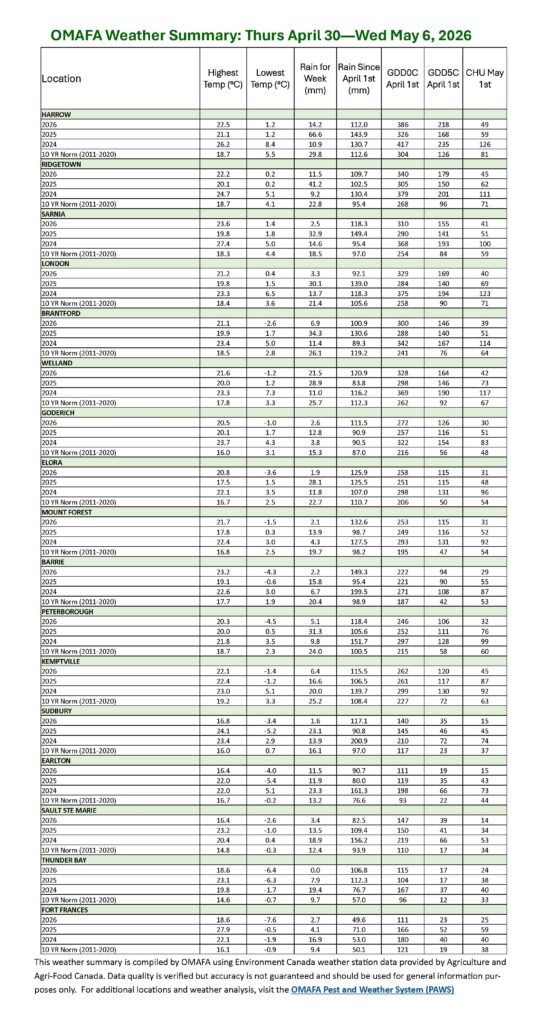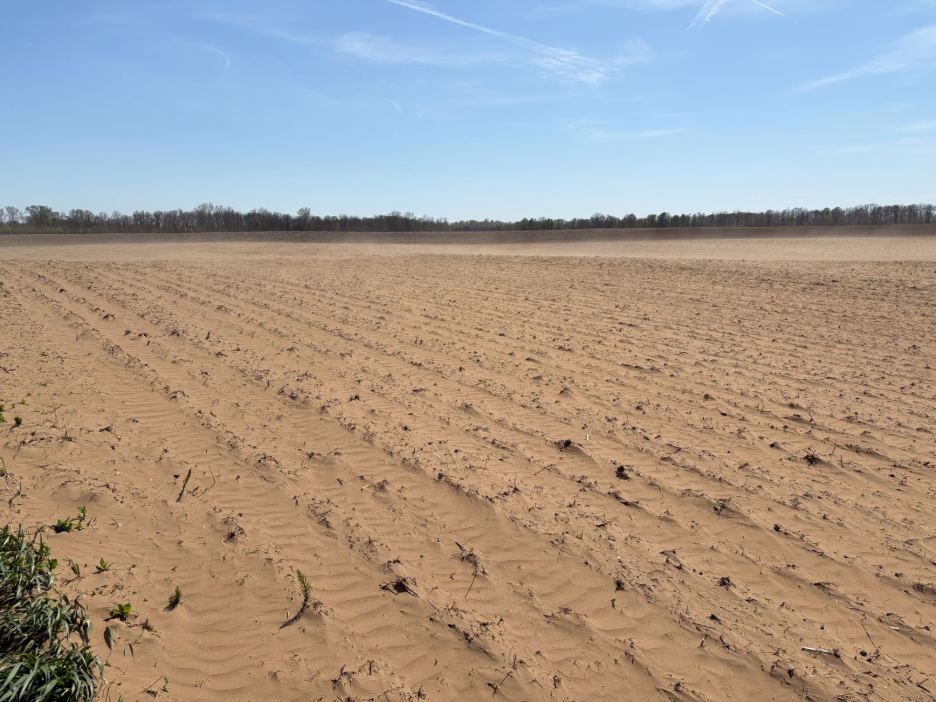
Variable weather has led to short windows for field work across the province. Most areas have had at least a few days to spread fertilizer and manure and begin tillage and planting. Manure applications are being strategically planned to reduce some rates of starter or broadcast fertilizer. Very windy days across the province this week have emphasized soil erosion and losses on worked fields.
Winter Wheat
Winter wheat stands are variable, with staging ranging from tillering in the far eastern and northern areas of the province, up to penultimate leaf emergence in the southwest areas of the province. (For a complete guide on staging winter wheat, the Winter Wheat Staging Guide can be found here). Most winter cereals have received an application of nitrogen and sulphur. The furthest advanced fields are just beginning to receive a plant growth regulator (PGR) application; however, most crop protection applications have been postponed until overnight temperatures are warmer. Septoria and powdery mildew are starting to show in some fields and should be monitored.
Spring Cereals
Most of the spring cereals in the province have been planted, but emergence is slow with the cool, wet weather. There are still some areas of the province waiting for better soil conditions to plant.
Forages
Alfalfa winterkill reports are above average in western Ontario and Northumberland County. Alfalfa fields that survived are coming along nicely, but cool temperatures have delayed growth in some regions. New seeded acres are up overall, and in areas where feed inventories are lower, growers are considering annual forages, such as sorghum-sudangrass to supplement feed. Sorghum is less tolerant of cold soils than corn, and should not be seeded until soil temperatures stay above 12°C.
Corn
A small percentage of corn is planted across the province (estimating 5% in most areas). Lighter, sandier soils have allowed for some field activity, despite varying rainfalls. Some growers are closer to 50% planted, while others have not started corn. The earliest planted corn is just beginning to emerge. This is a good time to get any pre-emerge herbicides down, as weed pressures are increasing. A reminder not to plant corn or soybeans at a shallower depth because of cooler, wetter soils.
For both corn and soybean, soil temperature is more variable in the first ¾-1” of depth, so ensuring planting depth can be critical to seed germination. Linked on Field Crop News are resources for determining corn planting depth based on your farm’s conditions and soybean planting depth recommendations.
Soybeans
Very few soybeans are planted yet, however the acres that have, are beginning to germinate. Seed quality in soybeans is something to continue to watch out for – check your seed tags for Certified #1 versus Certified #2 seed, and if you have questions, make sure to talk to your seed dealer for the best course of action. Some seed lots may require an increased seeding rate, or warmer soils. Other factors, such as white mould risk or fertility history (manure, high fertility) may affect increased seeding rates or final plant populations.
Canola
Winter canola in the southwestern areas of the province is estimated to be at 50% flower, with more eastern and northern regions just beginning to bolt. Winter survival in eastern Ontario was low. In fields that are flowering, cabbage seedpod weevil is more prominent than previous years, with some growers having to spray for control. Similarly to winter wheat applications, growers are being cautioned on tank mixing in cooler temperatures. Be mindful of mixing order, active ingredients in the tank, and temperature lows overnight.
Below Ground Pests
Cooler spring temperatures tend to increase the risk of soil insect pests, especially grubs, wireworms and seedcorn maggot. Early planted corn or soybeans slow to emerge and slow growing mixed forages are prone to longer periods of below ground feeding. Fields with gaps in stands should be evaluated for pest pressure and identification. No rescue treatments are available but if replanting is required, use an insecticide seed treatment and plant in ideal conditions when the crop is more likely to emerge quickly. More info on early season pests can be found on CropIPM.
Weed Control
There is some anticipation of weed seed banks having been replenished with last year’s dry weather in areas of the province. Weeds were hard to kill, and many emerged in late flushes. A lot of residual products require some rain to activate them, and they may not have received that last year, providing less control. In fields with higher weed pressures, pre-emerge herbicides can be a strategic way to get early season control and provide a bigger window for a second pass later in the spring.
Agricorp
May 10th is the deadlines for purchasing, changing or adding crop insurance for Grains & Oilseeds and Forage Rainfall. Premiums for Forage Rainfall coverage are also due May 10th. Please check the Agricorp deadlines for other programs here.
Exeter Breakfast Meeting Minutes – Tuesday, May 5, 2026
Soybeans
- Approximately 1% of soybeans have been seeded and seed supply is good.
- Soybean seed quality continues to be something to watch out for. Seed is extremely dry and should be handled with care. It is recommended to handle/move seed as little as possible.
- Some of the germination is low because of abnormals so growers are reminded to adjust seeding rates where necessary. If conditions are fit, but cold, then seeding rates may need to be increased. If conditions turn warm, seeding rates can be reduced back to normal ranges.
- Most fields have a lot of moisture at 1” depth and should not be seeded deeper when planting early, particularly in cold conditions. If the ground is fit, there is little research that suggests delaying planting.
- There is good interest in IP soybeans this year with acres estimated to be equal to or slightly higher than last year.
- There is a need for soybean seed growers in the area.
Corn
- Approximately 3-5% of corn has been planted on lighter ground. Some areas are behind including the Mitchell and Brussels area due to frequent rain events.
- Seed supply is getting tight across most companies; however, most of the seed is in place. It is still early so there is little to no talk about switching varieties yet.
Cereals
- Winter wheat continues to look good in the area for the most part and has received all of its nitrogen and sulphur. However, significant differences in growth stage and overall stand counts are being noted between timely and later planted wheat. Early planted wheat is now at the second node (GS32) stage while later planted wheat has just reached stem elongation (GS30) and did not tiller very well. In more northern areas wheat is still in the tillering stages.
- Where nitrogen was missed or where misapplication occurred, variation in growth and colouring is becoming more evident.
- In more northern areas of Grey, Bruce, Wellington, Simcoe and Dufferin counties winter wheat fields have gone backwards due to persistent wet, cold conditions.
- Some of the most advanced fields in the area have just received their application of PGR. If growing a responsive variety to PGRs ensure the conditions before, during and after are ideal to reduce negative responses. In some varieties half rate of PGR is recommended.
- Most of the crop protection applications have been put on hold until temperatures warm up, especially if tank mixes are being planned. Growers are reminded that the ideal timing for all these products will differ and there may be a need to adapt and evolve as the season progresses.
- While low temperatures have kept disease at bay, low levels of septoria and powdery mildew are starting to show up in some fields.
- Early planted triticale is progressing well with lots of biomass, while later planted fields are showing thinner stands with more variability. Those fields that had significant snow mould are recovering but there are significant differences in the level of recovery between varieties.
Forages
- Some alfalfa fields have been damaged due to extended cold and wet periods. Those first year stands planted into dry conditions last year are showing signs of stress. Fields that were cut late into the fall are also showing signs of stress.
Canola
- Canola in the most southern regions is now at 50% flower with more eastern and northern regions just starting to bolt.
- There are more fields in the south with cabbage seedpod weevil than in other years resulting in growers having to spray. Most fields are not at thresholds and should continue to be monitored.
- For those fields moving into the flowering stages there is an increased risk of herbicide injury. In one example where volunteer wheat was a concern, a group I herbicide was applied, which resulted in a 30 bu/ac yield loss. Pollination was negatively impacted highlighting the importance of fall weed control. It was noted that control has been slow where herbicides were applied this spring to control volunteer winter wheat.
- There have been questions around whether or not a fungicide can be sprayed in these cold temperatures. It can be applied in cold temperatures as long as growers are watching their tank mixing. When other products are added to the tank, the risk for injury increases and multiple surfactants in the tank should be avoided. The optimum response to fungicide application in winter canola is when the crop is at 30% flower. Many fields have not yet reached that stage and with the crop is progressing slowly, there is still time to apply.
Edible Beans
- No edible beans have been seeded to date.
Weed Control
- It was noted that fall weed control continues to show its benefits. With recent cold temperatures the decision to make a three-way tank mix application has been difficult for growers. Where fall weed control was utilized, growers have more flexibility to make their crop protection applications at the right time.
- Very few annuals have emerged to date. Most questions have been around perennial grass identification and control.
Soils
- More growers are utilizing soil sampling this spring to help determine fertility needs. Growers are looking to find ways to cut back on fertility where it makes sense.
- Growers are reminded to consider the value of that fertilizer and understand their bottom line before cutting back on fertility. It was also noted that you don’t need the same fertility recommendation philosophy across all farms.
Manure
- Lots of manure has been applied in the area.
- Growers are more conscious about compaction and waiting to make their applications until the conditions are fit. It was also noted that there are more tire inflation systems on tanks to help reduce the compaction.
- Those with manure in their system are cutting back on their starter fertility programs.
Winchester Breakfast Meeting Minutes – Wednesday, May 6, 2026
Rainfall & GDDs on par from previous years, regionally we’re behind on CHUs. Rainfall has been variable all over the region.
Winter Cereals
- Final winterkill acres are pretty low all things considered – some fields were able to be partially salvaged, while others were terminated. Better fields are the ones with a bit of a roll to it, and there are still some geese around damaging wheat.
- Anything that pulled through has N&S applied already – still a few fields to go but minimal acres left overall.
- Fields are tillering nicely in the cooler weather. Some fields near the river just approaching GS30 with most advanced fields at GS31.
- There isn’t a need to rush PGRs right now, or crop protection with the cool temperatures, but earliest fields will likely be ready for a PGR by end of the week/this weekend.
- Winter triticale is coming along nicely, stands look healthy and free of disease.
- Weed pressure is coming even if it isn’t already there. There are concerns that they timing is likely going to line up with planting corn, letting weeds get bigger than they should.
Spring Cereals
- Mostly planted – still some rye to go, but most of it is in. Some early emergence (very early planted, slow emergence).
Canola
- None locally. Research station survival variable – the later planting date or areas with low laying water did not survive the winter. There is minimal spring canola planned in the east.
Forages
- Late cut fields last fall came through winter tougher than fields that were not fall cut.
- Most areas escaped heaving but, there is a bit down towards Lake Ontario.
- Older stands didn’t do as well as new seeding from last year (maybe not pushed as hard). The new stands look really good this year.
- There is a fair amount of new seeding planned or already planted for this year. Likely more acres going in then initially planned, with lower feed inventories locally.
- There is some discussion around sorghum sudangrass being added into the rotation, but some growers are waiting to see how first cut yields before making a decision.
Corn
- Acres planted is regionally dependent – 0% to 15%, average is likely about 5% planted, depending on soil, rainfalls.
- There is no need to panic about planting dates or switching varieties yet, there is still all kinds of time to plant corn.
Soybeans
- Regional again, likely 0%-25% – some of the bean ground is ready ahead of corn ground
- No till beans, less worried about cold tolerance with beans
- Growers have been strategic about where to plant, which varieties, watching the forecast for cold rains, etc.
- If corn is 5% planted, beans are likely 7% planted overall.
- Don’t plant shallower just because there’s moisture or its cooler. There is more variability in first ¾-1” of soil depth, so seed may react to temperature fluctuations more.
- There is some speculation that corn residue isn’t as tough as other years – the early dry down and prolonged dry weather last season left stalks standability lower than previous years.
Weed Control
- Anticipating higher weed seed banks this year – that they have been replenished. Last year saw less canopy closure, more late flushes of weeds, etc. Many herbicides need water to activate, and they may not have got it. Doing some pre emerge can give us a bit of wiggle room for application, control them when they’re small, etc. Talk to your agronomist or retailer if you have concerns or questions.
- Locally, we’re seeing an increase in giant ragweed the last few years and are kind of anticipating more of it this year – early reports show there is already some emerged.
- Winter wheat that got a herbicide application last fall looks far better and much cleaner than fields that did not – fleabane and dandelion pressures are high and will be hard to control going forward.
- A good rule of thumb for timing PGRs in Winter Wheat; if the dandelions are in bloom, it’s time for PGRs applications. This usually means we’ve hit enough GDDs for the wheat crop to be at GS31-32.
Simcoe Breakfast Meeting – Wednesday, May 6, 2026
Overall
With cool, wet conditions, very little field activity has occurred in the last two weeks on the clay soils of Niagara and Haldimand. Although conditions so far this spring have not been optimal, attendees were reminded that it is still early in May and that corn planted in late May – into fit soil – is often the highest yielding on the clays of Niagara and Haldimand.
Winter wheat
The winter wheat crop is generally at Zadok’s growth stage 31 or 32, with some late-planted fields not yet at first node (31) and the most advanced fields at growth stage 33. Nitrogen has now been applied to an estimated 90+% of winter wheat fields, with only the odd field without N. Generally, wheat with N applied is looking much better, but expectations are muted for the crop on the clays, given the saturated soil conditions and reduced tiller counts compared to normal. There is quite a bit of tile run wheat. On clay soils, there has only been the opportunity to get nitrogen applied; there has not been a chance for herbicide or fungicide applications. Concern was expressed for disease, such as septoria, beginning to set in for wheat fields given the current environmental conditions.
Corn planting progress
There has been no corn planted, let alone any field preparations, on the clay soils. On light-textured soils in Norfolk, there was a good run of planting late last week in early this week. An estimated 10% of the corn crop has been planted. Soils, however, remain cold (e.g., 11°C at 4 pm recently) and emergence is expected to be slow. Soils were reported to be reasonably dry on the sands, but the water table remains high.
Horticultural crops
A significant frost on Sunday was reported to have damaged asparagus, with emerged plants being unharvestable where temperatures were below freezing. Temperatures as low as -6°C were reported in Norfolk County. The impact of frost on fruit trees in the region is uncertain at this time.
Forages
Alfalfa was reported to be growing poorly due to cool, cloudy conditions and saturated soils.