Hairy vetch (Vicia villosa Roth) is a winter annual legume that is grown as a cover crop for its nitrogen (N) production, weed suppression and the mulch it provides. When seeded in late summer, hairy vetch grows slowly throughout the fall while establishing its root system. In the spring, it grows rapidly and can fix large quantities of N if left until flowering. Hairy vetch performs well on most soil types if there is adequate drainage and it overwinters consistently in southern Ontario. In field crop rotations, hairy vetch is most frequently used in cover crop mixtures sown after wheat for the purpose of spring growth ahead of corn. It ranked as the 11th most grown cover crop species in a 2020 survey of 520 Ontario farmers (Morrison and Lawley, 2021).
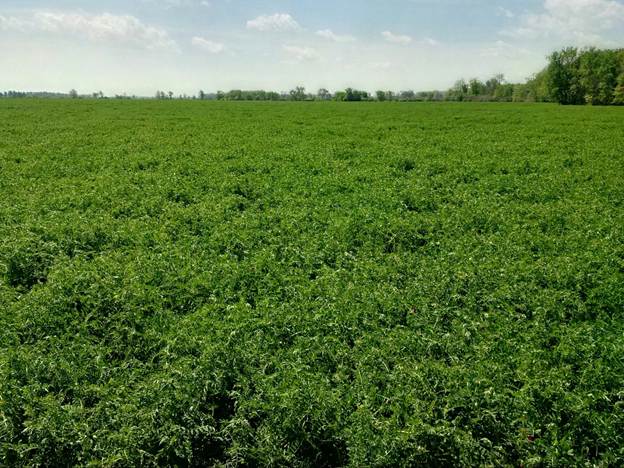
Figure 1. A hairy vetch cover crop growing prior to termination ahead of grain corn planting. Lambton County.
Establishment and growth
| Germination and emergence | Seeds are small, round, black and irregularly shaped. A small percentage of hairy vetch seed is hard-coated and does not germinate until well after the time of seeding. Hairy vetch seed requires inoculant type “C”, also known as pea/lentil/vetch inoculant, for nodulation (Figure 2). Emergence and early growth are slow compared to other cover crop species. |
| Top growth | Vine-like growth habit with plants that are 30 to 50 cm (12 to 20 inches) tall/long when grown in monoculture. Can reach 90 to 120 cm (3 to 4 feet) in height if seeded with a tall cereal, for example, cereal rye. Stems and leaves are hairy, and each one contains 4 to 12 pairs of narrow, oval-shaped leaflets. Forms clusters of 20 to 60 blue-violet flowers (Figure 3). |
| Root system | Vetch has a high concentration of roots in the top 20 cm (8 inches), with additional fibrous roots that can extend down to 75 cm (30 inches) or more (Figure 4). Possesses a weak tap root that can grow to 60 to 90 cm (2 to 3 feet) in depth. Root growth can continue while the plant is dormant. |
| Overwintering | Winter survival depends on adequate fall growth. Hairy vetch tolerates very cold conditions and overwinters consistently in southern Ontario, so long as it is seeded early enough. Strong fall establishment, growth and overwintering has not been consistent in northern Ontario. Snow cover is critical to winter survival in regions with colder winter temperatures. There is variation in winter hardiness by variety. |
| Site suitability | Prefers soil pH range of 6 to 7. Performs well in many soil types. Prefers well-drained conditions. Drought tolerant once established. |
| Herbicide sensitivity | Hairy vetch is less sensitive to herbicide carryover injury than many other legumes and brassicas. Research has found hairy vetch to be sensitive to clopyralid (Group 4), flumetsulam (Group 2), and atrazine (Group 5; reduces biomass), and generally tolerant of pyroxasulfone (Group 15), s-metolachlor (Group 15) and mesotrione (Group 27) (Cornelius and Bradley, 2017; Palhano et al., 2018; Whalen et al., 2019). |
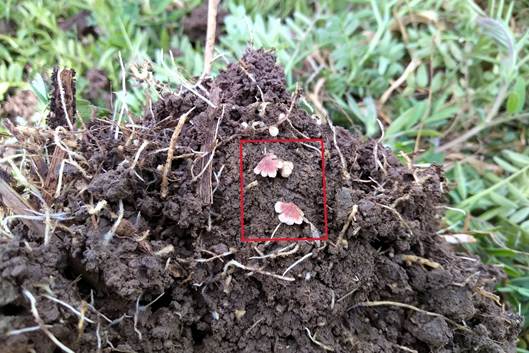
Figure 2. Hairy vetch roots and nodules (shown in red rectangle).
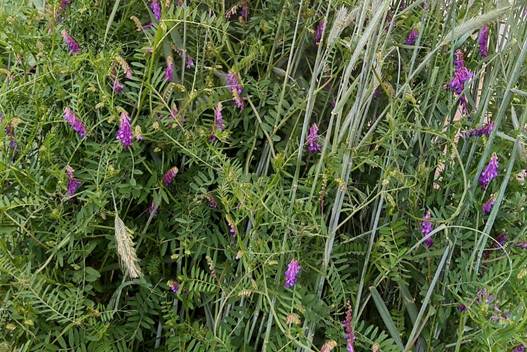
Figure 3. Flowering hairy vetch growing with winter cereal rye in early June.
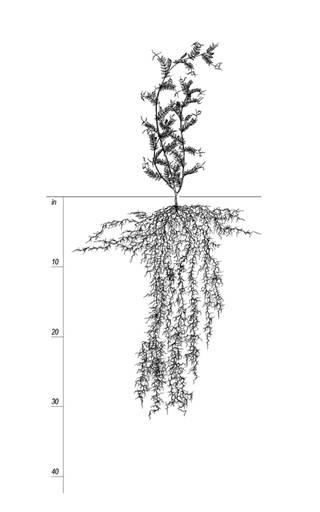
Figure 4. Illustration of hairy vetch’s root system (Credit: Erwin Lichtenegger, Wageningen University. Compiled by Conservation Cropping Systems Initiative).
Common uses in field crop rotations
- Most commonly grown as a component of an overwintering cover crop mixture after an early-harvested crop, often ahead of corn to help contribute nitrogen (Figure 5).
- Sometimes seeded on its own following an early-harvested crop prior to a nitrogen-demanding crop like corn.
Cautions
Hairy vetch can be grazed as a component of a multispecies pasture or cover crop mix but should not be harvested for hay. Seedings intended for forage should be managed carefully. Hairy vetch toxicosis is a concern.
Hairy vetch has hard-seededness in a percentage of seeds, which means that some seeds germinate long after initial planting. This increases the risk of it becoming a weed. Vetch with hard seed is not ideal for fields where small grains are grown as a cash crop, as seed contamination can decrease small grain market value.
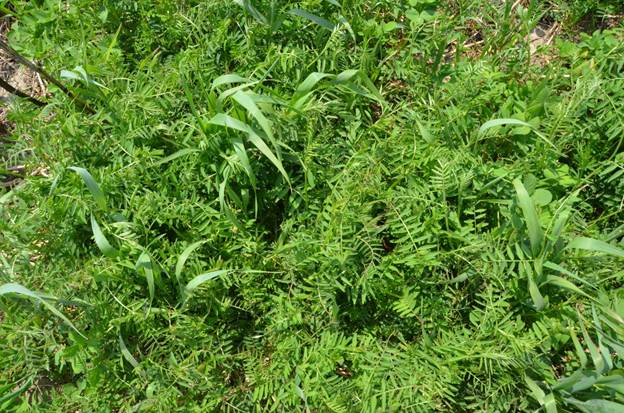
Figure 5. Hairy vetch with other common overwintering species in Ontario – cereal rye and crimson clover. Huron County.
Control options
Weather
- Hairy vetch is not killed by winter in southern Ontario and should not be relied upon for termination in northern Ontario.
Herbicides
- Glyphosate or paraquat alone is not effective in killing hairy vetch.
- Combinations of glyphosate or paraquat with 2,4-D or dicamba are effective in controlling hairy vetch (Wallace et al., 2024).
Mechanical
- Close mowing at peak flower can kill hairy vetch — or weaken it sufficiently to help discing finish the task. A large amount of plant material may cause issues with small mowers. Sickle-bar mowers are only appropriate if vetch is supported by a cereal crop and is dry (SARE, 2007).
- The mouldboard plow is the most effective method for termination by tillage. Chisel plowing is also effective but may require multiple passes with large amounts of plant material (Hill and Sprague, 2024). The same is true for disking. Flail mowing prior to tillage may be helpful.
- A roller crimper can terminate hairy vetch but must be done after the vetch has begun to produce pods for an effective kill. This usually does not occur until early to mid-June in Ontario.
Benefits and cautions
| Benefits | Cautions | |
| Nutrient management and organic matter | Fixes a significant amount of nitrogen when allowed to grow to its full biomass potential. Contributes 2,200 to 5,600 kg/ha (2,000 to 5,000 lbs/acre) of aboveground dry matter. | Due to slow early spring growth, it provides modest biomass when terminated in early spring. This limits its potential to contribute significant nitrogen to grain corn in many parts of Ontario. Residue management can be a challenge in situations where termination is delayed due to abundant, viny growth in spring. |
| Pest and disease management | Supports several beneficial insects, including ladybugs (Figure 6). A strong stand of hairy vetch usually outcompetes most annual weeds. | Care should be taken not to delay the date of seeding, since a vigorous and competitive cover crop is critical to competition with weeds. Hard-seededness may lead to volunteer plants. Hosts several species of nematodes. |
| Erosion control | Once established, it provides enough cover to protect soil. Provides a longer window of protection than many other cover crops. | May not provide adequate erosion protection over winter if seeded on its own past the optimal seeding window in summer. |
| Soil moisture | May assist in transpiring excess moisture in a wet spring as growth accelerates in the latter part of May. Leaving terminated residue on the soil surface creates a mulch layer that helps conserve moisture for the following crop by limiting evaporation. | Can deplete soil moisture for the following crop if left to grow too long in spring, particularly if conditions turn dry. |
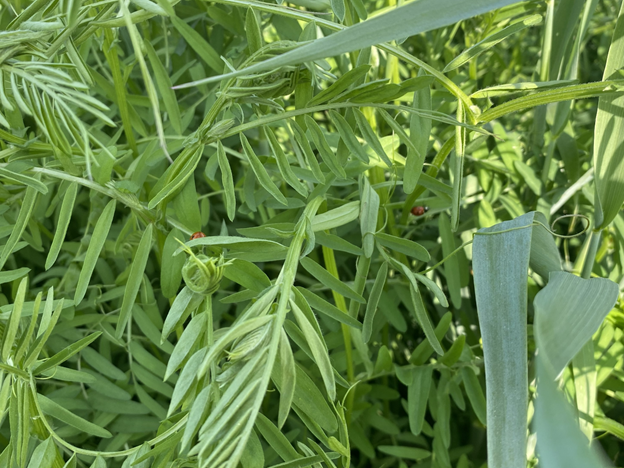
Figure 6. Ladybugs on spring growth of hairy vetch in a cover cropped field just prior to corn planting. Brant County.
Getting started
- Seed is readily available from cover crop retailers.
- Plant at 17 to 22 kg/ha (15 to 20 lbs/acre) when drilled in monoculture. Increase the rate slightly when broadcast seeding.
- Establish by mid-August to provide adequate soil cover by winter.
- Consider risks associated with hairy vetch becoming a weed and plan an effective termination strategy.
Related resources
- Midwest Cover Crops Council Cover Crop Decision Tool
- Cover Crop Termination and Weed Management (GROW IWM)
References
Chintala, R., S Haller, and B. Holleman. 2023. Plant Guide for Hairy vetch (Vicia villosa Roth). USDA-Natural Resources Conservation Service, Booneville Plant Materials Center. Booneville, Arkansas 72927. https://plants.usda.gov/DocumentLibrary/plantguide/pdf/pg_VIVI.pdf.
Cornelius, C.D. and Bradley, K.W. 2017. Carryover of common corn and soybean herbicides to various cover crop species. Weed Technology. 31:21–31. https://doi.org/10.1614/WT-D-16-00062.1.
Hill, E., and C. Sprague. 2024. Cover crop termination. Michigan State Extension. https://www.canr.msu.edu/resources/cover-crop-termination#:~:text=In%20systems%20that%20include%20tillage,reliable%20for%20cover%20crop%20termination. Accessed March 16, 2026.
Morrison, C.L., and Y. Lawley. 2021. 2020 Ontario Cover Crop Feedback Report, Department of Plant Science, University of Manitoba. https://gfo.ca/agronomy/soil-leadership/.
Palhano, M.G., Norsworthy, J.K., Barber, T. 2018. Sensitivity and Likelihood of Residual Herbicide Carryover to Cover Crops. Weed Technology. 32:236–243. https://doi.org/10.1017/wet.2018.7.
Sustainable Agriculture Research and Education (SARE). 2007. Managing Cover Crops Profitably, 3rd Edition. Hairy Vetch. https://www.sare.org/publications/managing-cover-crops-profitably/legume-cover-crops/hairy-vetch/. Accessed March 11, 2026.
The Root Project. Conservation Cropping Systems Initiative. Based on drawings by Erwin Lichtenegger. Wageningen University & Research Image Collections (https://images.wur.nl). By permission: Plant Sociological Institute (http://wurzelforschung.at) via Creative Commons (CC BY-NC-ND 4.0). Compiled by Conservation Cropping Systems Initiative, Indianapolis, IN (https://ccsin.org). Produced by Big Picture Studio, Downingtown, PA (https://bigpicture.studio). https://www.ccsin.org/root-project/. Accessed May 4, 2026.
Wallace, J., Flessner, M., Lingenfelter, D., Singh, V., VanGessel, M., Vollmer, K. and E. Unglesbee. 2024. How to select herbicide programs. GROW Integrated Weed Management. https://growiwm.org/cover-crop-termination/. Accessed March 16, 2026.
Whalen D.M., Bish, M.D., Young, B.G., Hager, A.G., Conley, S.P., Reynolds, D.B., Steckel, L.E., Norsworthy, J.K., Bradley, K.W. 2019. Evaluation of cover crop sensitivity to residual herbicides applied in the previous soybean [Glycine max (L.) Merr] crop. Weed Technology 33: 312–320. https://doi.org/10.1017/wet.2019.10.