Radish (Raphanus sativus) is a cool-season brassica that is grown as a cover crop for its compaction-fighting, weed-suppressing and nitrogen (N)-scavenging qualities. It thrives when seeded in late summer with adequate access to moisture and nitrogen. Radish grows quickly and establishes a deep taproot that can penetrate compacted soil layers. It is easily manageable in field crop systems: it dies over winter, its residue breaks down rapidly and it does not pose a challenge at planting. There are two main kinds of radish grown as cover crops: oilseed and forage/daikon radish (commonly referred to as tillage radish). Oilseed radish has a stubbier and more branched taproot. Neither type does well on poorly-drained soils, but otherwise are adapted to a wide range of soil types. Radish is a very popular cover crop option: it ranked as the third most grown species in a 2020 survey of 520 Ontario farmers (Morrison and Lawley, 2021).
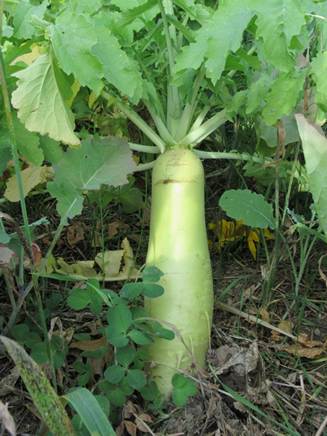
Figure 1. The tuber of a daikon radish cover crop.
Establishment and growth
| Germination and emergence | Small, mustard-like seed (34,000 seeds/pound). Emergence often occurs within three days, followed by rapid growth, assuming adequate moisture and warm soil temperatures. |
| Top growth | Plant develops as a rosette with deeply lobed, irregular leaves. Oilseed radish typically bolts and flowers six to eight weeks after planting. In daikon radish, flowering takes place if radish overwinters, if off-types are present in seed lot or if planted too early in the season. Grows to a height of 50 to 100 cm (1.6 to 3.3 ft). Top growth is typically rapid and results in broad leaf cover. Stunted growth can occur under waterlogged, nitrogen-deficient or drought conditions. |
| Root system | Oilseed radish has a stubbier taproot and more extensive fibrous roots than daikon radish (Figure 2). Thick, creamy white taproot of daikon radish can grow more than 30 cm (12 in) in depth and become very large in diameter given adequate resources. Daikon radish proven to alleviate compaction by taproot penetrating compressed soil layers (“bio-drilling”) under moist soil conditions. Roots attract earthworms and fibrous roots help to loosen soil. |
| Overwintering | Unaffected by early frost and resistant to mild freezing. Radish winterkills most of the time in Ontario, though there have been instances of winter survival after mild winters in southern Ontario (Figure 3). Several nights with temperatures between –4°C and –7°C kill forage radish. Re-growth may occur after a single night at these temperatures if the growing point survives and mild temperatures return (Hybner, 2014). Be aware that radish emits a strong odour when decomposing. |
| Site suitability | Prefers cool, moist growing conditions and well-drained loams to clay loam soils. pH range of 5.5 to 8.5 (Hybner, 2014). Intolerant of traffic. |
| Herbicide sensitivity | Radish is tolerant of most herbicides applied to the wheat crop in-season before flag leaf emergence but is sensitive to Group 2 and Group 5 herbicides. Check re-cropping information on the Ontario Crop Protection for similar species, such as canola, cabbage and mustard, to confirm sensitivities. |

Figure 2. Root system of oilseed radish (left) compared to daikon radish(right). Credit: Erwin Lichtenegger, Wageningen University. Compiled by Conservation Cropping Systems Initiative.
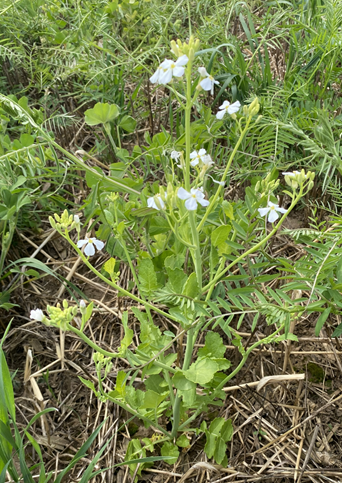
Figure 3. An overwintered, flowering daikon radish. Brant County, spring 2023. Only a small percentage of radish plants in this field survived the winter.
Common uses in field crop rotations
- Grown as part of a cover crop mixture seeded after small grain harvest, often with an oat base and sometimes including other species such as field peas or sunflower (Figure 4).
- Sown as part of a multispecies mixture for livestock grazing.
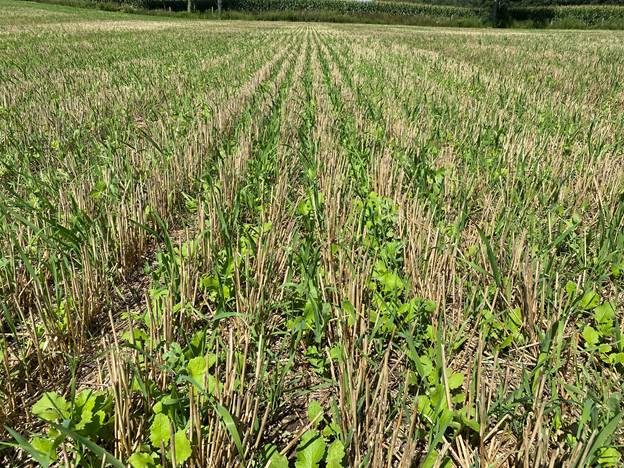
Figure 4. Early growth of an oat-radish-pea cover crop mix.
Management considerations
- Do not seed high rates of radish in mixtures, particularly when there is ample available soil nitrogen, to avoid crowding out companion species.
- Avoid planting radish earlier than August 1st in much of southern Ontario, as early seeding can result in bolting, flowering and seed production.
- Early planted, monoculture seedings supplemented with high-N organic amendment sources can increase the risk of radish roots plugging drainage tile.
Control options
Weather
- Winter conditions typically kill oilseed and daikon radish in Ontario.
Herbicides
- If radish overwinters, research suggests that glyphosate plus 2,4-D/choline provides more complete control than glyphosate alone (Wallace et al., 2024).
- Glyphosate with 2,4-D is also recommended for effective termination in the fall if radish flowers due to early planting.
Mechanical
- If terminating with only tillage, multiple passes are often required.
- Mowing or grazing can be performed to prevent seed set.
Benefits and cautions
| Benefits | Cautions | |
| Nutrient management and organic matter | Radish is a good nitrogen scavenger. It is well-suited for inclusion in mixtures seeded with summer or fall manure applications or when excess soil N is expected. Residues have low lignin content, which results in rapid decomposition. Can produce 1,300 to 4,000 kg/ha (1,200 to 3,500 lbs/acre) of dry matter if residual nitrogen levels are high, though biomass potential is much lower when part of a multispecies mixture. | Radish can take up a large amount of excess nitrogen, but because it winterkills early, the N will be released quickly in the spring – potentially before the following crop can take it up. It has been referred to as a “leaky” cover crop. |
| Pest and disease management | Some varieties, such as Adagio, have nematode-suppressing abilities due to high active glucosinolate levels. Nematicidal activity depends on which glucosinolates are present, in what amount in the plant and which nematodes the compound is active on. Ontario research has found that oilseed radish-containing mixes gave the fastest ground cover amongst 17 treatments and significantly reduced populations of glyphosate-resistant Canada fleabane compared to a no cover crop control (Cholette et al., 2018). | Nematode suppression relies upon turning under large amounts of green matter with high glucosinolate levels. The glucosinolate levels vary greatly amongst varieties. Suppression of weeds like glyphosate-resistant Canada fleabane is enhanced when radish is paired with a species that provides lasting residue (Cholette et al., 2018). Radish should not be grown when other brassica cash crops (for example, canola) are part of the crop rotation because they share similar diseases, such as clubroot and white mold, and control of volunteer radish can be difficult in brassica crops (SARE, 2007). |
| Erosion control | Provide erosion control through green canopy cover in late summer and fall until radish is killed by cold conditions. Bio-pores from taproots help water infiltrate into the soil faster (Figure 5). Pairs well with species like oats or cereal rye that provide residue cover. | Radish provides little ground cover in spring due to rapid breakdown. For this reason, avoid seeding as a monoculture, especially on erodible soils. |
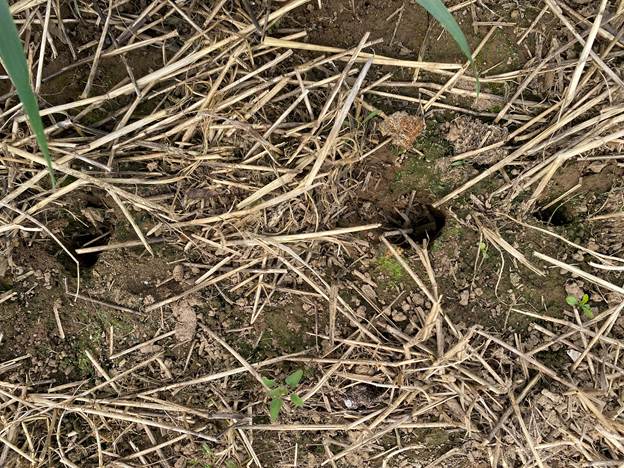
Figure 5. Holes from winterkilled daikon radish.
Getting started
- Seed is readily available in Ontario.
- Plant in a mixture during the month of August at a rate of 2.2 to 3.4 kg/ha (2 to 3 lbs/ac) with 34 to 67 kg/ha (30 to 60 lbs/ac) of oats. Drill the mixture at a depth of 1.3 to 1.9 cm (0.5 to 0.75 in) or broadcast with light incorporation.
- Avoid full-width tillage to preserve surface residue over winter and to keep radish “bio-pores” intact.
Related resources
- Midwest Cover Crops Council Cover Crop Decision Tool
- Midwest Cover Crops Council Cover Crop Recipe: After Wheat, Going to Corn or Soybean: Use an Oat-Radish Mix
References
Cholette T.B., Soltani N., Hooker D.C., Robinson D.E., Sikkema P.H. 2018. Suppression of Glyphosate-resistant Canada Fleabane (Conyza canadensis) in Corn with Cover Crops Seeded after Wheat Harvest the Previous Year. Weed Technology. 32:244–250. https://doi.org/10.1017/wet.2018.19.
Hybner, R.M. 2014. Radish: Raphanus sativus L. An Introduced Cover Crop for Conservation Use in Montana and Wyoming. United States Department of Agriculture. Natural Resources Conservation Service. Plant Materials Technical Notes MT-106.
Morrison, C.L., and Y. Lawley. 2021. 2020 Ontario Cover Crop Feedback Report, Department of Plant Science, University of Manitoba. https://gfo.ca/agronomy/soil-leadership/.
The Root Project. Conservation Cropping Systems Initiative. Based on drawings by Erwin Lichtenegger. Wageningen University & Research Image Collections (https://images.wur.nl). By permission: Plant Sociological Institute (http://wurzelforschung.at) via Creative Commons (CC BY-NC-ND 4.0). Compiled by Conservation Cropping Systems Initiative, Indianapolis, IN (https://ccsin.org). Produced by Big Picture Studio, Downingtown, PA (https://bigpicture.studio). https://www.ccsin.org/root-project/. Accessed May 4, 2026.
Sustainable Agriculture Research and Education (SARE). 2007. Managing Cover Crops Profitably, 3rd Edition. Brassicas and mustards. https://www.sare.org/publications/managing-cover-crops-profitably/nonlegume-cover-crops/brassicas-and-mustards/. Accessed March 23, 2026.
Wallace, J., Flessner, M., Lingenfelter, D., Singh, V., VanGessel, M., Vollmer, K. and E. Unglesbee. 2024. How to select herbicide programs. GROW Integrated Weed Management. https://growiwm.org/cover-crop-termination/. Accessed March 16, 2026.