Vast amounts of nitrogen (N) exist in our soils in many different forms, but only nitrate (NO3–) and ammonium (NH4+) can be taken up via the plant roots. Most of the nitrogen in the soil is in the organic form, which much be broken down by micro-organisms to become plant available. Mineralization is the process by which microbes break down organic N (existing as part of the soil organic matter) into NH4+, which rapidly converts toNO3–. Mineralization is affected by soil temperature and moisture, such that a cool, dry spring will supply less N from the soil than a warm, moist spring.
However, nitrate is also prone to loss from the soil, either through leaching downward through the soil profile and out of the rooting zone, or through conversion of nitrate to atmospheric nitrogen (N2) or nitrous oxide (N2O), known as denitrification. These losses are weather dependent as well, and may differ substantially field to field.
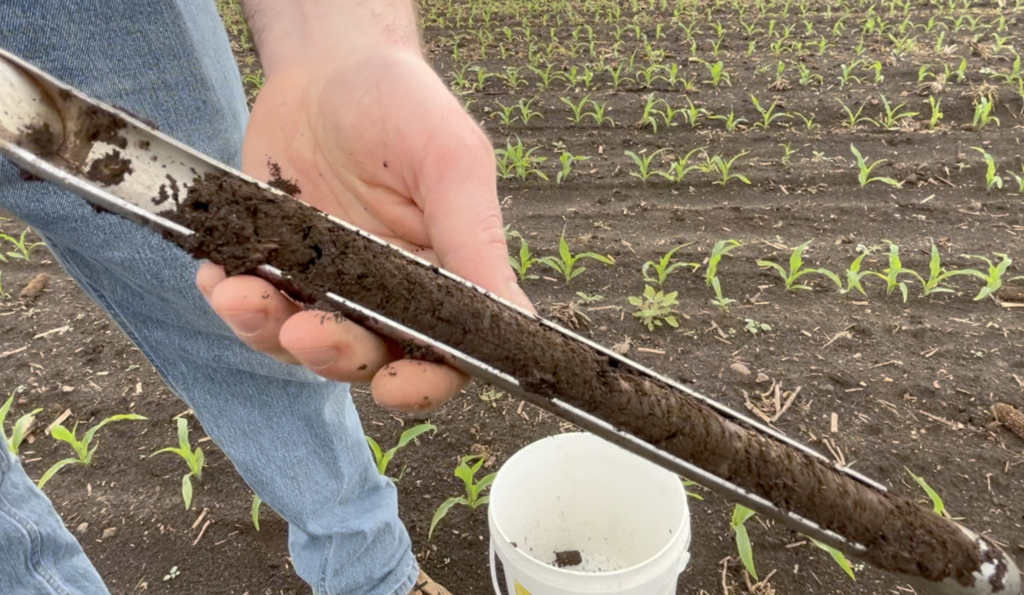
Taking a soil sample at critical times and testing for soil nitrate-nitrogen (NO3-N) can give an indication of soil N supply to the crop, taking into account what N has already been mineralized, as well as the losses that have already occurred.
Soil NO3-N sampling has been evaluated for use, and appropriate recommendations for corn and spring barley have been approved.
Sampling for corn:
- Preplant nitrate test (PPNT) – within 5 days of planting
- Pre-sidedress nitrate test (PSNT) – when corn is 15-30cm (6-12 in.) tall
Sampling for spring barley:
- Within 5 days of planting, for areas other than eastern Ontario that receive less than 3000 CHUs.
Limitations
Caution must be used when it comes to interpreting soil NO3-N tests, as it has not been properly evaluated or calibrated for:
- Fields with broadcast N fertilizer applied
- Fields with more than 30 kg-N/ha fertilizer banded or in-furrow as a starter
- Legumes or manure plowed down in late summer or fall; or legumes in a no-till system
- Areas with distinctly different soil types
- Samples taken before the soil has warmed up significantly
In these circumstances, use of the NO3-N soil test may be limited to a year-over-year comparison to identify trends in soil nitrogen supply to make adjustments to intended N application.
Sampling and handling
To collect a representative sample, farmers should use a soil probe or auger to take 20 to 30 cores from a uniform area no larger than 10 hectares (25 acres). Samples should be taken to a depth of 30 cm (12in.). To collect a representative sample, farmers should use a soil probe or auger to take 20 to 30 cores from a uniform area no larger than 10 hectares (25 acres).
Avoid sampling immediately after a heavy rainfall, and sample areas of different soil types or topography separately.
Soil should be crushed by hand and mixed well, before taking a roughly 500 g (1 lb) subsample and place in a clean plastic bag or soil sample box.
Proper handling is critical to maintaining the integrity of the sample and for accuracy of results. The goal is to minimize changes in PSNT values caused by soil sample handling. Microbes will keep working after the soil sample is taken, so proper handling aims to reduce microbial activity quickly.
Ideally soil samples are delivered to the lab the same day they are collected. If this cannot be done, keep samples cool: out of direct sun, in a cooler or insulated container. Do not leave fresh samples in a hot vehicle.
If samples cannot be delivered to a lab promptly, you must be prepared to refrigerate or start air drying as soon as possible. Samples should never be frozen at any point.
Refrigeration is the preferred soil handling method if samples cannot be sent to lab within 24 hours of collection. Store soil samples in a fridge or cooler maintained at 4oC or lower (but above 0oC) as soon as possible after field collection. Regular fridges are suitable. It is fine to refrigerate in clean plastic bags or jars. When refrigerated, samples can be stored without altering PSNT values for up to 7 days (including shipping time to the lab). Storing samples for longer than 7 days will increase the likelihood of changing PSNT recommendation.
If refrigeration is not possible, air dry the sample as soon as possible by spreading a thin layer (1 cm depth) of soil on a clean, dry surface (e.g. plastic or aluminum trays or plates, or paper). If soil is in clods or chunks, it can be crushed or crumbled with a clean tool or gloved hands to improve drying speed. To speed drying, you can dry soil directly in the sun or use a fan blowing over the soil. Do not dry the samples in an oven. Soil will normally be fully air dried within 24-48 hours, and should be light and crumbly once air drying is complete. Fully air-dried soil can be stored for several weeks, and can be shipped in sealed plastic or paper bags without extra precautions.
Interpreting the results
Labs report the results in terms of parts per million of nitrate-nitrogen, and sometimes ammonium-nitrogen. Interpretation of the results will differ depending on the intended or already planted crop, as well as the timing of sampling and nitrogen application.
Please see nitrogen fertility factsheets in corn and cereals sections for individual recommendations.
While recommendations give an indication of soil supply, other factors influencing nitrogen demand may necessitate further adjustments as the season progresses, including future precipitation and risk of loss following application.
References
1. Janovicek, K., H. Wang, I. McDonald, B. Rosser, J. Lauzon, J. Sulik, E. Susko, and J. Nasielski. 2024. Effect of soil sample handling and storage on inorganic nitrogen determination: Implications for the presidedress nitrate test. Soil Science Society of America Journal. 2024: 1-11. https://doi.org/10.1002/saj2.20714