As of June 5, 2026 stripe rust had been identified in fields in Oxford, Huron, Wellington, Bruce, Perth, Waterloo, Brant, Essex, Lambton, Middlesex, Elgin, Brant, Hamilton, Niagara and Haldimand Counties. Leaf rust was also previously identified in a field in Essex County. Growers across southern Ontario should scout their winter wheat fields closely, particularly where susceptible varieties are being grown. Previous early stripe rust infections occurred mid-May in 2016, 2017 and 2024 and early May in 2025. Tolerant varieties and foliar fungicides kept the diseases at bay those years. However, significant yield reductions occurred in susceptible varieties where no fungicide was applied.
Current Disease Risk
Stripe rust infection in the U.S. has been found in Kansas, Tennessee, Michigan and Wisconsin as of June 5th (CPN stripe rust map). It has also been reported in Nova Scotia and Prince Edward Island. The risk in individual fields that are close to infected fields is high. Scouting is essential if fungicide use is not a standard practice.
The optimal temperatures for stripe rust development are 10 -18°C with intermittent rain and dew events. New stripe rust populations adapted to warmer temperatures have been identified and infection risk is reduced when nighttime temperatures are consistently above 18°C. Windy days help with spore dispersion. Stripe rust causes yellow to orange, blister-like lesions that are arranged in stripes (lines) on the leaf of the wheat plant (Figure 1). If left untreated, stripe rust can cause significant yield reductions. In previous outbreaks, high incidence of stripe rust left uncontrolled resulted in yields as low as 45 bu/ac.
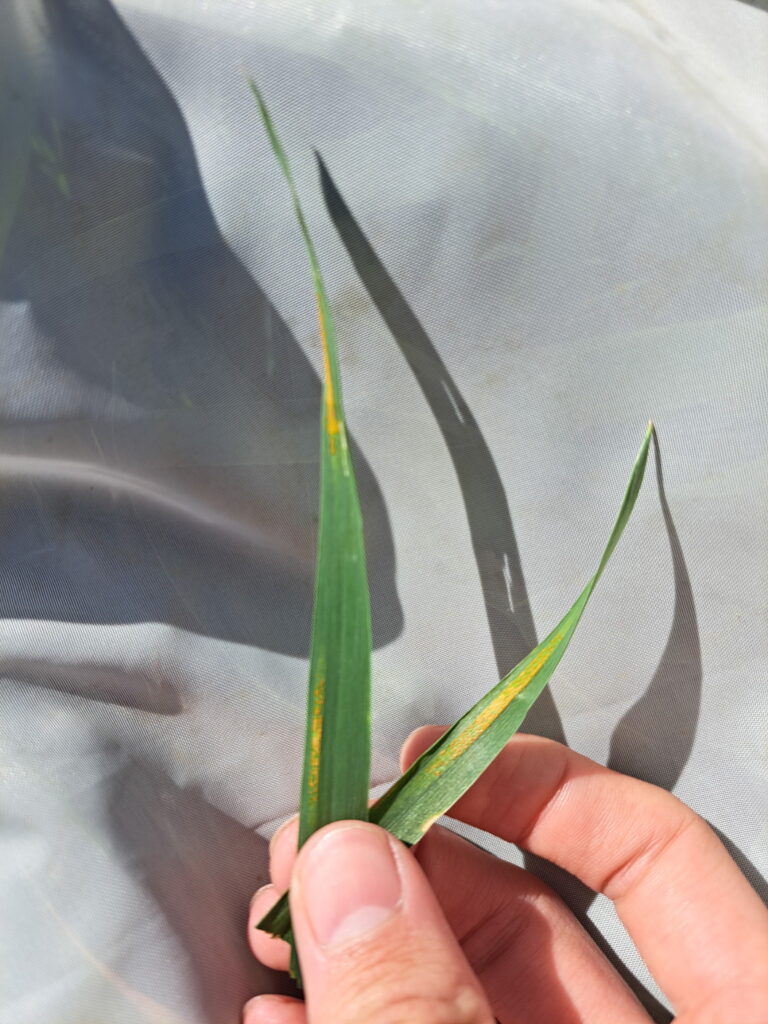

Leaf rust typically occurs when spores blow north on wind currents and begin new infections when they land on leaves. Rust pustules first develop on lower leaves and progress up the plant. Symptoms can be present from seedling stages through ripening. Leaf rust can be identified by scattered pustules on the leaf unlike the linear pattern of stripe rust (Figure 3).
High humidity and temperatures between 18 – 25°C favor disease development. When conditions are favorable, the infection cycle will continually repeat and result in secondary infections. Yield loss from leaf rust depends on the timing of infection and weather conditions when spores arrive in an area.

Integrated Stripe and Leaf Rust Management
The best defense against stripe and leaf rust is a combination of variety selection, scouting and timely fungicide applications. In Ontario winter wheat varieties, there are large differences in variety susceptibility to these diseases. Check the Ontario Cereal Crops Committee 2025 performance trials for specific variety ratings (GoCrops.ca). You can find the stripe and leaf rust ratings under the head to head feature. The 2025 historical report has detailed stripe rust ratings. If a variety has a rating of 6 or higher the variety is susceptible and will benefit from a fungicide application if disease is present (Figure 4). If a variety is rated 3 to 5 then it is considered moderately resistant and should be scouted regularly during the growing season. If stripe or leaf rust are present and on the upper leaves of the canopy consider a fungicide application, particularly if the wheat is before or just at flag leaf. If a variety has a rating less then 2 the variety is resistant against stripe and leaf rust and should continue to be monitored. As we saw in previous stripe rust years, some growers got caught with a severe disease infestation 10 days before the T3 fungicide application timing and had significant yield losses as a result. Therefore, if you are more than 7-10 days away from a T3 fungicide application and the variety is susceptible to stripe rust, a fungicide should be applied as soon as possible. However, if stripe rust incidence and severity is low, a tolerant variety is being grown and a T3 fungicide application is less than a week away, a fungicide application can wait until T3. Most winter wheat fields in southwestern Ontario are between GS 51 (first spikelets of the head are visible) and the anthesis/flowering (GS 65). If winter wheat is beyond the swollen “head in boot” stage, a fungicide containing strobilurin should not be applied. For more information on fungicide selection please visit the OMAFA Crop Protection Hub.
Continue to scout fields as regular scouting assists in determining if disease infection is progressing up the plant and is critical in determining if a fungicide application is needed, and at what timing. Disease progression depends on the level of infection, environmental conditions and crop susceptibility. With resistant varieties and appropriate use of fungicides these diseases can be managed effectively.
