OVERVIEW
A cool unsettled week with below-seasonal temperatures and high risk of showers and thunderstorms has slowed crop growth and made crop protection applications a challenge. That said, most of the intended acreage has been planted, and early season crop growth is considered good.
Field Corn
- Stands are generally good, with staging that ranges from June planted fields being at VE–V1 (1–3 leaf tips) to early-planted fields at V6+ (10 leaf tips), nearing canopy closure.
- Most fields are in the critical weed-free period (3-10 leaf tips), making timely weed control essential.
- Side-dress and top dress applications are ongoing, occurring between the sporadic rainfalls.
- Until recently, dry conditions have led to some nutrient deficiencies appearing, particularly nitrogen, potassium, and sulphur, among others. Recent rains are likely to help nutrient movement from soil into the roots, reducing many deficiency symptoms. Scouting is important to determine if deficiencies persist, in which case they may require correction.
- Tar Spot Risk: Scout fields for Tar Spot. Corn is vulnerable to Tar Spot between V10 and R3 (milking). The Crop Protection Network Risk Tool https://connect.doit.wisc.edu/cpn-risk-tool/ is currently forecasting a high risk (98%) for the development of tar spot over the next 14 days.
Soybeans
- Crop staging ranges from emergence to the 3rd trifoliate stage of growth, making weed control a priority given the critical weed-free period in soybeans is from the 1st to 3rd trifoliate stage.
- In identity preserved (IP), non-GMO soybeans, sub optimal activation of soil applied herbicides have resulted in weed escapes. Most grass and broadleaf weed escapes should be managed prior to them reaching the 6-leaf stage to optimize efficacy. Most herbicides cannot be applied past the 3rd trifoliate stage of soybean, as the risk of crop injury can increase. Check the product label to determine the maximum crop stage for application.
Cereals
- Overall, the winter wheat crop is progressing well, with recent cool nighttime temperatures providing ideal conditions for grain fill.
- Winter wheat is mostly past the ideal stage for fusarium head blight protection. Most fields received a T3 fungicide for fusarium head blight, which also offers protection against stripe rust.
- Armyworm feeding has been observed in a few fields. Scouting is best done shortly after dusk, when armyworm come out to feed. The threshold for chemical control is 4 to 5 un-parasitized larvae, that are smaller than 2.5 cm (1”) long per square foot. Larvae larger than 2.5 cm will not be controlled by an insecticide (Figure 1). Insecticide options can be found in the Crop Protection Hub – True Armyworm Insecticide Options .
- Cereal leaf beetle and aphid levels have been found at threshold in some fields and should continue to be monitored in spring cereals.
Edible Beans
- Most of the intended acreage has been planted, has emerged and are at the unifoliate stage to 1st trifoliate stage.
- Scout regularly for weed escapes—post-emergent herbicide options in dry beans are only effective on small weeds (2–4 leaf stage).
Canola
- Winter canola pods are still green but nearing ripening.
- Thinner winter canola stands have branched well and are producing pods to compensate.
- Some spring canola seeded in mid-May has been sprayed to control flea beetles as the weather was hot and dry during early growth stages. These fields have withstood the flea beetle pressure and are entering the 5- and 6-leaf stage and are receiving or received a postemergence herbicide application.
- Spring canola seeded in the first week of June is in the cotyledon stage as dry planting conditions reduced early germination until rain occurred.
- Swede midge scouting is ongoing in the spring canola crop.
Forages
- Monitor alfalfa and alfalfa/grass mixes for potato leafhopper, especially after forecasted thunderstorms this week. Damage is often visible only after economic thresholds are exceeded. Thresholds vary by plant height—see https://fieldcropnews.com/2025/04/how-do-i-manage-potato-leafhopper-in-alfalfa/ for details.
Weed Control
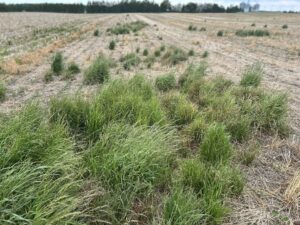
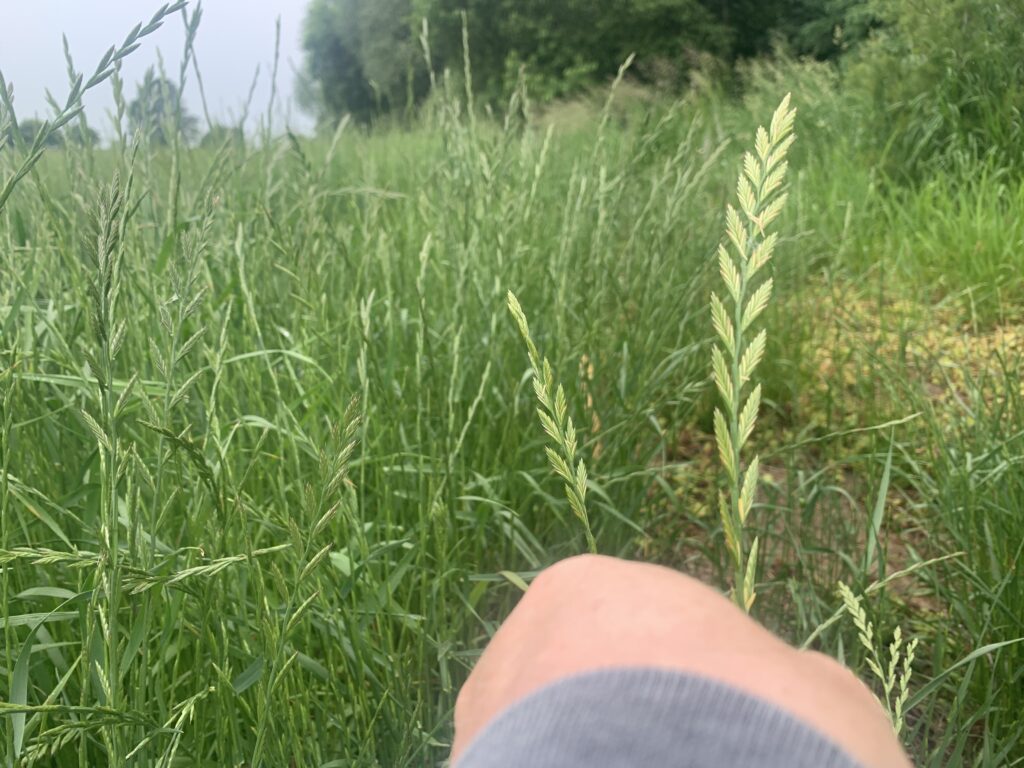
- Ryegrass (Lolium spp. – Figure 2) is heading and visible in wheat, corn, and soybeans. It’s highly adaptable and often glyphosate resistant (Figure 3).
- All identified ryegrass specimens have been perennial. Control requires a combination of tillage (e.g., ploughing) and effective residual herbicides in spring and fall.
- Dig out clumps where possible to prevent spread. Abstain from the use of high-speed discs or vertical tillage tools when managing crop residue this fall as that aids in the spread of this species.
- If you have this ryegrass on your farm and would like it tested for susceptibility to herbicides, you can e-mail mike.cowbrough@ontario.ca
Upcoming Events
- Winchester Field Crops Research Day – June 30 – Register at: https://www.eocac.ca/crop2026.php
- Southwest Diagnostic Days – Ridgetown – July 7th and 8th – https://www.uoguelph.ca/ridgetown/diagnostic-days
- Weed Control Tour – Elora Research Station – Thursday July 16th – Register at: 1-877-424-1200 or online
- Georgian Soil and Crop Compaction Day – July 16th – Register at https://www.greyagservices.ca/compaction-event
- NorthWest Diagnostic Days – July 28th, Emo Research Station – Register at https://membership.ontariosoilcrop.org/event/northwest-diagnostics-day/
Exeter Breakfast Meeting – Tuesday June 16, 2026
Soybeans:
- Recent rainfall significantly helped soybean and edible bean emergence.
- Most replants are complete on tougher ground in areas further north that did not get rain. At this point, if stand counts in IP soybeans are on the lower end but plants are consistently spread out across the field and if winter wheat planting date is a concern, the stand should be left alone.
- Some bean leaf beetle was found in bin run and certified seed. Not at threshold but nearing 25% defoliation.
- For those looking to roll beans after emergence, it should be done during the heat of the day between the unifoliate and second trifoliate stages. It is important to get off the tractor during rolling to check the beans and ensure they are not broken off. Ontario research has shown a 1.2 bu/ac increase in yield from rolling. Edible beans should be rolled before planting and not after.
- In areas where it has been wet, weeds are starting to get large. Those trying to control red cover in IP soybeans have few options available. An application of Reflex can help knock the clover back but 100% control is not possible in emerged IP soys.
- Foliar fungicides should be considered where white mould is a concern. A two-pass fungicide program is needed to control white mould but if making one fungicide application it should be applied at full boom.
Edible Beans:
- Edible beans are emerging nicely. Weed control should be top of mind for those fields that were planted in late May and early June as weeds such as lambsquarters are coming through.
Corn:
- Overall corn is looking good in the area, with side dressing nearing completion.
- Some deficiencies are appearing in corn after the heavy rain. It could be a seed or fertility placement issue or related to the weather and rapid growth which is temporary in most cases.
- Soil nitrate levels are looking good.
- Growers are encouraged to book their fungicide applications for tar spot now. It is easier to take your name off the list versus trying to get onto it if it turns into a tar spot year.
Wheat:
- Overall, the winter wheat crop is progressing well, with recent cool nighttime temperatures providing ideal conditions for grain fill.
- Armyworm feeding has been observed in a few fields and larvae have been found in significant numbers in freshly cut forage fields. Fields should continue to be monitored in the coming weeks. Scouting is best done shortly after dusk, when armyworm come out to feed. The threshold for chemical control is 4 to 5 un-parasitized larvae, that are smaller than 2.5 cm (1”) long per square foot. Larvae larger than 2.5 cm will not be controlled by an insecticide. Insecticide options can be found in the Crop Protection Hub.
- Cereal leaf beetle has been found at threshold in some fields requiring control. Spring cereals should continue to be monitored over the coming weeks. If an average of three cereal leaf beetle larvae per tiller are found before boot stage, spray is warranted. One CLB adult or larvae per stem warrants control after boot but prior to heading. Insecticides registered for cereal leaf beetle can be found on the Crop Protection Hub. A reminder that Decis has a pre-harvest interval of 40 days.
- Cereal aphids are also being found in many fields; however, only when populations reach an average of 12 – 15 aphids per stem prior to heading is a foliar insecticide recommended. Once in heading, populations need to reach closer to 50 or more aphids per head to warrant control. Insecticides registered for aphids can be found on the Crop Protection Hub. A reminder that Cygon has a pre-harvest interval of 35 days.
- Winter wheat is mostly past the ideal stage for fusarium head blight protection. Spring cereal fields should continue to be monitored for stripe rust if they have not yet received a fungicide application.
- Barley yellow dwarf virus and wheat streak mosaic virus has been confirmed in several fields. If you are suspicious about viruses in your wheat field, please contact Joanna Follings at joanna.follings@ontario.ca.
- The U of G he U of G Wheat Breeding Day will be hosted on Thursday, June 25th at the Elora Research Station. If you are interested in attending, please RSVP by Wednesday June 18th HERE.
Weed Control:
- Lots of pigweed is emerging in fields but ryegrass continues to be the biggest weed control challenge this season. Glyphosate resistance is a concern so growers should add another mode of action in the tank with it to ensure good control.
- If dealing with red clover in emerged soybeans, there are few options available. An application of Reflex can help set the clover back but 100% control is not possible.
- Perennial sow thistle has been a challenge in some fields. To get good control herbicide applications should be made when the weed is at the 5-7 leaf stage. It can easily be controlled in corn now and then again in the fall.
- With the recent announcement regarding the use of drones for crop protection applications, there are several questions and concerns. Certain products such as Dicamba cannot be applied with drone and are effectively illegal applications. There needs to be two people present to make drone applications – there must be a Transport Canada certified pilot as well as one person who must have all the proper pesticide application licensing to handle the crop protection products and fill the tank.
- Growers are reminded to follow the label and use a reputable company. Some registrants may not support application via drone so growers should speak with their crop protection company directly.
- The Ontario Weeds Tour will be held at the Elora Research Station on July 16, 2026.
Winchester Breakfast Meeting – Wednesday, June 17, 2026
- Rainfall variable this past weekend, but should be sufficient to activate any soil applied or residual herbicides
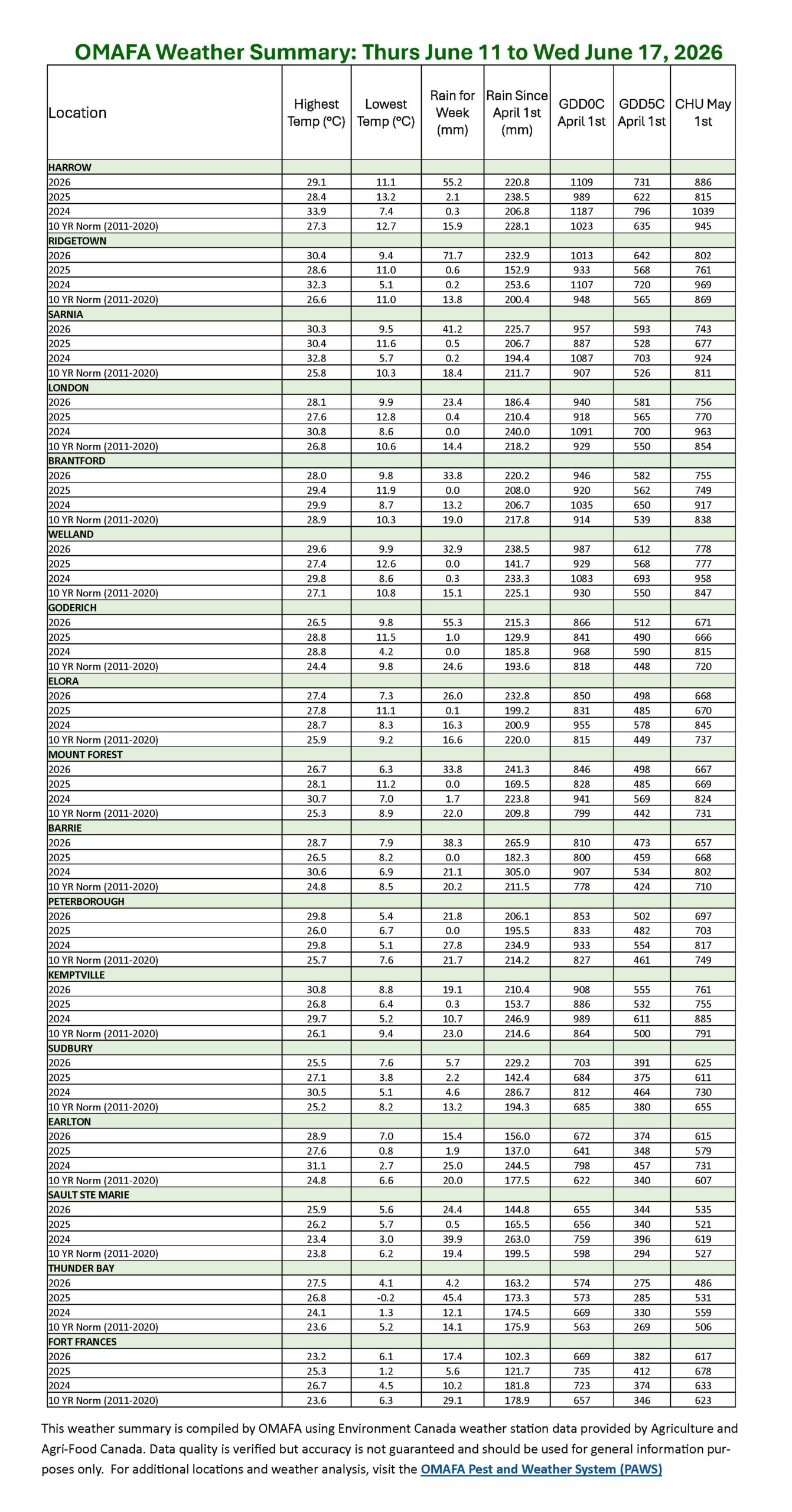
- Weather data can be found in the Crop Report on Field Crop News or at the Pest & Weather System website
- There are forecasting models on Crop Protection Network that can be helpful in anticipating disease pressure. They can be found here: https://cropprotectionnetwork.org/tools
Cereals
- Most of the winter wheat already has T3 applications done, with most acres almost done flowering
- Some reports of stripe rust up the Ottawa Valley, but not widespread
- Fusarium Head Blight pressures have been high on models – humid days, warm overnights, foggy mornings, so continue to scout for pressures.
- Soybean for success link – gilles to send, there’s models for disease (ask albert?) (US)
- With thinner winter wheat stands, there is more tillering in areas, and heads aren’t all emerging evenly. This means the window of exposure for FHB will be longer.
- Cereal leaf beetle pressure is quite heavy further west, up the Ottawa Valley and west towards Prince Edward County, Napanee, etc, where damage is severe.
- Lots of Barley Yellow Dwarf Virus locally this spring, and questions on identifying it, how to manage it, etc. Wheat streak mosaic virus also generating some questions from producers.
Spring cereals
- Some True Armyworm in spring cereals – Winchester area, in the headlands
- Flights have been low, despite seeing pressures in fields
Forages
- Most first cut acres done, some non-dairy acres still to go
- Yields are sufficient – grasses came on with the heat, so anyone who waited a bit got more volume than those who cut early
- No leafhoppers yet, but timing and weather patterns would support moving them in so continue to scout. A reminder to watch new seeding – anything that didn’t get cut yet for first cut will most likely be susceptible first.
Corn
- Populations are good, but there are some areas where they are thin.
- Sidedress/Topdress is well underway, with producers trying to strategically apply before/between rains
Soybeans
- Soybean acres were planted as intended, and planting progress is complete across the region.
- There were some emergence issues locally, but not significant acres – mostly soil crusting or cool temperatures.
- Soybeans are struggling to get sprayed – weeds are coming on fast with heat and rainfalls, but wind and rain has delayed spray days and ideal conditions
- Slug damage is lower than previous years, but still a bit around
Weed control
- Insecticide and fungicide supplies are good for going further, there are no major changes in supply or products at this time.
- Changes have occurred to drone applications of crop protection products. Please check labels, rates and regulations prior to any applications. Information on drone spraying best practices can be found here: Safe & Effective Pesticide Application using Drones.
Agricorp
- Please report in final acres before June 30th online or by phone.
Simcoe Ag Breakfast Meeting – June 17, 2026
Overview:
Frequent rain – up to 75 mm – has softened soils and helped improve crop emergence for recently planted corn and soybeans. All acres planned for corn are planted and about 90% of soybeans have been seeded. Surprisingly, overall planned crops have not changed significantly from May 1st intentions.
Wheat:
Generally, wheat stands look good, with some lodging in thick, better fields. Approximately 10% of fields had PGR’s applied and nearly 90% of wheat in the area received a T3 application. Harvest intervals are closing in, limiting any further applications. Some fields had late nitrogen and herbicide applications.
Forages:
Dairy 1st cut forage quality was excellent with excellent harvest window, but early stage of maturity resulted in yields for the early cut fields were at about 80% of normal. Most of the forage was ensiled and manure applied, resulting in excellent regrowth for a 2nd cut. Dry hay harvest is on hold for a drier weather forecast.
Corn:
Corn on clay soils is about 3-4 weeks behind areas to the north of the region. Nitrogen side-dressing is occurring on earliest-planted fields and latest-planted fields are emerging. Weed pressure is high in many fields, and advanced weeds will be difficult to control in fields that have not had a herbicide application.
Soybeans:
Soybean planting is nearing completion. Continued frequent (light) showers will be required to help with emergence in fields still being planted. Weed control is being hampered by rain and high winds.
Pest Control:
- Calls about waterhemp are increasing. Growers should check any weed escapes and check with a trusted agronomist if unsure. Information on waterhemp identification can be found here.
- Vegetable growers may need to look at wider crop rotations between high-value crops for managing weeds without herbicide options.
- A few cooler nights have helped fleabane emergence continue. Crop safety for surrounding crops make dicamba options too risky.
- With the recent announcement regarding the use of drones for crop protection applications, there are several questions and concerns. Safe & Effective Pesticide Application using Drones
- Certain products such as Dicamba cannot be applied with drone and are effectively illegal applications.
- There needs to be two people present to make drone applications – there must be a Transport Canada certified pilot as well as one person who must have all the proper pesticide application licensing to handle the crop protection products and fill the tank.
- Pesticide efficacy has been fine-tuned for in-crop applicators or aerial application. Risk of products not providing intended control with drone application could be expensive, especially for tar spot or other diseases where application accuracy is critical for control.
- Aerial application must maintain the required buffers from water sources (rivers, creeks etc). Fungicide drift with aquatics could result in damage to aquatic life.
- Zidua label for soybeans recommends application pre-flower. Later application have lower recommended rates and would cause damage to the first flowers, however depending on weed pressure the economics may favour weed control.
Crop Insurance:
- June 15th was the deadline for reporting un-seeded acres. If the deadline was missed, please still call Agricorp as soon as possible.
- June 30 is soybean planting deadline
- Clarification that the planting deadlines are in place for the crop insurance area of the field where the crop is planted, which may not necessarily be the same as the home mailing address.
- Vegetable crops are doing well, but there are some reports of cutworm damage
- Sour cherry crops in the area suffered severe damage from frost earlier in the spring.
Mental Health – With finances tight on many farms and the stresses of a challenging spring taking their toll, mental health is a growing concern across the farming community. Please take the time to check in—whether by visiting or calling—the farmers you work with. Those under the greatest stress are not always the most obvious, and a simple conversation can make a meaningful difference. The Farmer Wellness Initiative offers unlimited free counselling to farmers, farm families and farm employees.
Save the Date: November 18th 9 am – Simcoe Ag Breakfast Fall Wrap up Meeting