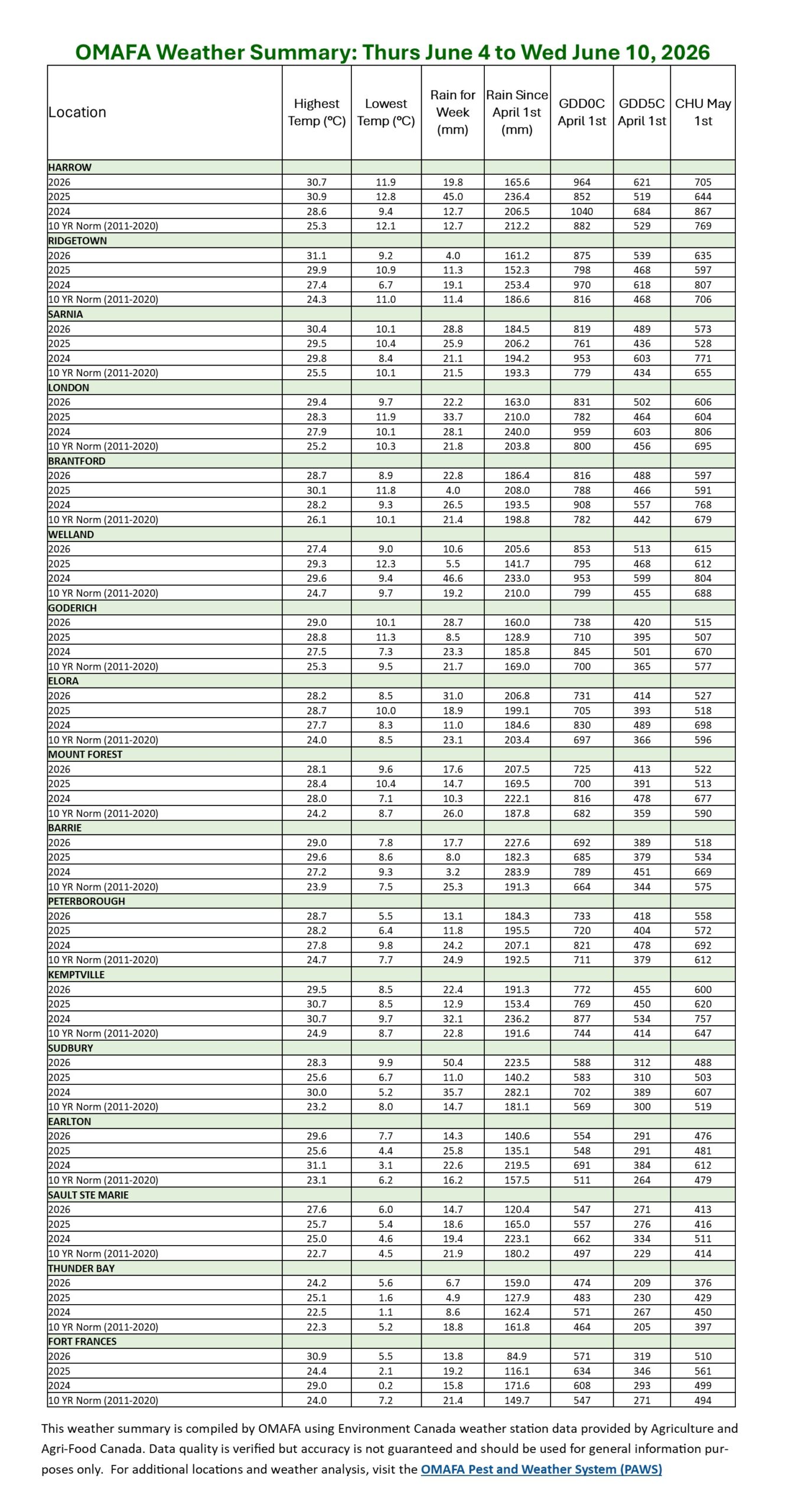
Overview
Crop progress across Ontario has advanced significantly over the past two weeks, with most regions wrapping up planting and moving into early-season crop management. The majority of the province has received rain in the past week.
Crops are generally progressing well. Variable emergence is evident in some heavy-textured soils where late May rainfall resulted in crusting and in other regions where dry soil conditions impacted emergence. Crop stages vary significantly depending on planting date and local weather, but development overall has accelerated with recent heat. Most growers are now focused on weed control, nitrogen application in corn, and monitoring disease and insect pressure in wheat and protecting yield potential.
Corn
Final acres are being planted on clay soils this week where conditions permit. Corn planting is effectively complete across the lighter soils, and crop stage generally ranges from V2 to V5.
Emergence has generally been uniform, though some uneven corn stands and re-plants have been reported in heavier soils that were planted ahead of the May 23rd heavy rain. In contrast, corn planted more recently into warmer soils has emerged quickly and evenly. Thin stands have been reported in some eastern regions due to cool soil conditions at planting, but replanting has been minimal overall.
Potassium deficiency symptoms are visible in some fields in both the southwest and eastern Ontario, particularly where starter rates were low. Sidedress nitrogen application is happening, particularly in more southern parts of Ontario. Early pre-sidedress nitrate test (PSNT) values tin the southwest report adequate to higher-than-expected nitrogen levels.
Soybeans
Soybean planting is nearly complete, with some areas fully finished. Growth stages range from emergence to first trifoliate. Generally, the crop is off to a good start. Many soybean growers are now transitioning to post-emergence weed control.
Late May rainfall followed by dry conditions led to crusting on some heavier soils, which has required replanting on some acres, particularly in southwestern Ontario. In other regions, residue, variable moisture, and slug pressure have contributed to uneven stands on some acres. However, most fields have acceptable populations. Seed corn maggot injury has been noted in some slower-emerging fields.
The 2026 growing season is seeing a larger acreage of identity preserved (IP) soybeans and with it comes more complicated weed control. Effective weed control in IP soybeans is based on a solid residual-based pre-emergent herbicide program combined with diligent scouting and early control of weed escapes.
Winter Wheat
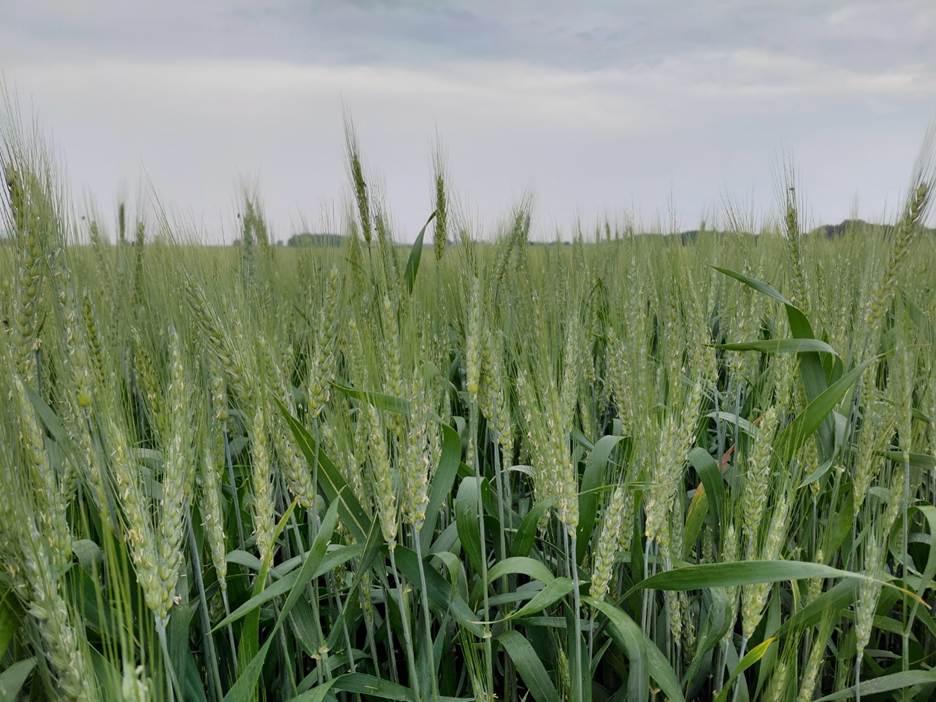
Winter wheat has progressed to flowering across southern Ontario (Figure 1), with T3 fungicide applications either recently completed (in most southwest areas of Ontario), underway, or just about to begin. Fields in lower heat unit regions are still in the early boot to heading stages with fields in northern Ontario in the stem elongation phase.
Yield potential remains strong, with high head counts reported in fields. However, crop development is slightly accelerated in some regions, and if forecasted heat occurs it could impact the grain fill period.
Stripe rust has spread across much of southern Ontario, and timely fungicide applications are critical to protect against this disease. There are reports of wheat streak mosaic virus and barley yellow dwarf virus in a number of winter wheat and barley fields across southern Ontario.
Cereal leaf beetle has reached threshold in some fields and should continue to be scouted for into the heading stages. True armyworm moth counts in the Great Lakes and Maritimes Pest Monitoring Network (GLMPMN) traps have increased in the past two weeks but continue to remain lower than numbers in neighbouring states. Continued scouting remains important.
Spring Cereals
Spring cereals are well established and progressing through early vegetative stages in the south, and just emerging in some northern regions. Herbicide applications are largely complete, and most nitrogen topdress applications are finished or nearing completion. Dry conditions have limited disease pressure so far, and fungicide use has been minimal.
Edible Beans
Edible bean planting is nearing completion. Establishment conditions have been mixed, with dry seedbeds slowing emergence in some cases. Early-planted fields have emerged and variability between market classes has been noted. Weed management programs are underway as crops reach appropriate stages.
Canola
Spring canola is still being seeded in northern regions such as Temiskaming, North Bay and Manitoulin. Winter canola is at full bloom (eastern Ontario) to various stages of pod fill across the province. It is recommended to scout for Cabbage Seedpod Weevil, as it has been found above threshold in some winter canola fields.
Forages
Forage harvest is well underway. First cut is complete or nearing completion for many dairy producers, while others are starting based on weather and logistics. Yields are variable, with generally good quality but below-average tonnage in some areas.
Harvest of winter cereals such as cereal rye and triticale has wrapped up, with double-crop soybeans, corn, or alternative forages like sorghum-sudangrass being seeded. Low forage inventories remain a concern and are influencing harvest timing and cropping decisions.
Pasture regrowth has been limited in drier areas or where early grazing occurred. Insect pressure has been low.
Weed Control
Weed control programs are actively underway across the province. Limited rainfall in some regions has reduced the effectiveness of some residual herbicides, leading to increasing weed escapes. Fields with residual programs still show improved control compared to those without.
Post-emergence applications are in progress across crops and are being timed around other priorities such as T3 wheat fungicide applications. Tank-mix performance and antagonism are important to consider, particularly for volunteer corn control where the highest labelled rates may be required.
Weed pressure varies by region, largely reflecting moisture patterns. Continued scouting and timely applications will be essential as crops approach canopy closure.
Upcoming Events
Mark your calendars for the following events:
- July 7 & 8, 2026 – Southwest Crop Diagnostic Days – University of Guelph, Ridgetown Campus. Please visit the event site for more details or https://www.uoguelph.ca/ridgetown/diagnostic-days.
- The Winchester Research Station is hosting a Field Day June 30th at the station. Details & registration can be found at eocac.ca. Registration closes June 22nd.
- July 28, 29 and 30, 2026 – Northwest Ontario Ag Tour and Diagnostic Days (Emo, Rainy River, Thunder Bay)
Cobourg Breakfast Meeting – Wednesday, June 9, 2026
Wheat
- Most fields are somewhere between just heading out (GS 50) and early flowering (GS61). T3 fungicide applications have started. Protecting the crop will be important with the hot, humid forecast this week, although that same weather may make spraying difficult (thunderstorms expected).
- Stripe rust is confirmed in almost every county west of Toronto, so growers here should be scouting for it.
Forages
- Fall rye and winter triticale harvest is wrapping up. Late-seeded fields are starting to head out. Yields are variable.
- Dairy first cut is mostly complete. Some non-dairy producers took first cut during the first week of June. This slightly early cut date may have been motivated by low forage inventories, a good weather forecast, or both. Expectations are for good quality but lower-than-normal yields.
- Pastures that were grazed in late April/early May have limited regrowth. Rain is needed to bring them on.
- Alfalfa weevil pressure is very low this year. No reports of potato leafhopper yet.
- For hay growers trying to negotiate a price with buyers: Publication 60: Field Crop Budgets has a partial hay budget that can help growers determine their break-even price. The more of a farm’s own numbers they use, the more accurate the result. Use estimated or actual yield to convert the cost per acre into cost per tonne or per pound.
Corn
- Harvest 2025 is (still) ongoing. Controlling volunteer corn from hybrids that had a below-ground Bt trait against corn rootworm is essential. Volunteer corn contains a lower dose of Bt, which makes it easier for corn rootworm to overcome. More information can be found on the Canadian Corn Pest Coalition website.
- Planting is estimated at about 95% done.
- Early planted corn is about 3 to 4 leaf stage.
- Some of the earliest planted fields didn’t emerge for nearly a month, but emergence is still fairly uniform, and the crop looks better than expected.
- Some corn that went in after the May 23rd rain smeared the sidewalls, and those fields are showing stress.
- Herbicide applications are underway, might need to pause to get T3 fungicide on wheat.
Soybeans
- Planting is estimated at 75-90% done.
- The most advanced beans are at first trifoliate.
- Some crusting has been noted, especially in the northern areas of Kawartha Lakes.
- Herbicide applications are underway, might need to pause to get T3 fungicide on wheat.
- There is a large increase in IP soybean acres in the region.
Edible Beans
- Planting is wrapping up on white, black, and adzuki beans.
Upcoming Events
- June 30th: Eastern Ontario Crops Diagnostic Day at the Ontario Crops Research Station – Winchester. Pre-registration is required.
- July 9th: Forage Expo in Norwood. Details are on Ontario Forage Council’s website.
Mt. Forest Breakfast Meeting – June 10, 2026
Cereals:
- Staging
- Locally, winter wheat is just heading and is at or very close to extruding anthers, T3 fungicide applications will be applied soon
- Timing may catch some off guard – wheat is more advanced than some may be expecting. Be ready for T3 applications.
- In more southern areas of the range covered by reps (e.g. London) wheat is headed and flowering, T3 fungicide applications have been underway
- Disease
- Strip rust is showing up in more fields, and is very present in Perth, Huron, Middlesex, Oxford, Waterloo Counties
- If growing susceptible varieties, it is very important to scout, ramping up in fields with susceptible varieties that have not received a fungicide application… consider moving T3 application to earlier side in susceptible fields where fungicide has not been applied this spring
- Pests
- While most fields are OK, cereal leaf beetle has been showing up at levels above threshold (1 larvae per stem at heading) in some fields, controls being applied in some fields (some isolated fields have had as much as 7 larvae per stem)
- Scout fields prior to T3 fungicide applications to reduce need for additional field passes after fungicide is applied, if control is warranted select products carefully as there are significant differences in pre-harvest intervals
- Armyworm moth catches in trap network have increased significantly this past week – at heading, defoliation losses can have small impacts on yield, but head clipping can be a significant concern – scout to ensure no head clipping is occurring if armyworm are in your fields
- Watch for armyworm While most fields are okay, cereal leaf beetle has reached threshold in some fields and control has been required.
Scout fields prior to T3 fungicide applications to reduce need for additional field passes after fungicide is applied. If control is warranted select products carefully as there are significant differences in pre-harvest intervals
Armyworm moth catches in trap network have increased significantly this past week – Ontario research has shown that defoliation has less of an impact on yield as the crop progresses through grain fill. Head clipping can be a concern and should be monitored for if larvae are found.
Winter Canola:
Corn:
- Planting essentially complete
- Corn stands are generally good
- There are some reduced stands and a bit of replanting, especially for corn planted just prior to the May 23/24 weekend rains and cool spell
- Corn planted after forages is generally looking good
- Most fields look fairly clean from weeds
- A few cases of crop injury observed where herbicide tank mixes
Soybeans:
- Planting progress
- Soybean planting is essentially complete in the area; the odd field still being wrapped up
- Some replants occurring, often fields planted just prior to the wet/cool spell of the May 23/24 weekend or fields that received pounding rains, crusting after planting
- Recent rains have helped thicken up stands in fields where populations were marginal, have avoided some replants
- Some discussion around successfully no-tilling soybeans into heavy corn residue
- Corn stalk management the year before is important, those having good success are generally leaving as much corn stalk in the air as possible, chopping heads are a challenge for no-tilling due to wet soils under a residue mat
- Having a good drill or planter setup for no-till makes a big difference for operations doing it successfully, ability to get good residue free seed placement at proper depth is very important
- Patience is a virtue – don’t expect to be no-tilling soybeans when conventional tillage neighbours are planting soybeans
- With many different herbicide traits on the market now, it is very important to pay extra attention to what traits are in what fields, implications for crop safety but also replant decisions
- Some soybean fields are on the weedy side, going to need to pay close attention to weed control programs, especially for those growing IP soybeans
- Smooth rollers have caused issues with pulverizing and sealing some soils, seems to be making wind erosion and dust worse
- Various reasons for rolling – pushing stones into soils, smoother seed beds for faster planting speeds, excess tillage and/or need to conserve moisture, prevent seedbed drying
- Packer or roller? Some personal preference, others comment packers are more expensive and require more repairs and maintenance
- Growers should be scouting IP Soybean fields 21 days after planting for respray needs
- Volunteer corn expected to be more of an issue in soybean fields where corn stood over winter
Forages:
- Hay has been coming off the last week or so, decent yields, and okay quality
Dry Beans:
- Edible bean planting generally wrapping up, some still going in
- Seemed more difficult than normal to make a good seedbed for edible beans this spring, rough/cloddy/marbly seedbeds and dry weather were making depth and seed placement more important this spring
- Some are needing thorough tillage for herbicide programs (some herbicides can have reduced control if not incorporated 24 hrs after application)
- Moisture has been an issue, some were planting 2” deep but still not into moisture, emergence has been variable – recent rains are well received to help stand uniformity
Manure:
- No comments around manure
Fertility:
- No comments around fertility
Weeds:
- Pay close attention to weed staging for both abilities to control weeds (weeds are growing very fast this time of year) and to minimize yield loss from weed pressure
- talk to herbicide reps if concerned about crop staging/safety when weeds are growing fast (balancing crop stage safety versus weed stage control)
Events:
- University of Guelph Wheat Open House, June 25, Elora
- Southwest Crop Diagnostic Days, July 7 and 8, Ridgetown
- Elora Weeds Tour – July 16, Elora Research Station
- Honeywood Compaction Day – July 16, Honeywood
Ridgetown Ag Business Breakfast Meeting – June 9, 2026
General conditions:
- Ground has turned dry and hard due to lack of rainfall over the past couple of weeks
- Forecast looks to have some scattered showers coming this week
Corn:
- Most corn is currently in V3-V5 stage, with earliest planting ahead of that
- A very small amount of corn has continued to be planted this week, but majority has been completed
- A very small number of replant acres as well
- Some localized potassium deficiency is appearing, earlier than we normally expect to see
- Early Pre-Sidedress Nitrate Test (PSNT) values have come back showing normal to higher than expected values
- Limited rainfall likely means minimal losses have occurred thus far
- Note: PSNT recommendations are not calibrated where fertilizers have been applied, but may provide a general indication of long-term trends
- Reminder to keep PSNT samples refrigerated after sampling, but do not freeze before getting to the lab
- Trend towards more urea applied upfront this spring, sidedress applications may be lower than normal
Soybeans:
- Roughly 95% planted in the southwest
- Most planted fields have emerged rapidly, within 5-6 days
- Earliest are around V1 stage, many are still emerging
- However, replants have begun on heavier clay soils in Lambton, Essex, and Kent
- Thick crust has formed after heavy rainfall in mid-May followed by dry weather
- Seed for replants is still in good supply, although specific varieties may be limited – talk to your seed dealer for more information
- Some feeding by seed corn maggot noted on slow emerging soybeans
Winter Wheat:
- Excellent yield potential
- 75-80 heads/ sq. ft. in many fields
- Staging roughly 4 days ahead on flowering
- Hot days in forecast may shorten up grain fill period somewhat
- T3 fungicides have wrapped up in the southwest over the weekend
- Stripe rust has rapidly spread over the past week, although sprayed fields will be protected
- Variety specific susceptibility, but yield losses of 1 bu/ac/day can occur once lesions are visible
- Cereal leaf beetle is at threshold in Alvinston/Petrolia areas with some producers applying insecticide for control
- Threshold is 1 adult or larvae per stem
- Use of insecticide for control depends on Pre-Harvest Interval on pesticide label
- Wheat streak mosaic virus has been noted, as well as damage from grass sawfly on field edges
Edible beans:
- Planting is ongoing, some producers are waiting for soil moisture before planting
- Earlier plantings have emerged
- Differences in emergence noted between market classes
Weed control:
- Fields have started very clean, but escapes have appeared as there has been a lack of rainfall for residual herbicide activation in many cases
- Still better control with residual herbicides applied than without
- It is important to know corn traits prior to spraying
Wheat Disease Sample Collection and Submission Protocol
Collaborators are requested to collect wheat plant samples exhibiting disease symptoms to support provincial pathogen monitoring, disease surveillance, and pathogen characterization efforts. Whenever possible, collect infected plants or leaves displaying clear and representative disease symptoms. Submission of the entire infected plant is preferred, as it provides greater flexibility for tissue selection, pathogen isolation, diagnostic confirmation, and additional downstream analyses that may support collaborative research and disease monitoring activities.
Each field or sampling location should be placed into a separate paper sample bag or paper envelope. Plastic bags should be avoided, as moisture accumulation can promote tissue degradation and secondary microbial growth during shipment. If samples are wet from rain or dew, allow them to air dry before packaging.
Collaborators are encouraged to submit samples containing any wheat disease symptoms of interest, including stripe rust, stem rust, leaf rust, Septoria, tan spot, bacterial leaf streak, powdery mildew, Fusarium head blight, common root rot, viral symptoms, or other unusual or unidentified disease symptoms observed in the field.
The following information should be clearly written on each sample bag or included with the submission:
- Collaborator/surveyor name
- Collection date
- GPS coordinates or nearest town/location
- Crop species and variety (if known)
- Growth stage (preferably Zadoks scale)
- Previous crop and tillage system (if known)
- Fungicide application history (product and timing if known)
- Disease observed
- Approximate disease severity/incidence
- Any notable field observations (e.g., drought stress, lodging, mixed infections)
This information is important for tracking pathogen distribution and disease development across production regions. Samples should be shipped as soon as possible after collection to preserve pathogen viability for isolation and characterization work.
Sample Submission information
Shipping Address:
Gursahib Singh
University of Guelph – Ridgetown Campus
120 Main Street East
Ridgetown, ON N0P 2C0
Note: Please clearly label the package with “Plant Samples – Wheat Disease Survey” to ensure proper routing upon arrival.
Sample Drop-Off Information
Animal and Poultry Science Building
University of Guelph – Ridgetown Campus
Phone: 437-430-8682 (Elham Pourkhorshid)
Email: zpourkho@uoguelph.ca
Note: Please contact us a few hours in advance if you are planning to drop off samples.
Northern Ontario Breakfast Meeting – Wednesday June 10, 2026
Colin Elgie (OMAFA Soil Fertility Specialist) delivered a presentation on patterns, causes, and diagnosis of nutrient deficiencies in field crops.
- Common deficiencies observed are:
- Sulphur deficiency in wheat on sandy knolls
- Nitrogen deficiency in cereals caused by inconsistent fertilizer application equipment.
- Potassium deficiency in corn caused by dry conditions.
- Phosphorus deficiency in corn planted after a non-mycorrhizal crop like canola.
- Other causes of nutrient deficiencies:
- Waterlogged soils, nutrient interactions, and compaction.
- Scouting within the growing season and tracking deficiency prone areas each year can optimize nutrient deficiency corrections with targeted management.
Christine Brown (OMAFA Field Crop Sustainability Specialist) presented on maximizing the value of manure.
- Nutrient values vary based on livestock type and feed quality, so it is encouraged to use farm-specific manure analysis over provincial averages.
- The Organic Amendment calculator is a valuable AgriSuite tool to aid in calculating manure value and available nutrients based on user inputted manure source, application timing, method, and incorporation timing.
- Compare the nutrient value of different amendments such as compost, biosolid pellets, and wood ash to determine if the nutrient is well-priced for the fertilizer needs of a specific field.
- Maximizing economic return and reducing environmental risk with manure involves following the 4R (rate, time, source, place) approach and using well-calibrated application equipment.
Temiskaming:
- Reported that 95% of crop is planted with good weather in late May that enabled planting.
- Some canola is being seeded.
- Earlier planted crops emerged in the first week of June.
- Some heat and drought stress observed in the earlier emerged cereals.
- Winter wheat is variable in the area with some high levels of winter kill.
- Alfalfa is in early bud stage.
- Winter forages were booting in the first week of June.
Thunder Bay:
- Seeding largely wrapped up by the end of May with 95% of the crop planted.
- Most crop stands look good.
- Lots of manure and fertilizer being applied.
- Spring cereals are just emerging.
- Timely rains in the district.
North Bay:
- Most of the crop is planted
- Canola still being seeded.
Manitoulin:
- Most of the crop is planted.
- Some canola and black beans still to be seeded.
Nipissing:
- Was dry but got rain on the June 6 weekend.
- Most of the crop is planted.
Arnprior Breakfast Meeting –
Tuesday, June 9th, 2026
Winter Cereals:
- No more confirmed cases of stripe rust, but there are reports of Barley Yellow Dwarf Virus
- Some speculation as to a correlation between early planted wheat and increased Barley Yellow Dwarf Virus
- Most acres are at or approaching Day 0 for T3 fungicide timing, and are anticipated to go on in the next few days, depending on rainfall
Spring Cereals:
- Most herbicides are on – many applied before temperatures got very hot.
- Some Nitrogen topdress has been applied but not 100% done
- Not a lot of T1s for spring cereals – neither planned nor applied with the drier weather lately.
- Some peas planted locally, and are planned to go right to maturity
Winter Canola:
- The few acres that survived winter/early spring are in full bloom this week.
Spring Canola:
- Frost damage a few weeks ago created some replants, and those replanted acres are reporting some slug pressure and damage.
- Slug pressure is directly tied to residue; those areas or fields needed an additional tillage pass.
- Acres that did survive frost damage are looking really good.
Forages:
- Triticale is done and beans are in to follow it
- Some peas, oats into chopped fall rye as another feed/green chop. The rye is ready to cut already, and then planning to plant sorghum into the chopped stand to make more feed, especially with inventories being low.
- First cut is anywhere from not started to 100% done. Dairy farmers are wrapping up or are done – lots of good weather has been conducive to cutting and chopping. Some other growers are waiting on custom harvesters and expecting that soon, while others are choosing to wait until later in the month.
Corn:
- 100% planted
- There are some acres that didn’t germinate with cold soils – not at damage levels to replant, just thinner stands.
- 4 collar corn on light ground, while clay is 2-3 collar
- Corn that was planted to 2” emerged faster and more evenly than 2.5” corn.
- Corn with a lower starter fertilizer rate is seeing lower leaves yellowing off – likely potash deficiency. Not a huge concern, since we got rain, but would have been an issue without rains this weekend.
- Seeing an increase in tillage this spring to manage residues. Corn residue is continually a problem no matter the crop the following year
Soybeans:
- Soybeans are pretty much done too, unless some beans are still to go in after first cut
- Variability with residue and slugs in bean emergence, but not likely enough to worry about replanting. Growers are encouraged to check fields as they emerge the next few days.
- Some beans are still emerging, while others are unifoliate, or just approaching first trifoliate
- IP soybeans still a few acres going in. Most IP soybeans got a pre-emerge herbicide, and any ones that went on early were quite effective.
Weed control:
- Some of the pre-emerge on corn acres are seeing a bit of weed pressure, if they didn’t get an activating rain and are anticipating needing a second pass before canopy.
Events:
- Winchester Research Station Day – Tuesday, June 30th. Registration closes June 22nd. More information can be found at eocac.ca
- July 18th TractHer (open to OFA members) and Kids Safety Day (open to everyone) in Renfrew County, aimed at how familiarizing women with various farm implements and operating them, or knowing how to move them in emergency situations. Information is available on the Facebook Page/Event
- August 13th at the Ottawa Innovation Farm, Ontario Soil Network is hosting a field day showcasing drone seeding, row cultivating robots, biologicals, AI, etc. More info will be available through Ontario Soil Network coming soon.
- A reminder to consider safety protocols going forward – check fire extinguishers, ensure they’re on equipment & charged, have 911 signs visible and fire protocols in place. Apps like What 3 Words are good to have set up in case of emergency situations in remote areas (i.e. middle of a large field) and can allow emergency services to find you easily (free download).