
The 2025 growing season was challenging in many parts of Ontario, mainly due to moisture stress. Outcomes varied tremendously by region and from field to field. Some growers in central Ontario had complete crop failures, while other regions had above average yields. Acres dropped by 7% to 2.865 million acres compared to 2024. The provincial average for 2025 was 45.7 bu/ac which is down 10% from a 5-year average of 51 bu/ac. The Agricorp floating claim price was $13.5823/bu. Approximately 24% of soybeans grown in Ontario were non-GMO this year.
Growing Season
Early seeded soybeans were slow to emerge due to cold conditions. Seed corn maggot, cold soils, and crusting resulted in lower plant stands in many fields. Most soybeans were seeded during the month of May which is normal in Ontario. A few growers were forced to delay seeding until June.
Serious moisture stress impacted large parts of the province during the summer, especially in central and eastern Ontario. In the most affected regions, crop stress manifested as stunted growth, poor pod set, and reduced yields. Some fields failed entirely in the worst hit regions. Conversely, southwestern Ontario, which received more favorable moisture fared better. There, soybeans developed normally, with robust yields and fewer signs of drought-related plant stress.
Harvest Losses
Soybean harvest progressed relatively quickly this fall, aided by dry, warm weather. By mid-October most soybean fields were harvested. For some growers it was so dry that seed moisture levels dropped well below normal, reaching as low as 8% at harvest. Because yield is calculated at a standard 13% seed moisture, harvesting at lower moistures results in significant yield losses. Harvesting soybeans at 8% moisture results in a 5.4% yield loss purely from reduced seed weight. At 9% moisture the loss is 4.4%, at 10% moisture it is 3.3%. For example, a 60 bu/ac crop harvested at 9% moisture effectively becomes 57.4 bu/ac due to moisture-related shrink.
Conversely, delaying harvest because of poor field conditions can result in even greater losses. A University of Wisconsin study examined harvest delays of 2, 4, and 6 weeks later than the first possible harvest date. Although results varied by year, the three-year averages showed yield reductions of 2%, 5.4%, and 7.8%, respectively. This means a 60 bu/ac crop left in the field for an additional six weeks dropped to 55.3 bu/ac. These losses are primarily due to pod shatter and stem breakage. In severe weather conditions losses can be even higher.
New Soybean Maturity Group (MG) Recommendation Map
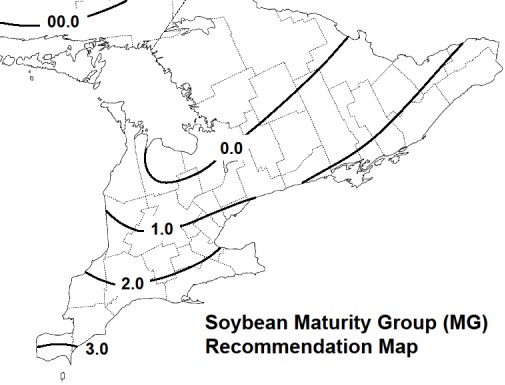
In 2025 an updated Soybean Maturity Group Recommendation Map was approved for Ontario. See figure 1. This map provides a general maturity guideline to optimize soybean yield potential. This map is based on the current varieties grown in the Ontario Soybean Variety Trials. Not all varieties available for sale in Ontario are tested in these trials. Planting date, individual variety characteristics, field elevation, soil type, desired harvest date, and other local parameters must also be considered. For example, when planting very early, a higher MG may yield more. Conversely, when planting extremely late (past the production insurance deadline) or in a double crop situation, a lower MG is recommended. Variety trial performance results can be found at GoCrops.ca. “Go Crops” stands for Growing Ontario Crops.
Figure 1.
Double Crop Soybeans
Double-cropping soybeans is becoming more common in Ontario. Traditionally, growers double cropped mainly after winter barley or pea harvest. Now, in southwestern Ontario, double cropping after winter wheat is also being attempted some years. Successful double cropping depends on seeding soybeans by early July, having sufficient soil moisture for rapid germination, and an open fall ensuring that plants can mature before a killing frost.
Selecting short-season varieties (low maturity group, MG) is critical to success. The variety chosen should be at least one full MG earlier than the area’s adapted recommendation (figure 1). Ongoing research aims to identify the most suitable varieties for different regions of Ontario when double cropping. Seeding an adapted variety in July is often unsuccessful.
Double cropping in areas with less than 2800 Heat Units is risky and seeding after July 10th is often unsuccessful. However, in 2025 some growers obtained good results even when planting in mid-July and in shorter season areas. For example, a trial at the Elora Research Station planted on July 11 yielded between 35 and 46 bu/ac depending on the variety planted (0, 00, and 000 MG varieties).
Two spotted spider mite (TSSM)
Infestations were widespread this year in Ontario. Samples were collected from 74 fields to test for resistance to dimethoate and other miticides at Western University. Though not all the results are in, 8 out of the 10 samples sent from eastern Ontario were found to be resistant. This was a surprising find, given that TSSM infestations have been rare in that region over the last several years. This indicates that dimethoate resistance as well as tolerance to other miticides continues to build in TSSM populations in Ontario. Not every field is guaranteed to have resistant populations so if you find TSSM in your fields, contact Tracey Baute, OMAFA so that samples can be taken for testing. This research will continue, helping to build our understanding of these TSSM population dynamics, while also exploring novel approaches to control. This includes the viability of using biological controls applied via drones and RNAi sprays.
Japanese Beetle
Japanese beetle feeding was relatively high in 2025. Soybeans leaves, stems, and pods are an ideal food source for these beetles. Most years, the amount of feeding does not warrant control but, in dry years it’s not uncommon to find individual fields that reach thresholds. This insect is easy to identify by it’s bright, metallic-green head and coppery wings. See figure 2. Japanese beetles leave a distinctive “skeletonized” or lace-like appearance on damaged leaves. The Ontario Crop Protection Hub which can be found online is OMAFA’s official crop protection resource to find pest management options available for this and other pests.

What’s happening with herbicide-resistant weeds in Ontario?
Both the number of herbicide-resistant weed species and the number of herbicide groups to which they are resistant continue to rise. This trend is driven by repeated use of the same herbicide modes of action, which accelerates resistance development. New species arriving from other regions, such as Palmer amaranth, add to the challenge. Some cover crops, like Italian ryegrass, have also become problematic weeds; glyphosate-resistant (Group 9) populations are now confirmed in Ontario, making control more difficult.
What trends are most significant for Ontario Soybean Growers?
Resistant species identified during the 2025 season in soybeans include:
1) Waterhemp – over 40 new populations confirmed
2) Group 14 resistance (e.g., Reflex, Eragon LQ) – common ragweed, green pigweed and redroot pigweed.
Multiple-herbicide resistance is becoming common, limiting control options for soybean growers. Waterhemp is the most significant example, with populations resistant to five herbicide groups (2, 5, 9, 14, 27) confirmed in 19 counties across Ontario. Multiple resistance also occurs in common ragweed, pigweed species, and Canada fleabane.
Palmer amaranth, though not widespread in Ontario, has been detected in Lambton and Stormont, Dundas & Glengarry in 2025. See figure 3.
Globally, it is highly competitive and resistant to up to six herbicide modes of action, posing a severe yield risk.
Figure 3.
