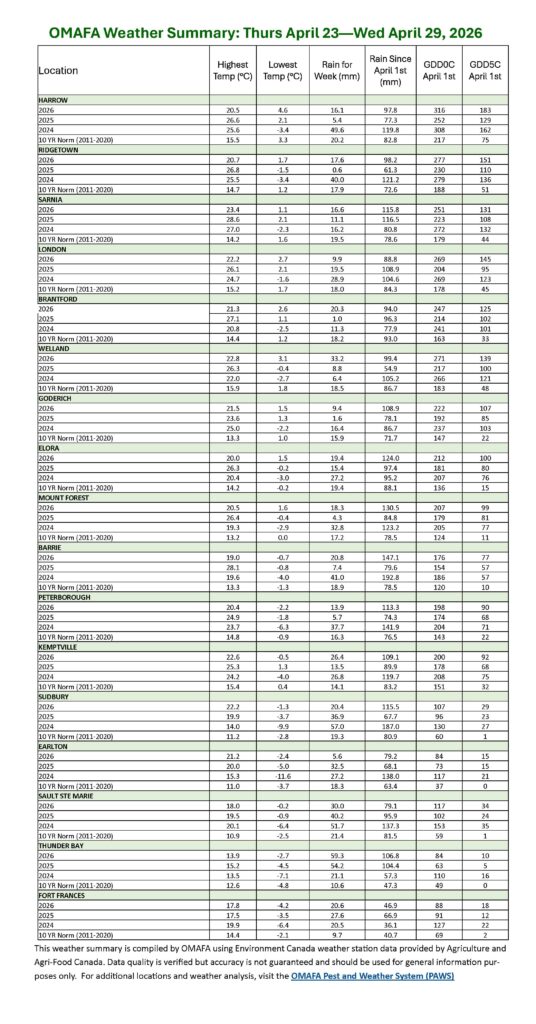
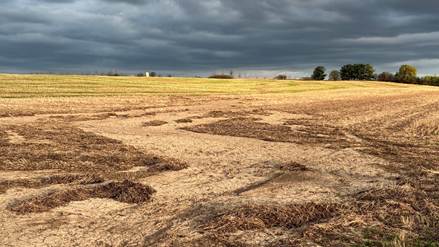
Weather conditions: Seasonal temperatures and relatively good drying conditions allowed fieldwork to begin in some regions. Nitrogen application on wheat, fertilizer applications and tillage on lighter soils, and planting of spring cereals, new forage seedings and even corn all began as soil conditions permitted. Manure application, some from storages near capacity, was evident by smell throughout the countryside. Evidence of heavy rain events earlier in April are visible with significant soil erosion and residue accumulation in areas where ponding occurred (Figure 1). Accumulated GDD (growing degree days) in most regions of Ontario are ahead of last year and the 10-year average.
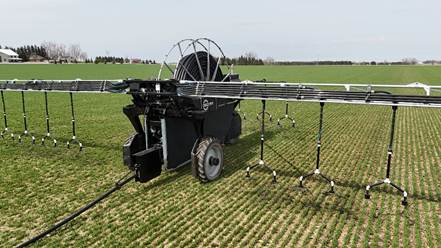
Cereals: The winter wheat crop ranges between first node (GS 31-32) in the southwest to tillering (GS 22-GS26) moving east and north. Overall, the crop looks good and uniform, but thinner stands have been reported in later planted wheat. PGR (plant growth regulator) applications are planned for the earliest fields within the next week. Nitrogen application to winter wheat fields was in full swing late last week ahead of forecast rain. Approximately 70% of the nitrogen and sulphur has been applied in southwestern Ontario and up to 90% in eastern Ontario. Wet soils have delayed applications on heavier clay soils. On a few fields still too wet for wheel traffic, drone application of nitrogen was done successfully.
Manganese deficiency is appearing in several locations, earlier than expected considering wet conditions. Leaf diseases, specifically stripe rust, septoria and powdery mildew have not been found yet, likely due to frequent low night temperatures. Overnight forecast temperatures in the low single digits require careful consideration for application of crop protection products, including limiting tank mixes to two products and keeping the water volumes high (20 gal/ac). Avoid application if the crop is stressed or growth is slow from cold temperatures prior to, on, and after chosen application date. Speak to your crop protection manufacturer representatives or retailers for more information on the products you are applying.
Spring cereal planting is about 90% complete in eastern Ontario and new forage seedings about 50% planted. Few spring cereal acres have been seeded in western Ontario.
Winter Canola: The crop looks good for the most part, although more injury than in wheat, probably due to dry conditions at planting, resulting in delayed fall development followed by wet, cool soils this spring. Earliest fields are starting to flower. In eastern Ontario canola acres are limited and winter survival is low. Cabbage seedpod weevil populations have reached threshold in some Essex and Chatham-Kent fields. The threshold for chemical control is 25 to 40 weevils per 10 sweeps during early flowering stages (10 to 20%). For more information and scouting techniques, refer to recent Field Crop News alert (Alert – Cabbage Seedpod Weevil in Canola in Southern ON Counties – Field Crop News).
Corn: A relatively small amount of corn acres has been planted on lighter soils as conditions permit. Concerns about forecasted cold rains causing cold water imbibition for seeds resulted in some growers waiting a few days. Dilemmas about whether to plant should consider farm acreage planting commitments, soil texture and soil conditions to help weigh the risk of early planting issues relative to the risk of potential yield reduction with planting after May 24th. Planting into fit soils is the best way to set the crop up for success. In recent corn planting date research conducted by Dave Hooker, corn planted May 15-20 had net returns of about 95% of maximum while corn planted May 30 had net returns of about 90%. By May 30, net returns were declining about 2% points per day at Winchester and Elora and 1% point per day at Ridgetown.
There is still a fair bit of corn to harvest in Ontario. Managing volunteer corn in these fields is especially important if the 2025 crop had below-ground Bt traits for corn rootworm protection. The volunteer plants contain Bt at a lower dose than their parent hybrid, which speeds up the development of Bt resistance in corn rootworms. Corn rootworm is an adaptable pest that develops resistance to management tools very quickly. Currently there are only a few options to manage corn rootworm. More information on Bt-resistant corn rootworm can be found on the Canadian Corn Pest Coalition’s website.
Soybeans: Very few acres of soybeans have been planted to date. There are some seed quality concerns especially where soybeans were harvested from areas with prolonged dry weather. Check seed tags for Certified #1 versus Certified #2 seed, and discuss with seed reps whether seeding rates need to be adjusted or if other options need to be considered.
Forages: Forage inventories are variable across the province but tight in areas that experienced drought last summer. Where forage inventories are tight, check quality to ensure to make the best use of what’s available. Alfalfa winterkill in central Ontario is higher than normal largely due to wide temperature swings in April combined with wet soils.
Snout beetle activity is reported in Perth (eastern Ontario) with thriving populations. Scouting alfalfa fields for snout beetle is essential to avoid spreading them to other fields. Thorough cleaning of equipment between fields, crop rotations that limit alfalfa to a few years and storing first cut for at least 2 months before shipping hay will help to limit the spread of the beetle.
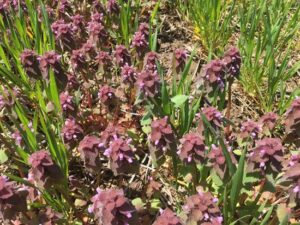
Weed Control: Weeds are growing rapidly with dandelions beginning to flower. Ragweed, Lambsquarters and sow thistle are thick in some fields and growing well, as weeds get bigger, they become more tolerant to herbicides, sometimes requiring higher herbicide rates. Chickweed, purple deadnettle, henbit and pennycress are thriving in high populations on unsprayed fields. Scentless Chamomile has also been difficult to control. Control at the rosette stage is most effective with fall or very early spring herbicide applications.
![Scentless chamomile has been difficult to control this spring.[DN1]](https://fieldcropnews.com/wp-content/uploads/2026/04/image-3-300x200.jpeg)
Agricorp: Producers are encouraged to report damage when it occurs. A damage report does not always mean a claim will be paid. Until May 10th, un-insured winter wheat can still obtain production insurance without winterkill coverage.
Upcoming deadlines:
- April 30 – apply for AgriStability
- May 10 – apply or change coverage for Production Insurance or RMP: Grains and Oilseeds. Premiums are due for Forage Rainfall coverage.
- Uninsured winter wheat can still obtain Production Insurance without winterkill before May 10
Ridgetown Breakfast Meeting: April 28, 2026
Cereals:
- Overall, winter wheat looks very good in the southwest
- Further north and east shows somewhat worse, with holes in more fields
- Late planted wheat looks much worse off than early or normal planting windows this year
- Winter wheat now mostly at GS 31 or 32
- Accumulated GDD ahead of 10 year average and 2025
- Nitrogen and sulphur applications are ~ 70% completed, wet conditions have delayed application on heavier clay soils
- Manganese deficiency is appearing in several locations, earlier than expected considering wet conditions
- Very little incidence of leaf disease noted
- Cold overnight lows in the forecast mean careful consideration necessary for crop protection application
- Stick to 2 products or less of herbicides, fungicides, PGRs, foliar fertilizers in a tankmix
- Keep water volumes high (20 gal/ac)
- Avoid application if the crop is stressed or growth is slow from cold temperatures prior to, on, and after chosen application date. Speak to your crop protection manufacturer representatives or retailers for more information on the products you are applying.
Winter Canola:
- Crop looks good for the most part
- Somewhat more injury identified in canola fields compared to winter wheat
- Dry conditions at establishment may have delayed development in fall, leading to issues after turning wet and cold towards winter
- Starting to flower
- Discussion around need for white mould fungicide this year
- Temperatures currently too low for white mould to develop, as the apothecia that eject the spores on host plants require temperatures of at least 10-15°C for 3-5 days paired with wet soil to develop.
- Cold injury may occur from cold overnight temps
- Flowers can abort, and stems can crack and split when temperatures reach -5°C for an extended time; however, canola is expected to recover with compensatory growth and development.
Corn:
- A small amount of acres have been planted on lighter ground in Kent and Middlesex
- Cold rains causing cold water imbibition are biggest risk of planting, more so than cold soil temperatures
- Weigh the risk of planting early compared to the risk of planting after May 24 when yield potential starts to drop off
- If soil is fit, plant on
Soybeans:
- Very few acres planted so far
Forages:
- Cold injury from frost noted in alfalfa and orchardgrass
- Potassium deficiency appearing earlier than normal in alfalfa
Hort Crops:
- Sweet corn, peas, potatoes, carrots, onions, have all been planting steadily
- Frost concerns for fruiting trees in the Niagara region due to cold temperatures forecasted
Weed Control:
- Weeds are growing rapidly, size in winter annuals especially is becoming an issue
- Scentless chamomile has been difficult to control
- Chickweed, purple deadnettle, henbit, and pennycress are thriving in high populations on unsprayed fields
- Dr. Isabelle Aicklen is looking for some field sites for research trials:
- Corn fields with wild carrot issues
- IP soybean fields with herbicide-resistant common ragweed
Agricorp report:
- Total damage reports for Southwest Region are 15 reports for approximately 900 acres
- 83% of those acres reported for winter wheat and canola
- Remainder for early seeded vegetables
- Producers are encouraged to report damage when it occurs. A damage report does not always mean a claim will be paid.
- Upcoming deadlines:
- April 30 – apply for AgriStability
- May 10 – apply or change coverage for Production Insurance or RMP: Grains and Oilseeds
- Uninsured winter wheat can still obtain Production Insurance without winterkill before May 10
Cobourg Meeting Notes
Weather:
- Some warm, sunny days in the past week enabled fieldwork to start in earnest.
- Snow fell in late November 2025 and did not melt until late in March of 2026, so the first jobs on many farms is spreading manure to empty storages.
- Since the ground did not freeze before snow fell, the soil seems to have captured more snowmelt than normal, which should help the region recover from last year’s drought.
Corn:
- Tillage is progressing with the goal to manage crop residue and prepare fields for seeding.
- There is still a fair bit of corn to harvest in the region, most notably in Kawartha Lakes.
- Managing volunteer corn in these fields is especially important if the 2025 crop had below-ground Bt traits for corn rootworm protection. The volunteer plants contain Bt at a lower dose than their parent hybrid, which speeds up the development of Bt resistance in corn rootworms.
- Corn rootworm is an adaptable pest that develops resistance to management tools very quickly, and we have few options to manage them. More information on Bt-resistant corn rootworm can be found on the Canadian Corn Pest Coalition’s website. Some corn planting is just starting on the driest fields.
Cereals:
- Overall, winter wheat looks very good.
- Custom operators are working to get nitrogen onto the crop as quickly as they can, since soils were too wet to apply it any earlier. Keep an eye out for magnesium deficiencies showing up in the next couple of weeks.
- There are some reports of snow mould on fall rye and winter triticale across the region. This is due to fall conditions, where it snowed before the soil froze and the snow cover stayed all winter.
Forages:
- Alfalfa winterkill is also worse than normal, although the damage is more likely to have occurred in April in wet soils with large temperature swings. Fields that were established in 2025 could be overseeded with alfalfa, but any stands older than that will struggle with alfalfa autotoxicity. These fields could be patched with red clover or grass to provide forage this year. Heavily patched fields should be rotated out of alfalfa for 2027 to maximize yield potential.
- Feed inventories across the region are tight due to last year’s drought.
Arnprior Meeting Notes
Fertilizer
- Quite a bit moving this past weekend – mostly hay and wheat, but some early corn ground
- Economics of phosphates moving forward might be a concern – consider seed placing, reduce general broadcast applications, etc. Anticipate moving to TSP this fall, next spring is still dependent on global markets for supply and cost.
Cereals
- Estimated to be 90% done nitrogen on winter wheat. Still a few fields to go.
- Stands are thinner than maybe anticipated, but fairly even
- Later planted fields are just starting to tiller mid-week, earlier ones have at least one tiller
- Not a lot of appetite for T1 fungicides with cooler temperatures and less biomass on the crop. Recommended to continue to monitor for disease pressure
- Spring wheat is estimated to be 80% planted. Eastern Ontario has had a 4-5 day window of good weather, and much of the acres are in.
Canola
- Winter canola is down from last year, even with limited acres, survivability is low.
- For information on herbicide choices in crop rotations including canola, please check out this article on Field Crop News.
- Some spring canola planned, none planted yet.
Forages
- Inventories are all over the map. Consult your agronomist and nutritionist for annual or emergency forage options. It’s best to check on availability of seed for any unplanned annual forages before moving ahead.
- Corn silage is still the highest yielding annual forage, take into consideration when planning
- Alfalfa snout beetle has been found in Perth again, and populations are thriving
- There are reports of some spoilage in baleage put up too dry (dried very quickly last summer). Spoiled feed and lower quality forages from 2025 are a big contributor to inventories being lower than initially anticipated.
- Grasses are coming on slower than normal this year – similar height and staging to alfalfa.
Corn
- A few acres planted, mostly higher and drier ground. Many waiting until after the upcoming rains
Soybeans
- Some soybean acres planted
- Remember to check seed tags for Certified #1 vs Certified #2. If you have #2 seed and/or concerns, please talk to your dealer or seed rep. They will advise on the best options for potential compensation in seeding rates or management
Other
- A reminder to check your Agricorp deadlines
- The Eastern Ontario Research Station day registration is now open at eocac.ca. Join us on June 30th to hear from U.of G. researchers & tour the Winchester Research Station
- A reminder to be safe this spring. You can order children’s sized safety vests at no cost through BASF’s Safety Scouts program.
Mt. Forest Breakfast Meeting: April 29, 2026
Cereals:
- Winter wheat is variable in the region, some great looking fields, some poor or variable fields
- Planting date is a strong driver of wheat condition – early planted (e.g. September) wheat looks excellent, fields being considered for removal are generally October planted, especially fields planted just before rains received mid October, very slow to establish, especially apparent where there are other issues in these fields – drainage, ponding, no starter fertilizer, shallow planting
- Some wheat fields will be patched in with spring cereals – spring cereals mixed with winter cereals are not suitable to be sold for milling wheat, this can have significant consequences for end-users, will need to find feed markets for this wheat
- Some winter wheat fields will be removed, likely planted to corn or edible beans, if any herbicides have been applied growers need to make sure the following crop is suitable to be planted
- There were significant concerns about the potential for stand loss from snow mould, but most are pleasantly surprised that pressure was generally low
- Early planted wheat in the region may be at or reaching jointing stage (e.g. GS31) over the next week, this may be more advanced than some growers are expecting
- Nitrogen application progress is variable
- Last week was very busy week for N applications on wheat in many areas
- Some areas are nearing completion (70-80%) while others have just started or have only put a first split application on.
- Given the crop stage, any N applications at this point will be full rate applications
- Given prices and supply, some growers who traditionally have applied UAN have shifted to urea/AMS this spring
- Those making crop protection applications over the next week or two will need to watch night time temperatures for crop safety, the forecast has many low temperatures around zero or low single digits
Winter Canola:
- Winter canola is variable, some fields look good, others look tough – stands, plant conditions, heaving etc.
- Planting date is very important, canola needs a strong start to survive the winter (8 true leaves and a good taproot are ideal), optimum planting dates are estimated to be 3 weeks before optimum wheat planting dates (e.g. end of August)
- Very dry conditions last summer made fall establishment a challenge
- Important to control volunteer wheat – uses moisture, harbours slugs
- Winter canola acres planted last fall may be approximately 25,000 acres across Ontario
Corn:
- Small amount of corn planted on the lightest/driest soils only, very few acres overall, some only testing equipment, most ground has not been quite fit for planting
- Some questions about switching out of corn given prices, economics, expected planting dates – in Dave Hooker’s planting date research, corn planted May 15-20 had net returns within 95% of maximum, by May 30 net returns were about 90% and dropping about 2% points per day at Winchester and Elora and 1% point per day at Ridgetown.
- Spring harvest of corn that has been left standing over the winter is variable, but standability has generally been good with exception of areas of fields where snow drifted, yields and quality have generally been maintained
- In more southern areas (e.g. Oxford County) most standing corn has been harvested, corn is dry,
- In midwestern Ontario (e.g. Bruce/Grey/Wellington) some areas are only about 50% harvested, corn is not always fully dry (some running 17-19% moisture)
- Growers should know what herbicide traits over-wintered corn had when making herbicide plans to control volunteer corn this year, some corn hybrids may have resistance to some Group 1 herbicides that are commonly used to control volunteer corn
- Corn rootworm resistance continues to be a developing issue, especially in heavy livestock areas with lots of corn-on-corn (Huron/Perth/Wellington), growers are encouraged to develop mitigation strategies before yield loss and standability issues become significant
Soybeans:
- Increase in interest in IP soybeans this year given soybean prices and IP premiums, more interest in IP soybeans than edible beans given the price spread between soybeans and edible beans
Forages:
- Alfalfa is variable in the region, some great looking fields, others have had issues with winter survival, especially older stands
Manure:
- Manure pits getting very full in some areas, applications well underway in areas where growers can get on fields, fewer applications on heavier soils, some are going when dry on top but still quite wet underneath
Fertility:
- These has seemed to be an uptick in soil sampling with the increase in fertilizer prices, seems to be more than normal number of samples coming in at extremes (low or high) – more consistent soil sampling may have helped manage these fields
- Most report that growers will not be reducing fertility rates this year in response to prices, but will be more careful managing fertility applications
- Growers who bought fertilizer in the fall (a large percentage of acres) are less impacted by high prices, growers who only buy in the spring will have the greatest price shock
Agricorp report:
- Soybeans experienced the greatest claims in 2025 with Eastern Ontario being the highest claims area
- Experiencing some claims now with late planted wheat
- Growers trying to finish spring corn harvest to submit final corn yields
- Has been an increase in inquiries about registering for crop insurance this year, expected from very dry conditions last year
- Deadline to register for crop insurance is May 10, do not wait until the last minute
[DN1]Image link for Mike’s Scentless Chamomile picture
OMAFA Weather Summary: Thurs April 23—Wed April 29, 2026