The forage production year starts in the fall, not the spring. How perennial forage crops are managed now helps set them up for 2027.
Fall fertilizer applications assist persistence
Perennial plants “harden off” to survive the winter. The process changes how water is regulated in the plant, to prevent ice crystals from forming inside cells and rupturing them. Potassium (K) is a key nutrient plants need for water regulation. The most economical time to apply potash to forage fields is about a month before the start of the fall rest period (see dates below). Applying K in late summer or early fall ensures that adequate amounts are available when the forage crop needs it the most.
Other nutrients, like phosphorus (P) and sulphur (S) if required, can be applied at the same time as potassium to minimize passes across the field. The rate of P and K required is based on soil test values. Manure is a good source of plant nutrients but often does not provide balanced nutrition to the crop. Just like getting feed tested for a ration, a manure test can tell farmers what nutrients are missing so they can top up the difference with another nutrient source.
In grassy fields, an early fall application of nitrogen (N) will increase tillering. Tillers help fill in small gaps in the stand. This is particularly important after a dry year to help the yield potential recover. A rate of 45 kg/ha (50 lbs/acre) of actual N is enough to encourage tillering.
Avoid cutting alfalfa during the fall rest period
Perennial crops store energy in their roots and lower stems to fuel regrowth when they do not have enough leaves to make sugar. During the growing season, a hay crop draws on energy reserves to regrow after cutting, and refills those reserves once photosynthesis is underway. This stored energy also fuels green-up and early growth in the spring. Forage crops need enough time before a killing frost in the fall to build these early spring reserves. Cutting when the crop has time to regrow, but not enough time to refill the energy storage, weakens the plant. Green-up will be slow in the spring, and yield potential will be reduced.
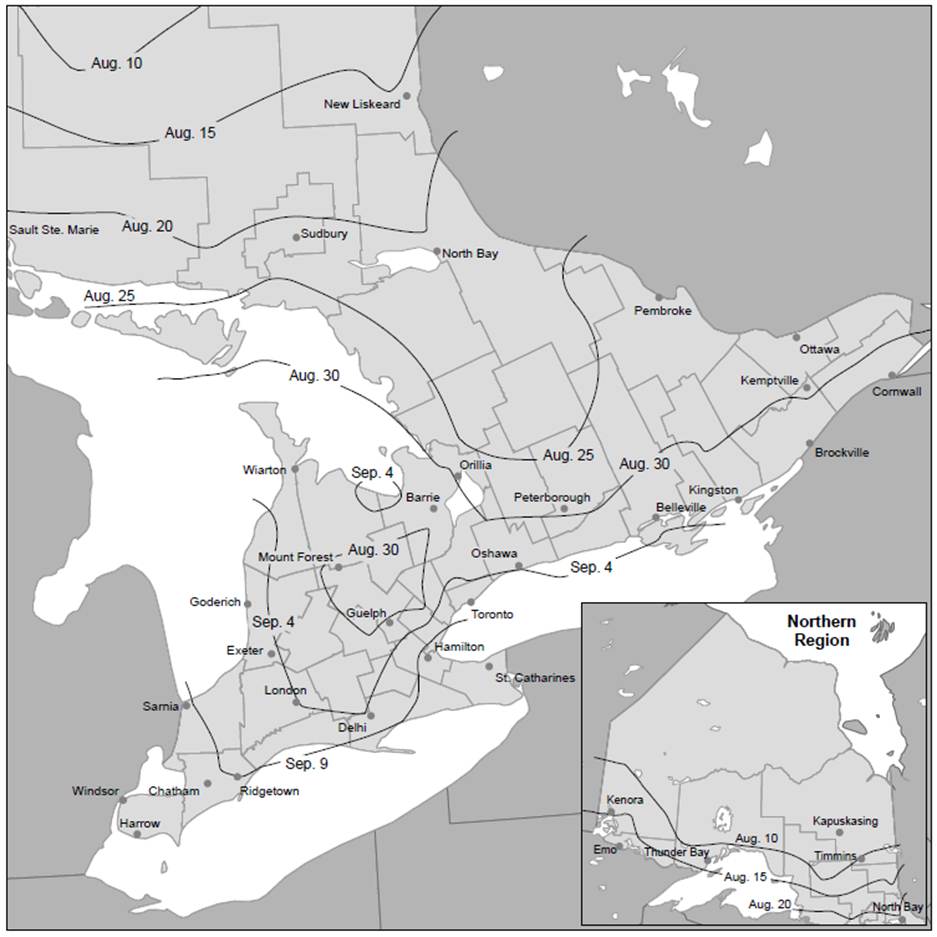
While all perennial forages benefit from rest in the fall, alfalfa is particularly sensitive to being cut at the wrong time. The fall rest period for alfalfa is about six weeks, and the start date varies by location (Figure 1).
If feed inventories are tight and a fall cut of alfalfa is needed to get through to spring, it is best to cut at the very start or very end of the fall rest period rather than in the middle. Expect the next year’s yield to be reduced by about the same amount as what was harvested in the fall. Make sure to follow other best practices for alfalfa agronomy, including good fertility, stand counts, and timely termination, to minimize the impact of a fall cutting on yield potential. Cutting is the stressor farmers have the most control over.
Take a plant count
Since the cost per acre to harvest forage changes very little with yield, maintaining high-yielding hay fields keeps the cost per tonne of forage low. Plant counts are the “early warning system” for declining yield potential in alfalfa. Alfalfa stands naturally thin over time, but since older crowns are larger, they can send up more stems per crown, which maintains yield potential. Table 1 outlines the plant count thresholds. Stands that fall below the minimums should be terminated and rotated to a different crop. Where a range is given, pure alfalfa stands should be at the high end of the range. Mixes with a large proportion of grass are acceptable at the low end of the range.
Table 1. Alfalfa plant count thresholds in plants per square foot, and plants per quarter square meter
| Age of stand | # of healthy plants/ft2 | # of healthy plants/ 0.25m2 |
| New seeding | 20+ plants | 53+ plants |
| Year 1 | 12-20 plants | 32-53 plants |
| Year 2 | 8-12 plants | 22-32 plants |
| Year 3+ | 5 plants | 13 plants |
Fall plant counts also give farmers a benchmark to assess how well alfalfa came through the winter. Repeat the plant count in the spring and compare it to the fall count to determine if winterkill was an issue.
Termination options
There are guidelines available to help farmers decide when it is time to let an alfalfa stand go. These were developed with maintaining high yield potential in mind, so that farmers can rotate fields before they start to struggle to grow enough forage to meet animal demands. Stands with low plant counts should be considered for termination. After 9 to 12 cuts over its lifetime, alfalfa yield and persistence drops quickly, so these fields are good candidates regardless of plant count.
It is easier to terminate a perennial forage stand in the fall than the spring. Systemic herbicides are translocated into the roots with the sugars the plant is moving into storage. Any tillage implement used needs to break the taproot; damaged crowns with an intact root system will still regrow next spring.
OMAFA Weather Summary