Late-Season Soybean Diseases: Diagnosis Matters
As Ontario soybean crops move through grain fill and head toward harvest, the focus of disease management shifts. Instead of protecting yield potential with in-season applications, growers should now be assessing how diseases may affect yield, grain quality, harvestability, and help make management decisions for next year. While the hot temperatures through much of July and early August slowed the development of some diseases, the return of cooler temperatures, higher humidity, and more frequent rainfall across much of the province has renewed concerns about disease activity, particularly tar spot in southwestern Ontario. This season has highlighted how strongly weather influences disease development.
When it comes to soybeans, disease development this season has reflected the wide range of growing conditions experienced across the province. While sudden death syndrome (SDS), soybean cyst nematode (SCN), Phytophthora root rot, Fusarium wilt and white mould have attracted most of the attention, agronomists and growers have identifying brown stem rot and charcoal rot in a number of fields. Phytophthora root rot remains one of Ontario’s most important soybean diseases, particularly in poorly drained areas that experience prolonged periods of saturated soils. Symptoms can range from damping-off and stand loss early in the season to purple-brown stem lesions, root rot, wilting, and plant death later in the year. Examining roots and lower stems remains one of the best ways to separate Phytophthora from other late-season soybean diseases.
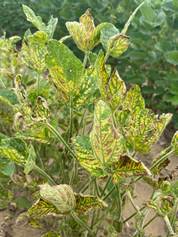
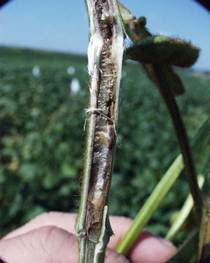
Brown stem rot is noticeable this year and is often overlooked because its foliar symptoms can be nearly indistinguishable from SDS, producing the same yellowing and browning between leaf veins late in the season (Fig 1). The difference becomes apparent when stems are split open. Plants affected by SDS typically have a white pith, while brown stem rot causes a brown discoloration of the pith, which is where the disease gets its name (Fig. 2). Ontario has two strains of brown stem rot and both cause brown pith discoloration, but only one consistently produces the characteristic leaf symptoms. As is often the case with diseases, identification is not always straightforward.
Because SDS and brown stem rot can occur in the same field and cause similar symptoms, proper diagnosis is critical when evaluating variety performance and planning future management. Brown stem rot survives in soybean residue, making crop rotation and variety resistance important management tools. SDS is even more persistent, surviving not only in soybean residue but also in corn residue and soil, where the pathogen can remain for years. Since SDS is frequently associated with soybean cyst nematode, fields showing SDS symptoms should be sampled for SCN after harvest or before the next soybean crop. Knowing whether SCN is present can influence future variety and management decisions.
Charcoal rot is another disease that appears to have benefited from the hot, dry conditions experienced across portions of southwestern Ontario this summer. Although less commons, charcoal rot can contribute to significant yield losses in water-stressed areas and is often mistaken for SDS or Phytophthora root rot. Unlike SDS, Phytophthora root rot, and white mould, which are generally associated with wetter conditions, charcoal rot thrives when soybeans are exposed to heat and moisture stress. Infected plants often prematurely mature, wilt during hot afternoons, and may die before surrounding healthy plants. Lower stems and roots develop a gray to silver appearance, while tiny black fungal structures (microsclerotia) are embedded in crown tissue giving the disease its characteristic charcoal-like appearance.
Adding to the complexity is Red Crown Rot! While it has not been found in Ontario yet, its spread in the Great Lake states has caused concern due to yield losses and spread. Above-ground symptoms are very similar to SDS, Phytophthora root rot, charcoal rot, stem canker, brown stem rot, and severe white mould infections. Premature yellowing, interveinal chlorosis, wilting, poor pod fill, uneven maturity, and early plant death can make red crown rot diagnosis very difficult.
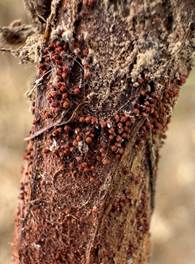
The most reliable identifying feature of red crown rot is found at the base of the stem and on roots, where distinctive red to orange fungal structures (perithecia) develop near the crown of infected plants (Fig 3). Red crown rot highlights the challenges of soybean disease identification. Many diseases can produce nearly identical symptoms from a distance, yet management recommendations differ considerably. Fields affected by SDS may require SCN management, while brown stem rot management relies primarily on resistant varieties and rotation. Phytophthora management focuses on resistance, seed treatments, and drainage improvements. Charcoal rot management centres on reducing crop stress, while white mould programs emphasize canopy management, field history, fungicide timing and variety selection.
As combines begin rolling this fall, growers should take the opportunity to ask a simple but important question: Why did these plants die early? Digging roots and splitting stems can reveal clues that are not visible from the combine cab. Getting the best return from resistant varieties, cultural practices, seed treatments, foliar fungicides, etc starts with knowing exactly which disease is present. Accurate diagnosis this fall will help ensure that management decisions and crop protection investments for the 2027 growing season are both agronomically sound and economically justified.