What role does manure have in increasing soil organic matter?
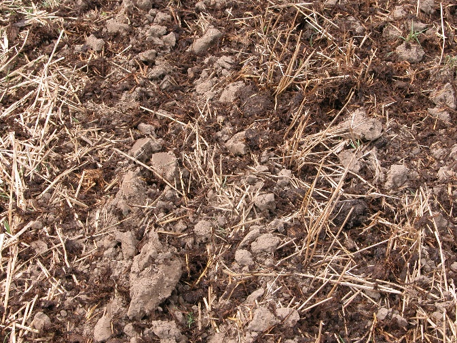
If the soil organic matter (SOM) levels in Ontario soils could be magically increased by 1 percent, the benefits would be substantial. Higher SOM improves resilience to both wet and dry weather conditions by enhancing water infiltration, increasing water-holding capacity, and improving internal soil drainage. These improvements can reduce runoff, soil erosion, and the impacts of weather extremes.
The value of SOM has been demonstrated in long-term field research. In one multi-year study, plots receiving compost every three years consistently yielded more than those receiving commercial fertilizer alone. During a particularly dry June and July, the compost-treated plots produced 27 additional bushels of corn per acre, highlighting the benefit of improved soil water-holding capacity.
A 1% increase in SOM would also improve nutrient cycling, support soil biological activity, help reduce phosphorus losses to surface water, and contribute to carbon sequestration goals. On average, a 1% increase in SOM represents approximately 5.8 tons of carbon per acre stored in the soil.
The challenge is that increasing SOM is a long-term process. Organic matter levels declined over many decades and rebuilding them requires sustained management. Even a 0.1% increase can result in measurable improvements in soil health.
Practices That Build Soil Organic Matter
The following management practices can help maintain or increase SOM:
- Longer crop rotations that include small grains or perennial forages
- Cover crops and winter cover
- Application of manure and other organic amendments
- Reduced tillage and increased residue retention
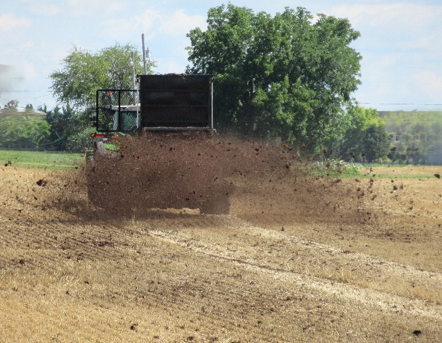
The Role of Manure and Organic Amendments
Applying manure or compost can help maintain or increase soil organic matter, although gains are typically greater when manure is combined with other soil health practices. Table 1; Adding Organic Amendment to Increase SOM by 1 percent vs. to Match Crop Needs, compares several manure types and application rates based on either crop nutrient requirements or the amount required to increase SOM by 1%.
The comparison highlights an important reality: the amount of manure required to increase SOM by 1% in a short period would greatly exceed crop nutrient requirements. Applying manure at such rates would result in excessive nutrient loading and would not be practical agronomically or environmentally.
Manures with a high carbon-to-nitrogen (C: N) ratio, particularly those containing substantial bedding, generally contribute more organic matter to the soil than liquid manures. The bedding supplies additional carbon that can be incorporated into stable soil organic matter over time.
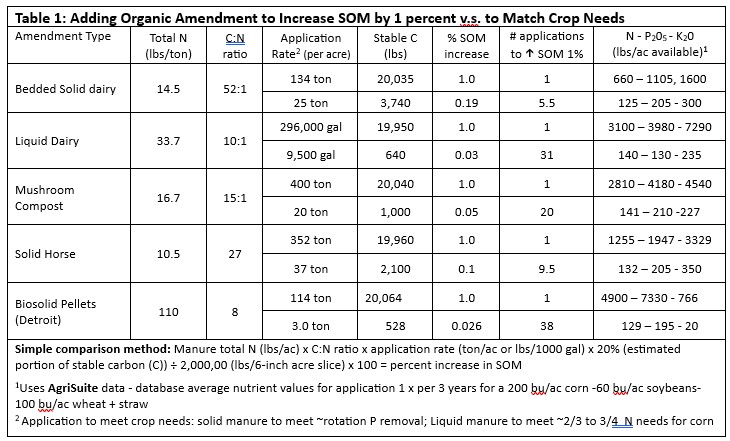
A common question is how much of the organic material added in manure actually becomes soil organic matter. The answer depends on several factors, including manure composition, soil texture, existing SOM levels, microbial activity, and cropping practices. For the purposes of the comparisons in Table 1, several simplifying assumptions are used:
- The top 6 inches of soil in one acre (an acre-furrow slice) weighs approximately 2 million pounds.
- Only about 20-30% of the carbon added through manure solids or crop residues becomes stable soil organic matter.
- The remaining carbon is largely utilized by soil microorganisms as an energy source.
Although adding enough manure in a single application to increase SOM by 1% is unrealistic, repeated applications at agronomic rates can contribute to gradual SOM increases over time. Solid manures with higher bedding content generally provide more stable carbon than liquid manures. At the same time, nutrients supplied by manure stimulate crop growth and soil biological activity, both of which contribute to soil building processes.
Building SOM Through Combined Practices
The greatest improvements in SOM occur when manure applications are combined with other soil health practices. These practices work together to create synergies that increase carbon inputs and support soil biological activity.
For example, manure applications can stimulate cover crop growth, resulting in greater biomass production than either practice alone. Reduced tillage helps preserve soil structure and slows organic matter decomposition, while retaining crop residue returns additional carbon to the soil.
Maintaining and building soil organic matter requires a long-term commitment. Manure plays an important role, but the greatest gains occur when manure is integrated into a broader soil health strategy that includes diverse crop rotations, cover crops, residue retention, and reduced tillage.