2025 Planting Conditions
Winter wheat, barley and triticale planting conditions during fall 2025 were generally favourable across Ontario. While some growers seeded as early as mid-September, the majority of the winter wheat crop was planted during the optimal late September to early October window. Dry conditions through much of September delayed planting in some areas as growers waited for rainfall to ensure adequate soil moisture for germination and establishment. Fall conditions also allowed for growers to make a fall herbicide application resulting in excellent weed control in those fields.
Stand establishment was generally good. Early planted fields went into winter with three to five tillers, while later planted fields were at the two- to three-leaf stage before winter. Overall, the crop entered winter in good condition with strong yield potential.
Acreage
Approximately 1,078,080 acres of winter wheat was seeded (includes SRW, HRW, SWW and organic). The proportion of acres in soft red wheat, hard red wheat and soft white wheat classes for the 2026 crop was similar to 2025 and 2024 with a slight increase in HRW and SWW classes (Table 1).
Table 1: Proportion of Acres Across Winter Wheat Classes
| Wheat Class | Proportion of Acres (%) | ||
| 2026 | 2025 | 2024 | |
| Soft red wheat (SRW) | 90.1 | 91.5 | 91.6 |
| Hard red wheat (HRW) | 6.4 | 5.6 | 5.4 |
| Soft white wheat (SWW) | 2.7 | 2.1 | 2.2 |
| Organic | 0.8 | 0.8 | 0.8 |
2026 Growing Season
Winter wheat emerged from dormancy in spring 2026 in better condition than anticipated given the significant snow cover and cold temperatures. Overwinter survival was strong, with less winterkill, snow mould, and saturated-soil injury than initially expected. Fields seeded within the optimum planting window and those receiving seed-placed phosphorus in the fall generally exhibited stronger stands and higher yield potential. In contrast, later-seeded fields and fields lacking fall phosphorus often showed reduced vigour and weaker spring growth.
Spring conditions were characterized by cool temperatures and frequent rainfall, which slowed early crop development and delayed nitrogen, sulphur, and crop protection applications. Winter wheat development progressed slow and steadily through April, ranging from tillering to first node by month’s end. Due to the cooler temperatures, disease pressure remained relatively low during the early part of the season; however, manganese deficiencies and uneven fertilizer application patterns were observed in some fields.
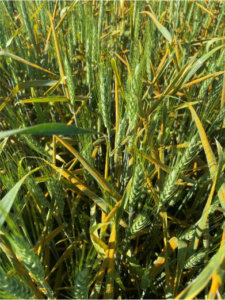
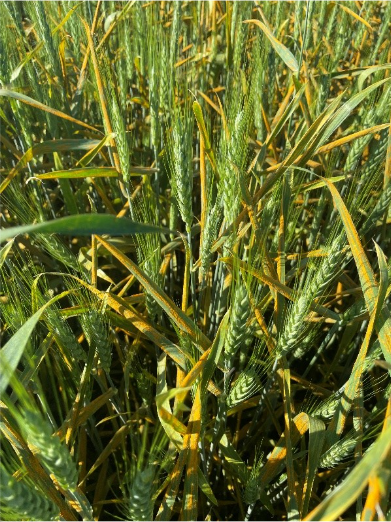
Following warmer overnight temperatures after the May long weekend, crop development accelerated compared to weeks prior. As temperatures increased, stripe rust (Figure 1) was identified in Oxford and Huron counties. By early June, the disease spread rapidly across much of southern Ontario. Growers and agronomists actively monitored susceptible varieties, with many opting to apply a T3 fungicide to manage both stripe rust and fusarium head blight. Moderate levels of powdery mildew and septoria were also observed throughout the season.
Viruses were also more prevalent in winter and spring cereal fields than in recent years. Due to aphids being present in fields in both the spring and fall, barley yellow dwarf virus (BYDV) was reported in many wheat fields and was particularly evident in winter barley and oat fields. Once a BYDV infection has been confirmed in a field, there are little to no control options in-season; however, there are management strategies that can be implemented to reduce the risk of infection. This includes planting within the optimum planting date window, selecting resistant varieties, and controlling the aphids via insecticide seed treatments in fields planted ahead of the optimum planting dates. An insecticide seed treatment for aphid management can reduce the amount of feeding that occurs but will not totally eliminate infection. Wheat streak mosaic virus was also confirmed in some fields during the growing season.
By late May to early June, cereal leaf beetle populations reached economic thresholds in some areas, leading to insecticide applications. True armyworm activity was also monitored closely throughout the season with larvae populations generally remaining well below economic thresholds.
Conditions during flowering and grain fill were generally favourable. Most production regions received adequate soil moisture, head counts were high, and yield potential remained strong. A brief heat event in early June brought temperatures of 28 to 30°C during pollination in some areas. In addition, an extended period of extreme heat from late June through early July likely shortened grain fill, particularly where crops experienced moisture stress.
Spring cereal seeding began in pockets of southern Ontario in mid-April; however, persistent cool, wet conditions in many spring cereal areas delayed spring cereal seeding well into May. Overall spring cereals while slow to emerge, had fairly even and strong stand counts. Growers were able to make timely herbicide and fertilizer applications.
2026 Cereals Harvest
Crop Quality
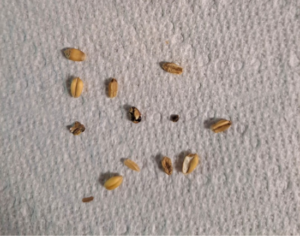
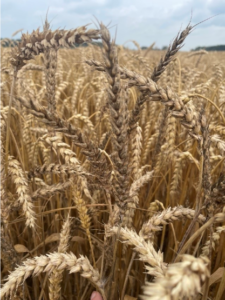
Harvest began with generally positive reports across southern Ontario. Early harvested fields reported good grain quality and average to above-average yields. As harvest progressed into areas outside of deep southern Ontario, yield reports became increasingly variable. Reports of shrivelled kernels, black point, and bunt (Figure 2) emerged in some areas. Significant levels of Alternaria and other black sooty mould symptoms were also observed in certain fields (Figure 3). In addition, concerns regarding premature head death and empty heads were reported, with observations suggesting that wheat midge injury may have contributed to these symptoms in some fields.
Overall, grain quality ranged from good to variable depending on region and local weather conditions during grain fill and harvest. Among the SRW samples received by the Harvest Sample Program at the Canadian Grain Commission, 34.8% were graded No. 1, 59.4% were graded No. 2 and 5.2% were graded No. 3. Mildew was the main reason for downgrading (Quality of Canada Eastern Soft Red Winter wheat in 2026 – Canada.ca).
Yields
Yield potential appeared to be strong throughout much of the growing season due to adequate soil moisture, high head counts and generally favourable flowering and grain-fill conditions. Actual yields generally ranged from below average to average across much of Ontario with considerable regional variability. The impacts of stripe rust, viruses, localized insect pressure (including wheat midge), some heat stress during grain fill, and rainfall during harvest all contributed to this regional variability.
The weighted average yield across SRW, HRW and SWW classes was 95.1 bu/ac (Table 2). Wheat straw yields were good. Winter barley yields were average, and spring cereal yields were variable with spring wheat currently running at 98% of average, oats at 94% of average, barley at 102% of average and spring grain at 107% of average. Cereal rye and triticale silage harvest began in the southwest in late April through early May with yields reported as being good to excellent.
Table 2: Agricorp reported yields in 2026 and 2025 for each winter wheat class as well as the previous 5-year yield average (2021-2025)
| Class | 2026 Yield (bu/ac) | 2025 Yield (bu/ac) | 5-Yr Avg (bu/ac) |
| Soft red wheat (SRW) | 96 | 101 | 99 |
| Hard red wheat (HRW) | 83 | 90 | 91 |
| Soft white wheat (SWW) | 95 | 100 | 98 |
| Organic | 54 | 59 | 63 |
Fall 2026 Planting Conditions
Winter wheat, barley and triticale seeding began in mid-September for those planting after canola, short-season soybeans, and some early-maturing edible bean fields. In most regions, however, winter wheat seeding began in late September and lasted into November in the deep south. Persistent dry conditions through September in some areas resulted in growers waiting for rainfall before planting. Early planted fields are very well tillered with 3-5 tillers per plant, while later planted fields have not yet tillered. Winter triticale, winter barley and rye fields are also tillering significantly and are comparable to last year. Some early planted winter wheat fields have exhibited yellowing and uneven growth. While these symptoms have raised concerns about Barley Yellow Dwarf Virus (BYDV), they are more commonly associated with the transition from seed roots to nodal roots, particularly where soil conditions are tight and root development has been restricted. In these situations, plants may struggle to access adequate nutrients until the nodal root system becomes established. Rust and powdery mildew have also been reported in some fields, although disease pressure has generally remained low. Approximately 1,075,319 acres of winter wheat were seeded this fall.