Soybeans
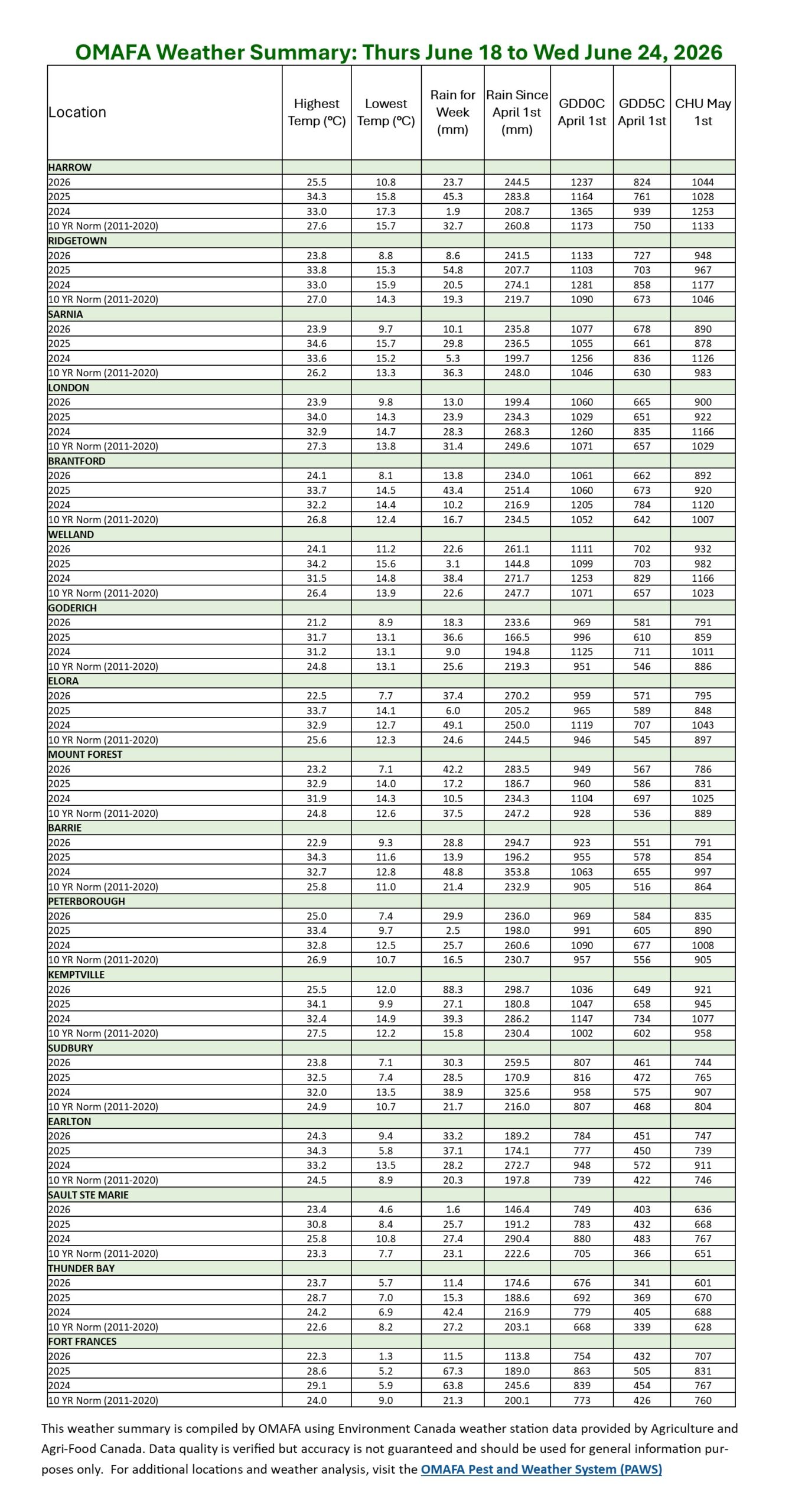
Soybeans are at the unifoliate to 5th trifoliate (V5) growth stage depending on planting date and region. Emergence is variable with some fields struggling to achieve a uniform plant stand. Overall, replanting was not necessary in most regions. Early planted fields are now starting to close the canopy. For maximum yield potential it’s ideal if soybeans reach the V6 growth stage before flowering.
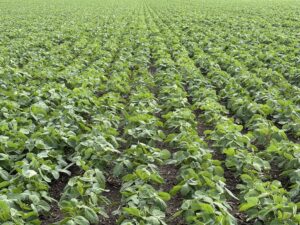
Cool and wet conditions, especially on clay soils, have resulted in slow growth, delayed nodulation, and yellow plants in some counties. Fields are showing increased herbicide injury due to these stressful growing conditions this year.
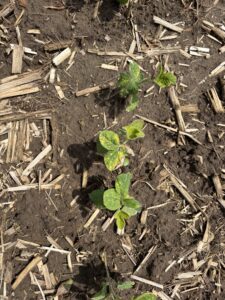
Research has shown that early season herbicide damage does not usually reduce final yields. Soybeans are extremely resilient during the vegetative growth stages. As temperatures gradually increase, soybeans will enter their rapid growth phase and quickly put on new leaves. The ideal daytime temperature for maximum soybean growth is approximately 28°C with a nighttime temperature of at least 20°C.
Severe thundershowers have resulted in hail damage in isolated fields. Broken or cut-off stems have a greater impact on yield and maturity compared to leaf loss. If soybean stand reductions or stem loss are under 50% prior to flowering, yield loss will usually be less than 10%. When evaluating hail damage, check for bruising on the plant stem. Plants have a difficult time recovering from severe stem damage. Stem damage also increases susceptibility to disease. Slight bruising, which does not cause breakage, results in minimal yield loss. In terms of yield reduction, soybeans are most vulnerable during the flowering and seed fill period.
For a single-pass application, the best foliar fungicide timing is usually the R2 to R3 (full flower to early pod set) growth stage. Spraying at R1 (beginning flowering) is too early for most foliar diseases. For white mold control a 2-pass system is most effective. In that case protecting early flowers is important so the first pass should be made during the R1 to R2 growth stage (beginning flower to full flower). The second pass is usually applied 14 days later. Fields that are most likely to show a positive return on investment are fields with a high yield potential, a history of disease pressure, and during a wet growing season.
Corn
Corn growth is progressing rapidly now with many fields ranging from the V4 to V7 growth stage or more in the south and V2 to V3 in the north and later planted fields on heavier textured soils. Some nutrient deficiencies are evident, particularly sulphur, magnesium, and zinc. Some have reported improvements in symptoms since rainfall has been received the past week. Weed control has been a challenge since windy and wet conditions this spring have limited opportunities to spray. Some hail damage occurred with thunderstorms last week – yield losses depend on degree of defoliation, but at early vegetative stages yield losses are generally very low. Research has not shown any enhanced yield benefit for a fungicide application following hail damage and yield responses at early vegetative corn stages are generally low. Side-dressing is underway or wrapping up in more advanced areas. Pre-side dress nitrate tests results are mainly showing up normal to higher than expected, with some exceptions. There is concern regarding nitrogen losses in flooded areas due to excess rains. For more information see: https://fieldcropnews.com/2023/07/nitrogen-losses-in-saturated-soils/
Cereals
The winter wheat crop continues to progress well with recent cooler conditions across the province being ideal for grain fill. Fields in the most southern part of the province are starting to turn colour and will progress quicker over the next week with warmer temperatures. Winter barley harvest is expected to begin in the south before the end of June. Winter and spring cereal fields should continue to be monitored for true armyworm larvae. If there are 4 to 5 un-parasitized larvae per 30 cm x 30 cm area and the larvae are smaller than 2.5 cm, control may be warranted. If a significant amount of wheat head clipping is occurring, spray is warranted if larvae are still actively feeding, are smaller than 2.5 cm and pre-harvest intervals have not been reached.
Edible beans
A significant number of edible bean acres were planted in late May and early June and have now received post-emergent herbicide applications or will receive an application over the coming days. Root rot has been reported where soils were saturated with frequent or heavy rain. The damage is most severe in poorly drained areas of fields.
Forages
Frequent rain over the past week has continued to delay first cut for those attempting to make dry hay. The rain has brought on very good regrowth in pastures and hay fields cut the first week of June or earlier. Second cut on dairy farms is expected to start this coming week.
Growers are encouraged to scout for true armyworm, particularly in mixed or grassy stands (see Cereals section above). Potato leafhopper will blow into Ontario on storm fronts, and the population can increase rapidly. Scouting details are available on Field Crop News: https://fieldcropnews.com/2025/04/how-do-i-manage-potato-leafhopper-in-alfalfa/
Agricorp
June 30th is the deadline to report final acreages. Call in as soon as planting is complete, or report online to avoid busy phone lines.
Upcoming Events
- Winchester Field Crops Research Day – June 30 – Register at: https://www.eocac.ca/crop2026.php
- Southwest Diagnostic Days – Ridgetown – July 7th and 8th – https://www.uoguelph.ca/ridgetown/diagnostic-days
- Weed Control Tour – Elora Research Station – Thursday July 16th – Register at: 1-877-424-1200 or online
- Georgian Soil and Crop Compaction Day – July 16th – Register at https://www.greyagservices.ca/compaction-event
- NorthWest Diagnostic Days – July 28th, Emo Research Station – Register at https://membership.ontariosoilcrop.org/event/northwest-diagnostics-day/