Don’t Turn Your On-Farm Trial into an Expensive Guess
On-farm trials are one of the best ways to evaluate new products, practices, and management strategies under real farm conditions. The often provide more useful information than testimonials or marketing claims alone.
However, a trial only has value if it is designed to produce reliable results. Poor design can make it impossible to separate true treatment effects from normal field variability, leading to costly management decisions.
Three common mistakes frequently undermine on-farm research:
1. No Check Treatment
One of the most common trial mistakes is evaluating products such as biologicals, seed treatments, or foliar fertilizers without an appropriate check treatment. If every acre receives the same “test” product, there is no way to determine what would have happened without it. Trial treatments should differ by only a single factor. For example, if evaluating micronutrient foliar treatments, the check should be managed identically except the micronutrients are not applied. For management trials, the check is typically the current practice being compared with the proposed change.
Problems often arise when producers compare a new management system to results from previous years. A grower adopting a new fertility program may attribute a 10 bu/ac yield increase to that change. However, weather, hybrid selection, pest pressure, planting dates, soil moisture, and disease levels can vary substantially year-to-year. Any of these factors could be responsible for the difference.
Without a check treatment in the same field and under the same conditions, it is impossible to isolate the true effect of the product or practice being tested. A proper check provides the benchmark needed to determine whether a change truly adds value.
2. No Replication
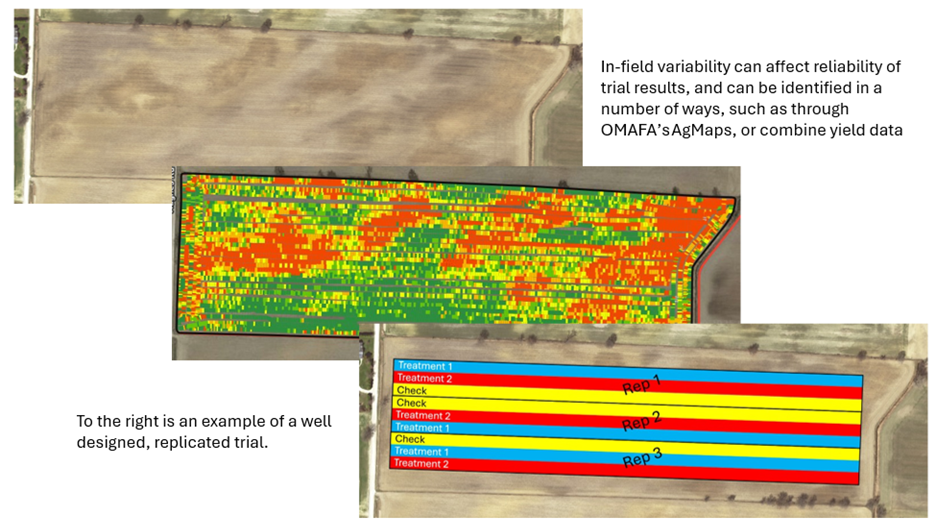
Another common mistake is comparing a single treatment strip with a single check strip, or splitting a field in half, comparing the two sides. While yield differences may appear meaningful, they often reflect natural field variability rather than a true treatment response.
Fields are rarely uniform. Soil texture, drainage, organic matter, compaction, landscape position, and past management can all influence yield. A treatment placed in a higher-yielding area may outperform a check regardless of any actual benefit.
Replication helps address this issue. By repeating treatments multiple times across the field, natural variability is distributed among treatments, improving confidence in the results.
Consider the example in Table 1. The first comparison harvested looks to show a 2.7 bu/acre response with addition of nitrogen and sulphur to the soybeans. With this single comparison, a producer might decide to change his fertility program, assuming the benefit outweighs the cost. However, additional replications show smaller or inverse responses. With all replicates considered, neither treatment is likely to provide return on investment.
Table 1. Soybean yield response to addition of sulphur, or nitrogen and sulphur fertilizers at planting in a single year.
| Treatment | Yield (bu/acre) | |
| 1 | Untreated Check | 70.4 |
| 2 | Sulphur | 70.8 |
| 3 | Nitrogen + Sulphur | 73.1 |
| 2 | Sulphur | 72.8 |
| 1 | Untreated Check | 71.6 |
| 3 | Nitrogen + Sulphur | 73.4 |
| 2 | Sulphur | 73.2 |
| 3 | Nitrogen + Sulphur | 70.8 |
| 1 | Untreated Check | 71.5 |
| Treatment Averages: | Untreated Check | 71.2 |
| Sulphur | 72.3 | |
| Nitrogen + Sulphur | 72.4 | |
Source: C. Elgie, OMAFA, Plot location: Chatham-Kent, 2025.
Replication and statistical analysis help determine whether observed differences are real or due to field variability. If data is presented without statistics, be wary!
Even then, a single-year trial provides limited confidence. Repeating trials with the same treatments across multiple years helps determine how consistently a response occurs and the chance that it’s profitable.
3. Failing to Evaluate Response in Both Treatment and Check
A third, often overlooked, mistake is failing to determine whether the crop responds to the factor being manipulated in the first place. Producers often compare a new product against their current practice without verifying whether the current practice itself is influencing yield.
This commonly arises with products marketed as nutrient replacements or as tools that improve nutrient efficiency. Consider a product promoted as a substitute for nitrogen in corn. A grower might reduce their nitrogen rate by 50 lb N/ac and replace that with the new product. If yields remain unchanged, it may appear that the product successfully replaced 50 lb N/ac.
However, that conclusion may be incorrect. If the original nitrogen rate already exceeded the Maximum Economic Rate of Nitrogen (MERN), reducing the rate may not have reduced yield even without the product. In that case, the product may contribute little or nothing to the observed result.
A stronger trial design would include four treatments:
- Standard nitrogen rate
- Reduced nitrogen rate
- Standard nitrogen rate plus the product
- Reduced nitrogen rate plus the product
This approach determines whether the crop responds to reduced nitrogen and whether the product provides additional value. The same principle applies whenever products claim to replace nutrients, improve nutrient efficiency, or enhance crop growth. Before accepting those claims, it is important to confirm that the crop actually responds to the factor being tested against.
Good Trials Lead to Better Decisions
On-farm trials remain one of the most effective ways to evaluate new products and management practices, but reliable results depend on sound design and analysis. Three common pitfalls can quickly undermine their value:
- No appropriate check.
- No replication.
- No confirmation that the crop responds to the factor being tested.
Avoiding these mistakes does not require large plots, complex equipment, or advanced statistics. Thoughtful planning and consultation with a trusted Certified Crop Advisor or agronomist can help ensure trials generate reliable information and support profitable management decisions.