This article was co-authored with Albert Tenuta, OMAFA Field Crop Pathologist.
OMAFA field crop specialists in collaboration with Grain Farmers of Ontario (GFO) and members of the Ontario Agri-Business Association (OABA) have completed the 2026 annual Ontario corn ear mould and DON mycotoxin survey. Corn ear moulds such as Gibberella and their corresponding mycotoxins occur every year in Ontario. These mycotoxins, particularly deoxynivalenol (DON, also referred to as vomitoxin) are produced primarily by Gibberella/Fusarium ear moulds and can be disruptive when fed to livestock, especially hogs. The 2026 survey found 77% of samples tested low (below 2 parts per million (ppm)) for DON. This is lower than the 10-year average of 86% of samples testing below 2 ppm and similar to levels from the 2016 and 2023 DON surveys. Levels of DON are lower than what was experienced in 2018, the highest levels experienced in the past 10 years.
Methods
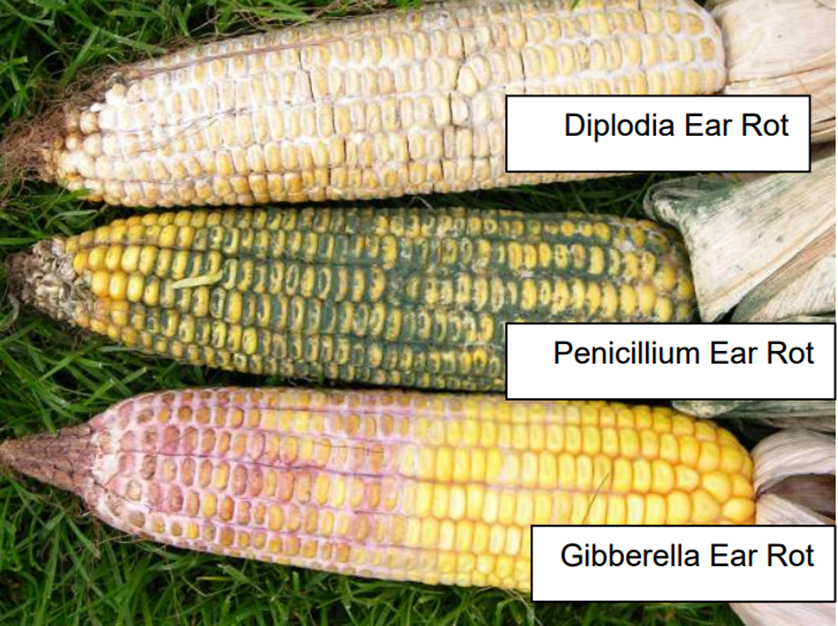
From September 23 to October 9, 2026, 272 ear corn samples were collected from corn fields across Ontario. Five consecutive ears were collected from four random locations within a field (20 ears total per field) and dried as soon as possible after collection using high temperature dryers (80°C). Pictures were taken to document ear moulds, insect or bird injury and other ear disorders (Figure 1). Once dried, ears were shelled, coarsely ground and mixed thoroughly to ensure subsampling consistency. Subsamples were collected and finely grounded and analyzed for deoxynivalenol (DON) using a quantitative ELISA analysis at the University of Guelph Ridgetown Campus Mycotoxin Lab of Dr. Gursahib Singh. Quantitative ELISA (enzyme-linked immunoassay) is a laboratory test used to detect and measure specific substances including mycotoxins such as DON.
Results
Results are presented in Table 1. Visual ear mould symptoms and DON concentrations were slightly higher than normal in the 2026 survey with 77% of samples testing below 2 ppm DON. This compares to an average of 86% of samples testing below 2 ppm over the previous 10 years of the survey (Table 2). Results from the 2026 survey are very similar to those observed in 2016 and 2023, but considerably lower than recorded in the 2018 survey, which was the highest DON levels in the past decade. The distribution of samples and their corresponding DON levels are presented in Figure 2. Although ear mould symptoms were observed in some samples, many displayed little to no visual mould.
Table 1. Deoxynivalenol (DON) results from the 2026 Ontario grain corn ear mould and DON survey.
| DON Concentration parts per million (ppm) | Number of Samples* | |
| < 0.50 ppm | 147 | 54% |
| 0.50 to <2.00 ppm | 63 | 23% |
| 2.00 to <5.00 ppm | 47 | 17% |
| 5.00 ppm and greater | 15 | 6% |
| Total | 272 | 100% |
| * percentages may not sum to 100 due to rounding | ||
Table 2. DON results from the past ten years of Ontario grain corn ear mould and DON surveys.
| DON Concentration (ppm) | 2017 | 2018 | 2019 | 2020 | 2021 | 2022 | 2023 | 2024 | 2025 | 2026 |
| < 0.50 | 69% | 33% | 84% | 58% | 63% | 88% | 41% | 76% | 88% | 54% |
| 0.50 to <2.00 | 17% | 27% | 12% | 31% | 26% | 10% | 36% | 18% | 10% | 23% |
| 2.00 to <5.00 | 8% | 15% | 4% | 10% | 10% | 2% | 18% | 6% | 2% | 17% |
| 5.00 and greater | 6% | 25% | 0% | 0% | 1% | 1% | 5% | 0% | 0% | 6% |
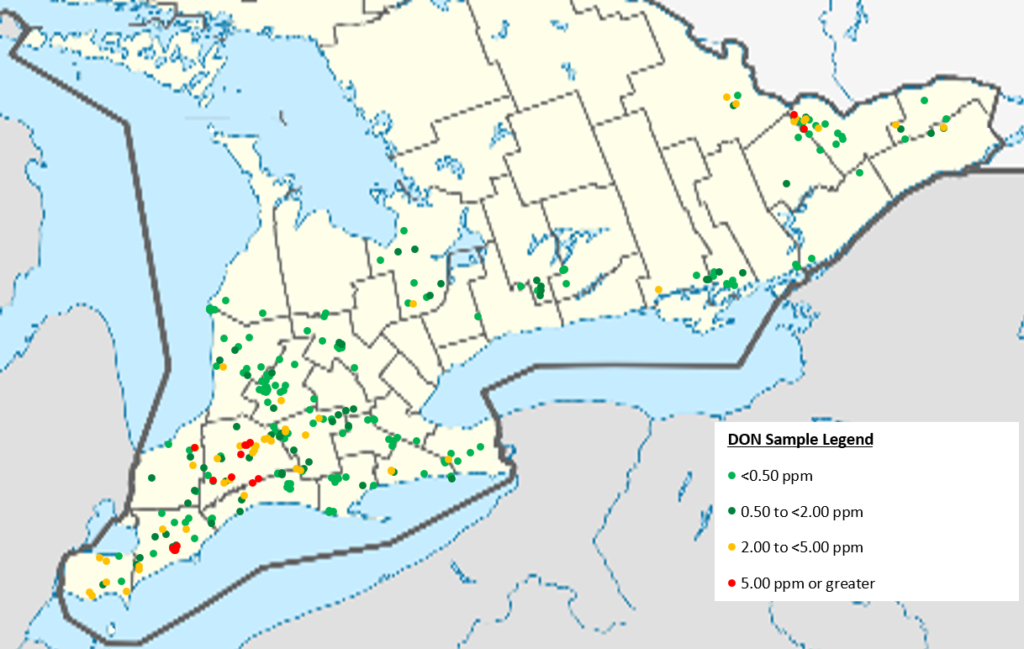
Figure 2. Corn ear mould and deoxynivalenol (DON) survey sampling locations and results in 2026.
Even though 77% of the 2026 survey samples tested below 2 ppm, growers should still be vigilant, as they may have individual fields with elevated DON. Ear moulds and mycotoxins are present to some extent every year in Ontario and risk can vary considerably from field to field. Growers should assess each field individually and prioritize higher-risk fields for harvest and drying first to reduce the chance of further mould growth and DON accumulation.
Variability in DON levels between fields can be influenced by several factors, including hybrid susceptibility, planting date, pollination timing, rainfall patterns, insect feeding, crop stress, and the presence of foliar diseases such as northern corn leaf blight and tar spot. While foliar diseases are not primary drivers of DON accumulation, they can increase plant stress and reduce photosynthetic capacity during grain fill, potentially contributing to ear mould development when favourable weather conditions are also present.
Refer to the “Going Forward” section below for management and storage options when corn with elvevated DON levels are found.
Environmental Conditions and Growing Season Summary
Very little corn was planted before May and what was planted was mostly on lighter-textured soils. The first half of May was cool and unsettled, with frequent rainfall across the province. While most rainfall events were small, they interrupted planting and made it difficult to keep planters moving in some areas. By mid-May, planting progress ranged from nearly complete in some areas to just getting started in others, depending on rainfall and soil conditions. Planting continued through the last two weeks of May except on heavier clay soils where planting generally did not occur until late May or early June. With exception of later-planted corn a lot of corn emerged or was emerging by the week of May 24. June was seasonal to slightly cooler than normal, with periodic rain events and unsettled weather. As a result, many areas were slightly behind normal in crop heat unit accumulation by the end of June.
Rainfall during the summer varied dramatically across Ontario’s corn-growing regions. Some areas received very little rainfall through July and into the first half of August and moisture stress was evident in those fields with shorter plants and frequent leaf rolling. Other areas, particularly parts of central and eastern Ontario received frequent and significant rain events including record amounts in some locations.
As a result, corn pollination across the province occurred over a fairly wide window. Some of the earliest planted fields tasseled by mid-July, while much of the crop pollinated around the third week of July. Later-planted fields followed over the next couple of weeks. The combination of uneven planting dates and highly variable weather created considerable differences in crop growth, stress levels, and ear development from field to field across the province.
August brought frequent showers, cool night temperatures and heavy morning dews which allowed corn canopies to stay wet for long periods of time. These prolonged wet conditions could create a favourable environment for ear mould development in some areas.
In addition to the variable moisture conditions, some fields experienced late season foliar disease pressure from northern corn leaf blight and tar spot. While these diseases are not primary drivers of ear mould development and DON accumulation, they can increase plant stress, reduce photosynthetic capacity during grain fill and contribute to variability in ear development. Combined with environmental stress and favourable conditions for fungal development, these factors may have contributed to increased ear mould risk in some fields.
Rainfall patterns during grain fill continued to vary considerably across Ontario. Parts of Eastern Ontario received frequent and, at times, significant rainfall events well into the season. Parts of Southwestern Ontario remained relatively dry while other areas received regular rain. As a result, crop stress, grain fill conditions, and ear mould risk varied considerably from region to region and even from field to field.
Factors Contributing to Ear Mould and DON Risk
As occurs every year, some fields have higher DON levels than others. This comes down to weather, genetics and the growing season. Wet weather and humid conditions around silking are key drivers for fungal infection, but that’s only part of the story. Hybrid selection makes a key difference as some hybrids hold up better against Gibberella ear rot and DON than others under the same conditions although none are resistant.
This year, many growers also dealt with tough planting and growing conditions. Uneven emergence leads to more variability within fields. Late-emerging “straggler” plants and secondary ears can silk later, extending the window those plants are susceptible to infection.
Crops also faced stresses including excess moisture, dry periods, compaction and restricted root growth. Development can become less uniform any time a crop is under stress and the potential for ear mould infection and DON increases. When favourable weather for infection is combined with plant stress, variable maturity and susceptible genetics, other diseases, it’s not uncommon to see higher DON levels in certain fields or parts of fields.
Feeding Damage
Ear feeding by insects, particularly western bean cutworm (WBC), corn earworm (CEW) or birds can open husks and damage kernels, which present opportunities for greater ear mould infection and DON. While still only representing a minority of samples, feeding damage was present in some samples. Peak WBC moth flights generally occurred around the week of July 27, generally coinciding with full tassel emergence and pollination. Later planted areas (e.g. heavier textured soils) generally tasseled a week or so later, possibly missing peak flight. Ontario trap counts submitted to the Great Lakes and Maritimes Pest Monitoring Network were generally in line with long term averages and lower than 2025. Where feeding damage was present, visual mould symptoms were usually more apparent. Most samples with mould symptoms did not have insect ear damage however, suggesting environmental conditions, hybrids and disease were greater factors for infection than insect damage.
How to Sample Corn Loads
The importance of collecting representative samples cannot be emphasized enough. Significant variability in mycotoxin testing results can come from poor sampling.
Collecting a Bulk Sample from a Corn Load
While sampling from the top of a storage bin, truck or combine may be convenient, mycotoxins are rarely distributed evenly in grain loads; hence, a sample probe is recommended. The more probes the better, but Ontario research shows that 4 probes sampling the full depth of wagons or trucks can do as good of a job representing corn loads as frequent tailgate sampling (swiping stream). Ontario research has shown that probes are not the major driver of variability experienced with DON testing. For moving grain streams, use a diverter or randomly collect cups of grain. Mix all collected probes/samples into one bulk sample of at least 2 kg.
Collecting an Analysis Subsample from a Bulk Sample
Ontario research shows that one of the most significant sources of variability in DON testing comes from collecting the subsample for DON analysis (e.g. amount of the 2 kg bulk sample that is finely ground for the DON test). Individual kernels can be highly variable in DON and still coarse in size relative to the analysis subsample.
For example:
- a 200 g whole kernel sample taken from the 2 kg bulk sample for fine-grinding may be representing the entire load with parts of only 500 kernels
- a 2 kg bulk sample that is first entirely coarse-ground, then subsampled for fine-grinding may be representing the load with parts of 5,000 kernels
Therefore, the whole bulk sample should be ground (at least coarsely) and mixed so the analysis subsample contains parts of all kernels in the bulk sample. This subsample can then be ground finer to meet the specifications of the DON test. More details on reducing sample variability through proper sampling and grinding are available HERE. Remember, samples must be processed quickly. It is important to ship or deliver a fresh sample promptly because the longer the sample sits around, the greater the potential for inaccurate results.
Going Forward
This survey does not capture all regions of the province, and results can vary from field to field depending on local weather, hybrid, planting date, insect feeding, rotation, residue levels, fungicide practices and moisture. Results may not capture what is occurring in your field, therefore, monitoring is always recommended.
A timely harvest is important since leaving infected grain in the field allows ear rot fungi to continue growing, which increases the risk of mouldy grain and mycotoxin contamination. Most ear rot fungi continue to grow (and potentially produce mycotoxins) until grain moisture is below 15%. In high-risk or severely infected fields, growers should consider harvesting at higher moisture and drying below 15%. If a field contains significant ear moulds (e.g. 10% or more ears with visual mould symptoms), collect a representative sample before harvesting and test for mycotoxins before storing or feeding livestock. A lab test is the only reliable way of determining mycotoxin levels.
If possible, segregate contaminated corn separately.
When ear rots are present, the following harvest, storage and feeding precautions are advisable (adapted from OMAFA Pub 811, Agronomy Guide for Field Crops):
• Harvest and dry as quickly as possible, especially susceptible hybrids. Mould and mycotoxin development cease with grain moisture below 15%.
• If insect or bird damage is confined to certain areas, harvest and handle damaged rows separately.
• Cob, small kernels and fines typically have higher DON concentrations. Adjust harvest equipment to minimize grain damage and to remove insect-damaged, infected or smaller tip kernels. Removing these parts when possible can be beneficial, though large amounts of removal may be required to significantly change grain concentrations.
• Clean bins before storing new grain and cool grain after drying. If possible, segregate corn by DON content to help match end use.
• Check stored grain often for temperature, wet spots, insects and mould. For grain with elevated mould content, market it as soon as possible. Avoid long-term storage.
• Exercise caution when handling or feeding mouldy corn to livestock, especially hog breeding herds and weanling pigs. Pink or reddish moulds are particularly harmful. Test suspect samples for toxins. Work with a nutritionist to manage DON levels in feed.
• Agriculture and Agri-Food Canada guidelines for DON in animal feeds are:
- pigs, calves, lambs, lactating cows, and lactating ewes, 1 part per million (ppm) in the diet
- adult cattle, adult sheep, and poultry, 5 ppm in the diet
Considerations for the 2027 Corn Crop
Preventing ear moulds and DON can be challenging because environmental conditions play a major role in disease development. However, there are several management practices growers can consider to help reduce risk in 2027.
Hybrid selection remains one of the most important management decisions. While hybrids with improved tolerance to Gibberella ear rot and DON accumulation are available, no hybrid is completely resistant. Growers are encouraged to discuss ear mould and DON ratings, as well as tolerance to other important corn diseases such as tar spot, northern corn leaf blight, grey leaf spot, and stalk rots with their seed supplier. Selecting hybrids with strong overall disease packages can help maintain plant health, reduce stress during grain fill, and improve standability at harvest.
The Ontario Corn Committee (OCC) conducts annual DON hybrid screening trials to evaluate differences in DON susceptibility among commercially available hybrids grown across Ontario (Figure 3). Reports are posted in the Ontario Corn Committee section of GOCrops.ca. The 2025 DON hybrid trial report can be found HERE, while the 2026 report is expected to be available in early 2027.
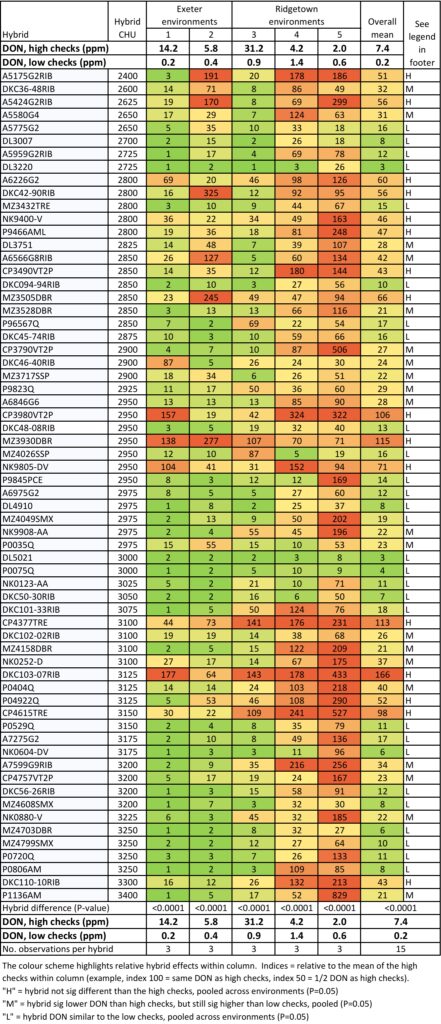
Figure 3. Hybrid table from the 2025 Ontario Corn Committee DON hybrid trial report is available at gocrops.ca
In addition to hybrid selection, an integrated disease management approach that includes crop rotation, residue management, timely scouting, minimizing insect feeding and fungicide applications where warranted can help reduce disease pressure and maintain crop health throughout the season. While foliar diseases and stalk rots do not directly cause DON, minimizing overall crop stress can help support healthy ear development and maximize yield potential.
Crop rotation may help reduce ear rots. While certain foliar fungicides are also registered for suppressing ear rots, they need to be applied at R1 when silks are green. See Ontario Crop Protection Hub HERE for fungicides labelled to suppress ear moulds. Cultural practices such as tillage are shown to have limited success in preventing ear and kernel rots.
Agricorp customers with mould issues are encouraged to immediately contact Agricorp at 1-888-247-4999 and report damage.
Additional Resources
For additional information, see the Crop Protection Network’s “Corn Management Disease Series – Ear Rots” publications at Crop Protection Network
CPN-2001 – Corn – An Overview of Ear-Rots
CPN-2002 – Corn – Mycotoxin FAQs
CPN-2003 – Corn – Grain Sampling and Mycotoxin Testing
CPN-2004 – Corn – Storing Mycotoxin-Affected Grain
Additional articles on managing corn ear moulds and mycotoxins are also available at FieldCropNews.com.
Good Mycotoxin Test Begins with a “Representative” Sample
Reducing DON Variability in Testing Truckloads of Corn – Prototype Grinder
To Clean or Not to Clean? Managing DON in Grain Corn
Fall Storage Tips for Mouldy Corn
Destroying a Corn Crop at Harvest Time
Land Application of Crops and By-products with Elevated DON Levels
Spring Storage Tips for Mouldy Corn
Acknowledgements
Sincere thanks to those who assisted in co-ordination and collection of samples: Agris Co-operative, Alliance Agri-Turf, Anderson Agronomy Services, Belmont Farm Supply, Benjamins Agronomy Services, Bruch Consulting, Central Ontario FS, Clark Agri Service, Grain Farmers of Ontario, Harriston Agromart, Hoegy’s Farm Supply, Holmes Agro, Lakeside Grain and Feed Ltd., MacEwen Agricentre, Maizex Seeds, Midwest Co-op, Millstone Crop Services, Oxford Agropro Ltd., Parrish and Heimbecker, P.T. Sullivan Agro Inc., St. Lawrence Grain and Farm Supply, Sylvite Agri-Services Ltd., TCO Agromart, The Andersons Canada Ltd., Wellburn Agromart and the many corn growers and OMAFA staff also involved. This co-operation is critical for covering as much of the corn growing areas of the province as possible in a short period of time.
Thanks to Grain Farmers of Ontario, University of Guelph Ridgetown Campus mycotoxin lab (Dr. Gursahib Singh and Harpreet Singh Hanzra) and OMAFA for support of the survey as well as Ontario Agri-Business Association (OABA) and its members for their interest and participation.
This project was funded in part by the Sustainable Canadian Agricultural Partnership (SCAP), a five-year federal-provincial-territorial initiative.