Winter Conditions 2025/2026
This past winter provided a lot of snow cover to protect overwintering forage crops. However, reports indicate higher-than-normal levels of alfalfa winterkill between Highway 400 and Kingston. This stand loss may be the result of accumulated stress from severe drought in 2025 coupled with spring conditions. Saturated soils and fluctuating temperatures throughout April seem to have injured alfalfa stands in western Ontario.
Hay and Haylage
Most new spring seedings were planted under good soil conditions and in good time.
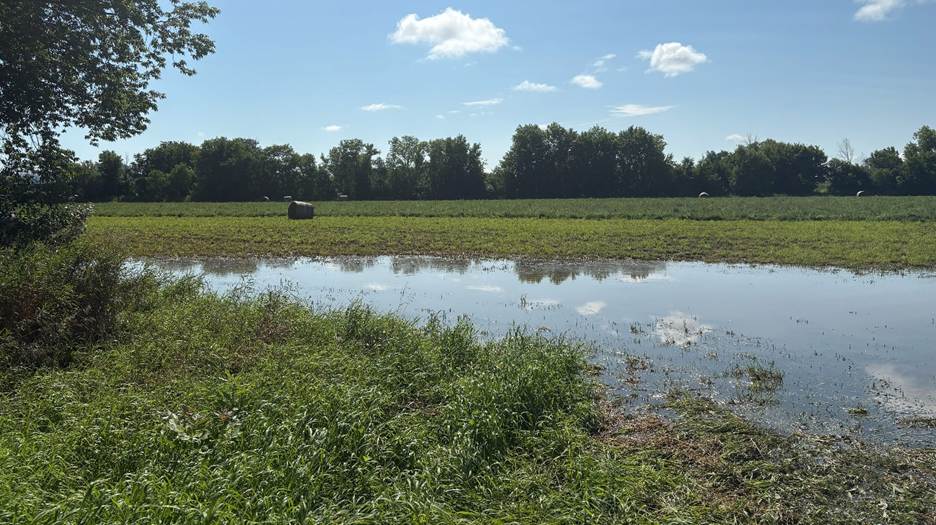
A cool spring kept growth slow, with alfalfa development approximately two weeks behind normal. Producers with low inventories or aggressive cutting schedules sacrificed some yield and stuck with late May first-cut harvest dates. Some growers who were watching the weather made dry hay a little early in the first week of June. From the second week of June onward, much of the province received frequent rain, which made dry hay harvest challenging.
Insect pressure was low, with very few reports of alfalfa weevil or potato leafhopper over action thresholds.
Pastures
Pasture growth was slow this spring. Areas hit hard by drought in 2025 were hindered by pasture plants still trying to recover from severe stress. Cool weather and wet soils also slowed growth. Although delaying turn-out until the pastures were ready is the ideal situation, many producers with low forage inventories were forced to put livestock on pasture before the fields were ready. This extra grazing stress will further reduce productivity and persistence. Managers should assess their pastures and take steps to rejuvenate or renovate as needed. See OMAFA Publication 19: Pasture Production for more information.
Frequent rainfall starting in mid-June encouraged good pasture regrowth.
Annual Forage Crops
Winter triticale acres continued to increase year-over-year across the province. Like 2025, heavy snow mould pressure affected many acres in the spring of 2026. Snow that falls and stays before the ground freezes creates ideal conditions for snow mould development.
Some agronomists have reported higher-than-normal mycotoxin test results in corn silage in western Ontario. The 2026 Ontario Grain Corn Ear Mould and Deoxynivalenol (DON) Survey found 77% of samples tested low (below 2.00 parts per million (ppm)) for DON, which is fewer than the 10-year average of 86% of samples testing low. This suggests that mycotoxins may be more prevalent this year than normal. While the survey does not include leaves and stalks, it is still a useful indicator on how likely mycotoxin issues will be with corn silage fed over the next year.
Corn rootworm injury continues to be a growing issue, particularly for livestock producers who rely on continuous or short rotation corn. There are increasing concerns about resistance as more cases of rootworm injury on corn with traits for corn rootworm protection have been observed in Ontario. Growers with corn-on-corn are encouraged to keep an eye for rootworm damage, understand resistance risks and know their management options. Many articles explaining scouting and management options are available by searching “corn rootworm” on FieldCropNews.com.
Agricorp
Claim payments for the excess Forage Rainfall option were paid in August to producers across the province for a total of $2.2 million, which is in line with the 5-year average of $2.5 million. The 2026 growing season has been anything but consistent for Ontario farmers. While some regions struggled with excessive rainfall and flooding, others experienced below-average precipitation and dry conditions. In contrast, parts of the province enjoyed near-ideal weather, illustrating how dramatically conditions have varied across the province. The insufficient rainfall option claim payments were a total of $1.7 million for 2025, which is below the 5-year average $2.9 million. Total Forage Rainfall payout for 2026 was $3.9 million. The highest payout year to date was 2021 ($11.0 million), followed by 2025 ($9.3 million), and 2020 ($8.0 million).
There were 56,450 acres insured under the standard and premium options of the New Forage Seeding production insurance program in 2026. Total claims paid were $739,770. Total acres and claims are similar to 2025 numbers.
Upcoming Events
December 1, 2 & 10: Forage Focus webinar series. 7:30 pm Eastern / 6:30 pm Central. Details and registration at https://onforagenetwork.ca/ontario-forage-council/forage-focus/