An extremely heavy population of true armyworm (TAW) larvae was found in a field of cereal rye being cut between Strathroy and Parkhill yesterday. This is the second field that TAW have been spotted in the last few weeks; the first being in a YEN wheat field near Oil Springs, though the population was much lower than this second sighting. Though the TAW larvae found yesterday were quite large (>2.5 cm) and beyond the appropriate size to effectively manage, other high risk fields even outside of this pocket should be scouted. High risk fields include all cereals (fall or spring planted), corn (especially, though not exclusive those fields planted into rye) and mixed forages.
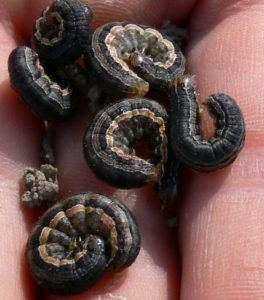
Scouting Guidelines: True armyworm larvae can vary in colour from dull-green to brown or black. Regardless of the body colour, they all have orange stripes bordered by a thin white line running laterally along the body (Figure 1) and dark bands at the top of each abdominal proleg (chubby legs along the back of their body). Infestations may develop throughout the field but can also move in from neighbouring fields and across lawns, roads and ditch banks. In cereals and mixed forages, feeding begins on the leaf margins, but larvae may strip plants clean of their leaves or quickly move up the plant to feed on the kernels and awns or clip the heads completely off of the stem. Clipped heads can be found on the soil surface and can impact yield if taking place in many areas of the field.
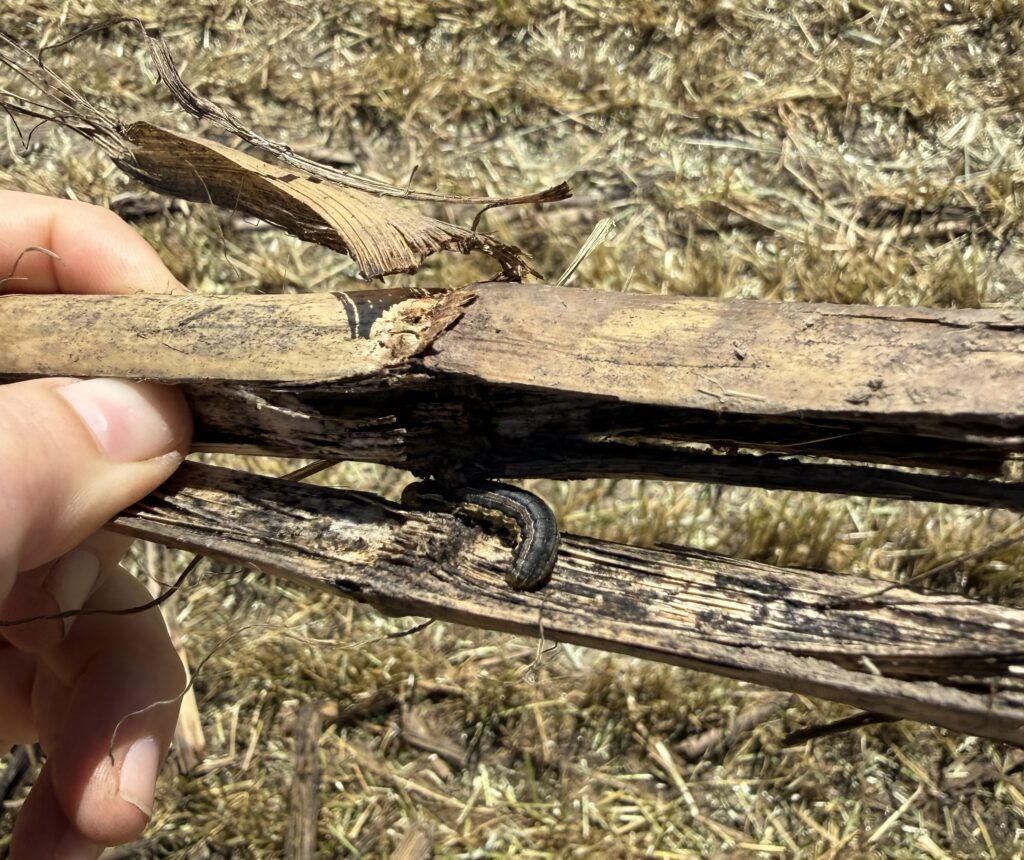
The best time to scout for true armyworm is shortly after dusk, when larvae are actively feeding. In corn, examine 20 plants in five areas in the field (100 plants total). In cereals and mixed forages, examine 10 areas of the field, assessing the number of larvae per 30 cm x 30 cm (1 ft2). Pay particular attention to the border area directly adjacent to other grassy host crops. During the day, if it is cloudy and overcast, larvae could be in the whorl, leaf axil, or on the head of the plant but on sunny days, they will be down on the ground among the crop debris or under soil clods (Figure 2). Brown frass may also be present on the plants and on the ground. Always take the time to assess the size of the larvae and look for any white eggs that may be attached to the backs of the armyworm larvae. This is a sign that the larvae have been parasitized by one of its parasites which have done the job for you. Avoid using insecticides if most of the larvae have been parasitized.
Threshold for Corn: Foliar insecticide may be warranted in seedling corn if there are two or more un-parasitized larvae per seedling or 10% or more of the plants have feeding and larvae are smaller than 2.5 cm (1 in.). For corn past the 6-leaf stage; if 50% of the plants have leaf feeding damage and are infested with larvae smaller than 2.5 cm (1 in.), insecticide treatment may be warranted. As long as the growing point of the plant is not damaged, the corn plant is usually able to recover from moderate feeding.
Threshold for Mixed Forages: Control is warranted when five or more larvae (smaller than 2.5 cm) per square foot are found. In seedling crops, two to three larvae (smaller than 2.5 cm) per square foot may warrant control. Avoid treating with insecticides when large numbers of parasitized larvae are present.
Threshold for Cereals: Chemical control is warranted if there are 4 to 5 un-parasitized larvae per 30 cm x 30 cm and the larvae are smaller than 2.5 cm. If a significant amount of wheat head clipping is occurring, spray may be warranted if larvae are still actively feeding, are smaller than 2.5 cm and as long as pre-harvest intervals have not been reached.
Management Guidelines: Insecticide options can be found on the Crop Protection Hub once you’ve selected the crop and filter to true armyworm. If the larvae are over 2.5 cm (1 in.) long, the insecticides will not provide adequate control. Treatment may be confined to infested areas. If armyworm are migrating from adjacent cereal, mixed forages or corn fields, spraying an insecticide along the field border may be sufficient. Pay close attention to pre-harvest intervals for all fall seeded crops.
Unfortunately there was a large moth flight over the last two weeks that was captured in traps in Ontario through the GLMPMN. This means that we could see a second wave of larval activity in about a months time. Corn will be past the stage of concern but spring cereals and mixed forages could still be at risk in July.