co-written by Horst Bohner and John Fluttert
Pre-harvest herbicides can improve harvest efficiency when weeds interfere with combining. They help dry down green weeds and plant material, making harvest smoother and more predictable. They can also improve field conditions for fall operations such as winter wheat planting.
What pre-harvest herbicides don’t do is speed up soybean maturity or dry down immature green seed. Applying too early can reduce yield and increase the risk of herbicide residues in harvested grain.
Success with pre-harvest herbicides comes down to:
- Applying at the correct crop stage.
- Matching the product to the target weeds.
Match the herbicide to the weed(s)
The most effective product depends on the weeds present in the field.
Perennial Weeds
If perennial weeds such as Canada thistle, perennial sow-thistle, field bindweed, or dandelion are the main target, glyphosate is usually the best choice. In the fall, these weeds move sugars to their roots for winter storage. Glyphosate applied at this time moves with those sugars into the root system, improving long-term control
Annual Weeds
For annual weeds, products such as Aim®, Eragon LQ®, or Reglone® often provide faster burn-down than glyphosate alone. Glyphosate is frequently tank-mixed with these products to broaden weed control and improve dry-down speed.
Avoid tank-mixing a fast-burn herbicide with glyphosate when perennial weeds are the primary target. Rapid leaf burn can reduce glyphosate movement throughout the plant, resulting in poorer perennial weed control.
Check Market Restrictions
Before applying any pre-harvest herbicide, verify that it is permitted by your grain buyer. Some food-grade and non-GMO soybean contracts restrict or prohibit certain products, including glyphosate.
Application Timing is Critical
Applying too early can reduce yield and increase the risk of unacceptable herbicide residues in harvested grain. Both can create marketing problems.
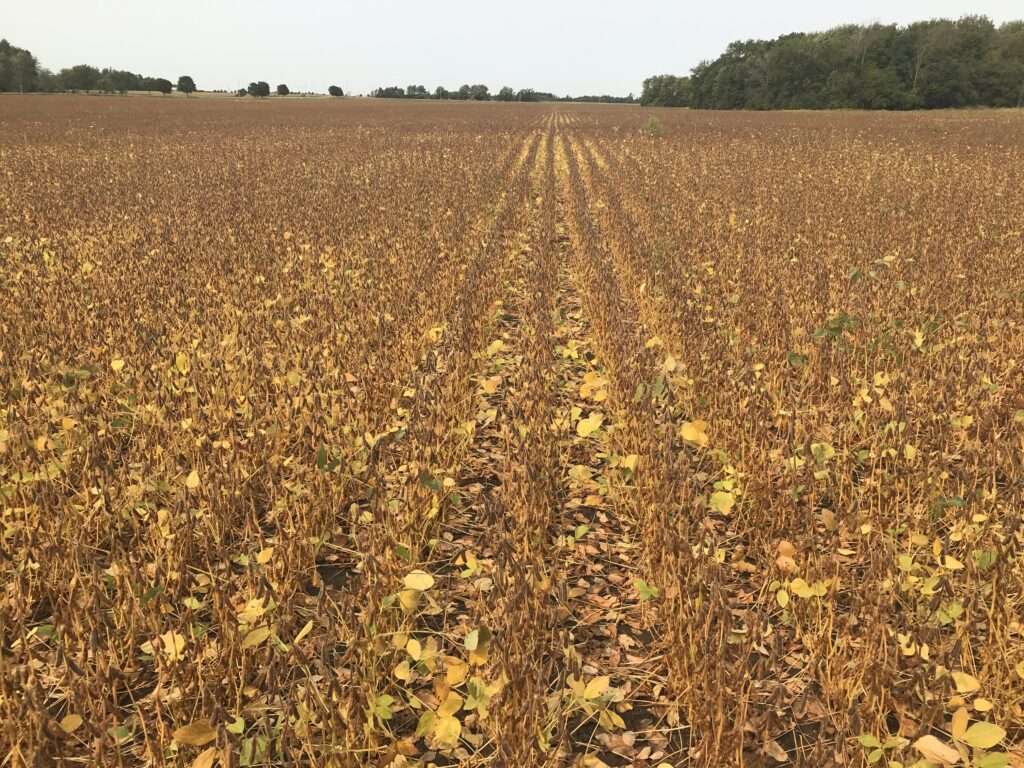
Do not spray until the crop has reached physiological maturity. When crop maturity is uneven, it is best to wait for the entire field to reach maturity.
The Best Indicator: Pod Colour
The most reliable way to determine readiness is by pod colour. Soybeans are ready for a pre-harvest application when:
- At least 90% of pods have changed from green to yellow, brown, or tan.
- No green colour remains on those pods.
- Most leaves have dropped, typically 80% or more. Leaf drop alone is not a reliable indicator. Always assess pod colour before making an application.
Confirm by Checking the Seed
Another way to assess maturity is to examine seeds from pods collected from the upper third of the plant.
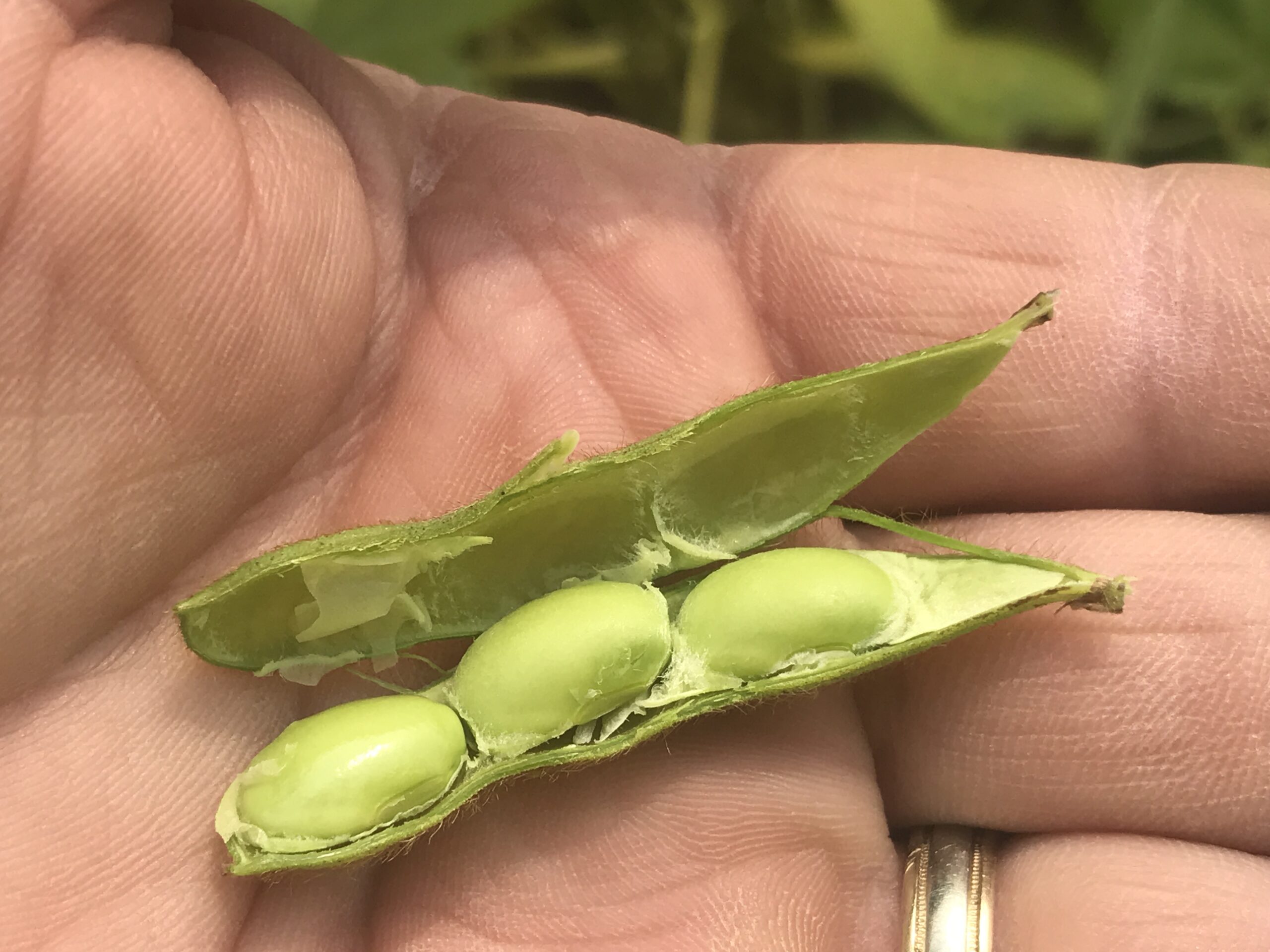
Immature seed will still be green and attached to the white membrane inside the pod. These fields should not be sprayed (Figure 1).
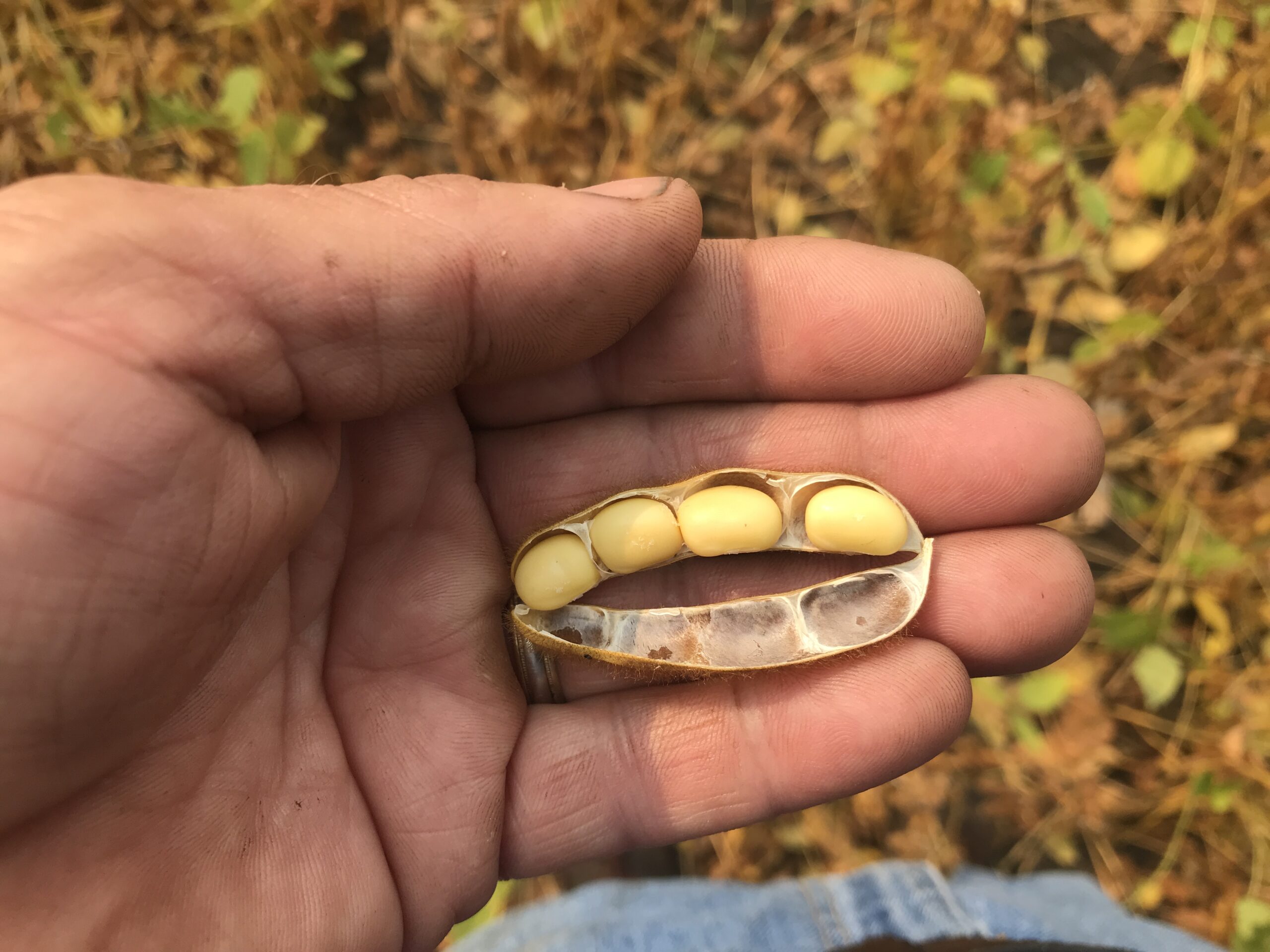
Once the seed has turned yellow and separated from the pod membrane, the crop has reached physiological maturity and can safely be treated (Figure 2).
Pre-Harvest Herbicide Options
Always follow the product label for rates, water volumes, and application instructions.
Aim EC®
- Rate: 47 mL/ac plus a non-ionic surfactant.
- Pre-harvest interval: 3 days.
Reglone®
- Rate: 0.68 L/ac plus Agral 90.
- Apply within 7 days of harvest.
- Performance is enhanced when sprayed in cloudy conditions and/or at dusk (the opposite of Eragon LQ).
- Harvest generally occurs 5 to 7 days after application.
Glyphosate
- Rate: 0.67 L/ac of a 540 g/L formulation.
- Apply when grain moisture is 30% or less.
- Do not use on soybeans intended for seed production because germination may be reduced.
- Observe a 7-day pre-harvest interval.
Eragon LQ®
- Rate: 60 mL/ac plus Merge at 800 mL/acre
- Apply when stems are green to brown and pods are mature, with 80 to 90% leaf drop.
- Pre-harvest interval: 3 days.
To improve performance with Eragon LQ:
- Use higher water volumes (minimum 20 gal/acre, but ideally 25-30 gal/acre).
- Spray during warm, sunny, humid conditions. Early morning or evening application timings will reduce its effectiveness. Avoid cool, cloudy conditions.
- Use medium to coarse spray droplets. Slow down your travel speed.
Pre-Harvest Intervals Matter
Always follow the longest pre-harvest interval in any tank mix. For example, a glyphosate plus Eragon LQ tank mix requires a 7-day interval because glyphosate has the longer restriction.
What Results Should You Expect?
Pre-harvest herbicides improve harvest efficiency, but they do not eliminate or dry down every weed. Ontario research conducted by Dr. Peter Sikkema found differences in weed control among products and tank mixes, with faster-acting products generally providing better suppression of broadleaf weeds than glyphosate alone. Pre-Harvest herbicides will not cause the berries of Eastern black nightshade to fall off.
The main benefit of a pre-harvest application is not perfect weed control. Rather, it is improved harvestability through reduced green material, smoother combining, and better field conditions for timely harvest and fall field operations.
Key Takeaways
- Pre-harvest herbicides help dry down weeds and improve harvest efficiency, but they do not speed soybean maturity.
- Choose products based on the weeds present, especially whether the target is annual or perennial.
- Wait until at least 90% of pods have changed colour and seed has reached physiological maturity before spraying.
- Follow all pre-harvest intervals and label directions.
- Check with grain buyers before application, particularly for food-grade or specialty soybean contracts.
- Expect easier harvest and improved field conditions, not faster soybean dry-down.
Comparative studies in Ontario
There is limited public research comparing performance of pre-harvest treatments on different weed species. Dr. Peter Sikkema has conducted four trials from 2010 to 2011 on edible beans and his results are summarized below. Regardless of treatment used, the expectation should be that the pre-harvest treatment will improve harvest efficiency but it will not result in a complete “dry down” of target weeds.
Table 1. Visual Control (%) of lamb’s-quarters, ragweed, pigweed and foxtail at 8 days after application of various desiccant treatments.
| Treatment (rate/acre) | lambsquarter | ragweed | pigweed | foxtail |
| glyphosate (1 L/ac)* | 32 | 20 | 38 | 62 |
| Reglone (0.92 L/ac) + Agral 90 (0.1% v/v) | 74 | 80 | 78 | 48 |
| glyphosate (0.67 L/ac)* + Aim EC (47 mL/ac) + NIS1 (0.25% v.v) | 39 | 25 | 50 | 64 |
| glyphosate (0.67 L/ac)* + Eragon (60 mL/ac) + Merge (0.5% v.v) | 49 | 72 | 66 | 65 |
| glyphosate (0.67 L/ac)* + Reglone (0.92 L/ac) + Agral 90 (0.1% v.v) | 70 | 77 | 76 | 49 |
* glyphosate rate per acre is based on a product concentration of 540 g/L (e.g. Roundup Transorb, Credit Extreme)
1 NIS = Non ionic surfactant (numerous products/trade names are available)
Source: Dr. P. Sikkema, 4 Trials: DB10D1A, DB10D1B, DB11D1A and DB11D1B. Weed Control Trials Research Report, 2010- & 2011. University of Guelph, Ridgetown Campus.