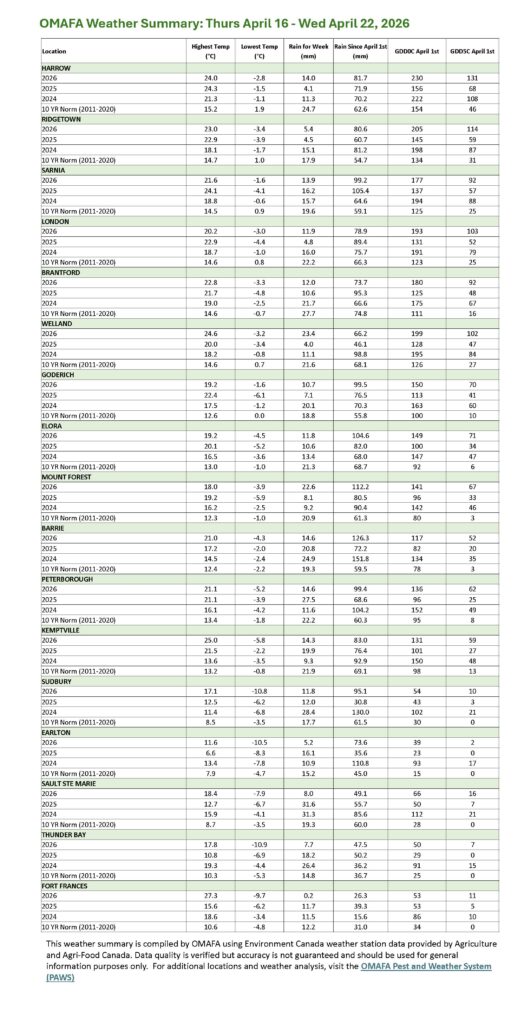
Cool temperatures with persistent rainfall have slowed field drying which has resulted in little field work completed to date. Very few winter cereals outside of the deep south have received an application of nitrogen and sulphur but are expected to receive an application before the weekend. Manure applications and tillage operations are slowly beginning where the conditions allow. Very little corn and no soybeans have been seeded to date.
Cereals
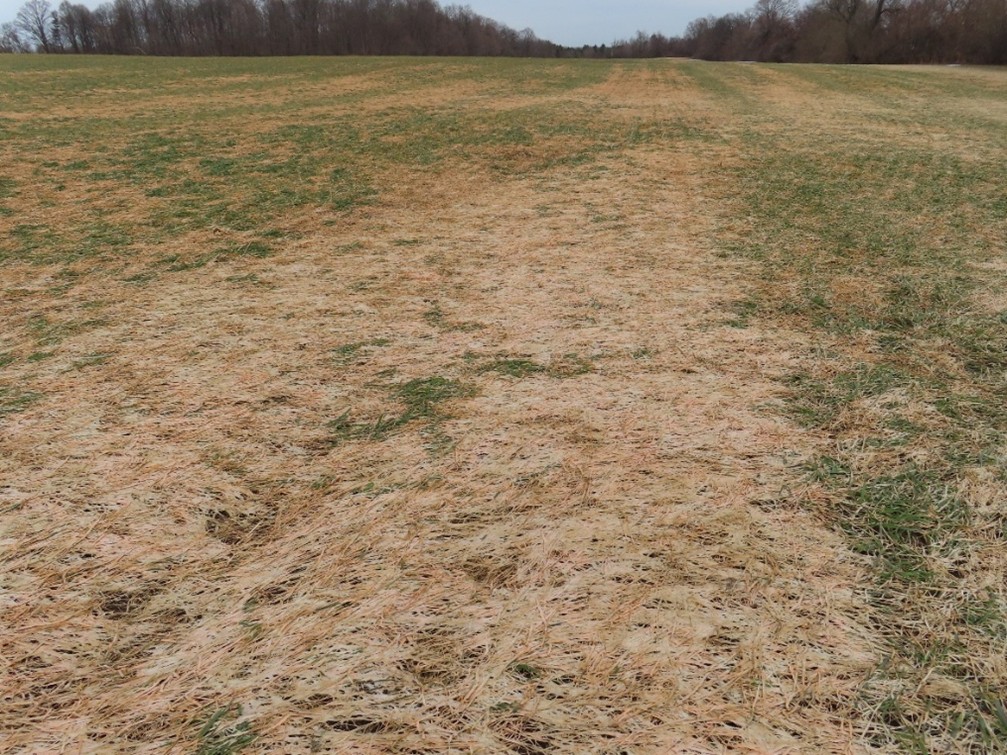
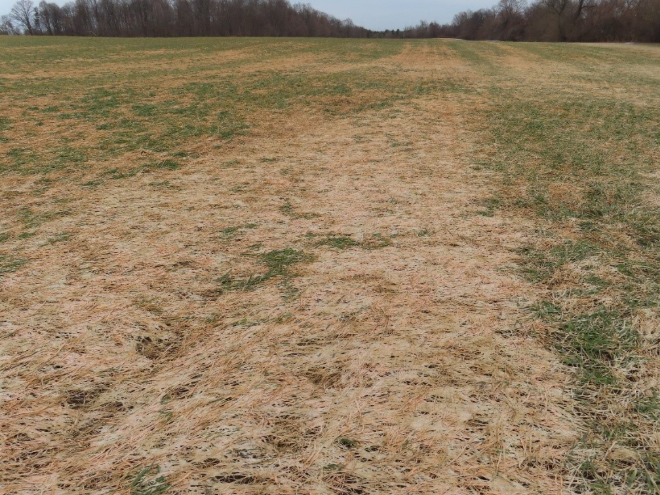
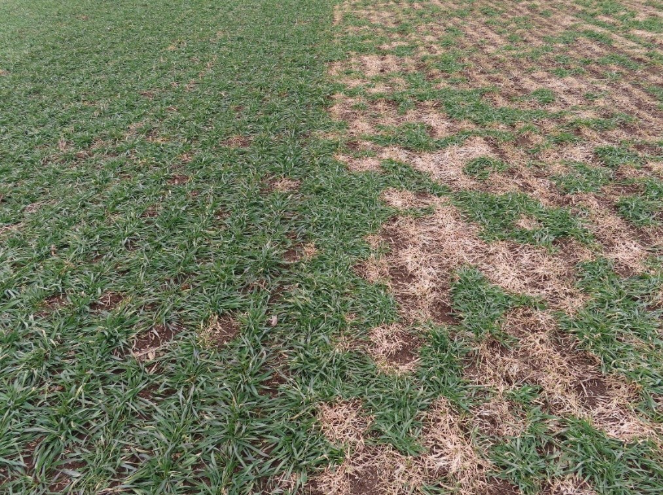
The majority of winter wheat stands continue to look good for the most part. Fields in some regions such as Grey-Bruce and Eastern Ontario are experiencing higher levels of loss due to ongoing standing water and winterkill. However, acreage being terminated is lower than normal with less acres reported as damaged to Agricorp than this time last year. While winter wheat stands look good overall, snow mould has also been particularly bad in fall rye and triticale fields (Figure 1). Genetic and planting date differences are being observed with earlier planted fields showing more severe symptoms (Figure 2). Plants are coming back in affected areas of the field; however, yield potential in those areas is expected to be lower. Winterkill has also been a challenge in winter barley fields, particularly where soils were persistently saturated. Seed placed phosphorus is showing improved survival and growth, particularly on clay soils.
Overall, growth continues to be slow with fields in more north-central and eastern regions having just greened up over the last week or two. Fields in the most southern and southcentral regions are at stem elongation (GS30) with most advanced fields at or approaching first node (GS 31). Those that have not yet applied any nitrogen or sulphur are anticipated to make those applications over the coming days. All remaining fertilizer applications are anticipated to be single applications due to the growth stage of the crop and the anticipated split nitrogen application timing overlapping with corn and soybean planting.
Those fields that received a fall herbicide application continue to remain weed-free and are anticipated to simplify spring crop protection applications with growers needing to only focus on fungicide and PGR tank-mixes. Those fields that did not receive a fall herbicide have flowering chickweed and heavy dandelion pressure in some cases. Bluegrass species and other perennial grasses continue to be a challenge in wheat fields as weed species shift with soybean herbicide programs. Research done by Michigan State University’s Dr. Christy Sprague has shown that yield losses of up to 50% can occur from bluegrass competition in winter wheat. Plants smaller than 10 cm in height are easier to control. Early spring applications provide better control than fall applications. Both fall and early spring applications provide better control than late spring applications. Herbicide selection should be based on the species of blue grass present; however, pyroxsulam (Simplicity) has shown the most consistent control across all bluegrass species. Contact Mike Cowbrough, OMAFA Weed Management Specialist to help identify bluegrass or other weed species present in your field.
Very few spring cereals have been seeded to date. With improving field conditions, planting will commence over the coming days. Winter wheat acres seeded with red clover are estimated to be down.
Winter Canola
Overall winter canola fields are in good shape; however, there are some fields with rotten plants caused by excess moisture. Canola is bolting in the southern counties, and in the early green-up stages in Eastern Ontario and northern parts of the growing region (e.g. Simcoe, Grey and Bruce counties). Nitrogen and sulphur should be applied as soon as conditions will allow, and prior to bolting. Fields that have already bolted and still need nitrogen and sulphur, should apply as soon as possible and anticipate some crop damage in the tire tracks.
Winter canola is susceptible to spring frost injury as plants enter reproductive development stages. In Ontario, winter canola has been observed to tolerate temperatures of -5°C for periods of up to two hours. Frost events may cause symptoms such as drooping stems, abortion of flower buds or open flowers, purple discoloration of plant tissue, or cracking of stems. Plants often recover with minimal impact on yield.
Corn
Very little corn has been planted to date. If the weather continues in a warming trend, planting is expected to commence.
Termination of alfalfa stands prior to corn planting may be a challenge for some, particularly where it was dry last fall and the alfalfa may have a deep tap root. Two passes of glyphosate may be required. If tillage is part of the termination plan, use an implement that breaks the tap root. Damaged crowns may still send up new stems if they are still getting water and nutrients from the tap root.
Soybeans
Soybean acres are generally expected to be stable with IP soybean acres seeing an increase. There are reports of seed quality issues in early day beans that were grown in drought-stricken areas in 2025. Growers are encouraged to do a germination test and bump up their seeding rates accordingly. There have been discussions about sulphur on soybeans. There were some large responses to S noted in 2023, 2024, and 2025 often on sandy soils, and on early planted fields. Most other fields have shown little to no response to S application. If growers are interested in testing the response to sulphur, 100 lbs/acre of AMS on sandy soils is recommended. ATS is not showing the same responses as AMS.
Edible Beans
Edible bean growers are reportedly switching from cranberries to kidneys or soybeans due to current economics.
Forages
Forage stands survived the winter well. The recent warm, soaking rains have improved the growth and development of the grasses and alfalfa. Alfalfa in some areas is now 3-4” tall. If growers are considering a fungicide application, they should be made 21-28 days prior to harvest to realize the most yield and quality benefits. Winter triticale and fall rye are experiencing high levels of snow mould in some fields. Snow mould has been found in some grassy hay fields too. Yield potential in affected areas is expected to be lower.
Drones
There are currently no registered crop protection products that can be applied with a drone.
Exeter
Soybeans
- Soybean seed quality is something to be aware of due to the dry conditions in 2025. Early day beans are of most concern for quality, especially those grown in central and eastern Ontario. Seeding rate should be increased based on the germination. If germination is over 85% it is considered number 1.
- There has been the occasional response to sulphur in soybeans in 2023, 2024 and 2025. Trials will continue with AMS in 2026. If growers are conducting sulphur trials in soybeans, please contact Horst Bohner so he can collect some soil samples.
- IP soybean acres are expected to be up.
Corn
- Growers in the area continue to harvest their 2025 corn crop. Growers are reporting excellent yields and quality.
- The combination of new genetics and fungicides have made a difference in standability and quality of the corn that was left out over winter.
- While some large growers are looking for more corn seed there are not a lot of swing acres as of yet.
Cereals
- Winter wheat in the area is at stem elongation or GS30 with some fields approach first node or GS 31.
- Very little winter wheat has received an application of nitrogen and sulphur. Those that have not yet applied any nitrogen or sulphur are anticipated to make those applications over the coming days. All remaining fertilizer applications are anticipated to be single applications due to the growth stage of the crop and the anticipated split nitrogen application timing overlapping with corn and soybean planting.
- HRW growers are still expected to make a split application in order to achieve the necessary protein.
- Winter wheat acres underseeded with red clover is estimated to be less than 10%. The use of red clover tends to be soil and grower specific. Growers in northern Lambton County and those that continue to plow seem to use red clover more.
- Snow mould has also been particularly bad in winter rye and triticale fields. Genetic and planting date differences are being observed with earlier planted fields showing more severe symptoms. Plants are coming back in affected areas of the field; however, yield potential in those areas is expected to be lower.
- Winterkill has also been a challenge in winter barley fields, particularly where soils were and continue to be saturated.
Forages
- Forage stands survived the winter well. The recent warm, soaking rains have improved the growth and development of the grasses and alfalfa. Alfalfa in some areas is now 3-4” tall.
- If growers are considering a fungicide application, they should be made 21-28 days prior to harvest in order to see the most yield and quality benefits.
- Winter triticale and rye are experiencing high levels of snow mould in some fields. Yield potential in affected areas is expected to be lower.
Canola
- Overall winter canola fields are in good shape; however, there are some fields with rotten plants caused by excess moisture. Canola likes moisture less than winter wheat.
- Canola is bolting in the southern counties. Nitrogen and sulphur should be applied as soon as fields are deemed acceptable, and prior to bolting.
- Fields that have already bolted and still need nitrogen and sulphur, should apply as soon as possible and anticipate some crop damage from application.
Edible Beans
- Cranberry growers are switching to kidney beans due to the current economics. It is anticipated that there may be a switch from edible bean acres to IP soybeans.
Weed Control
- Dandelion and chickweed pressure in both alfalfa and winter wheat fields is quite bad. Particularly in those winter wheat fields that did not receive a fall herbicide. If you have a winter wheat field with both dandelion and chickweed, Barricade M is the best herbicide option according to the OMAFA Crop Protection Hub.
- While growers are looking for way to cut input costs, it is important to continue to follow the herbicide label for certain weeds. Growers are also reminded to be careful with cutting herbicide rates and herbicide resistance.
- If terminating an alfalfa stand, group 4 herbicides and glyphosate are best for killing it. Tillage will also help. Growers need to watch re-cropping intervals.
Insects
- Great Lakes states such as Michigan and Ohio have already hit peak seed corn maggot flight. They have been found in high numbers. They are also experiencing high black cutworm and true armyworm numbers.
Soils
- More retailers are encouraging growers to soil sample with the current fertilizer prices.
- Soils with low testing K last year seem to be getting rectified. The drier the soil sample is, the more impact it can have on soil test results, particularly K. Of the samples coming in so far this spring, there has not been a lot of low K values.
Fertilizer
- The price of MAP is going to continue to go up as access to MAP going forward is going to be an issue. This could be a concern in the fall when wanting to plant winter wheat with MAP. There will likely be more triple super phosphate available.
- Phosphorus uptake in wheat is increase if there is nitrogen available with it. Previous research showed the P:N ratio to be 5:1 for improved P uptake. If MAP is difficult to get, AMS mixed with triple super phosphate may be the solution.
- It is unclear what is going to happen with MESZ, but it is anticipated it will be in short supply as it is already tight. It is also unclear where supply is at for Amidas.
Drones
- There was a discussion on drones and the concerns with uneven coverage. There are currently no registered crop protection products that can be applied with a drone.
- Dicamba should never be applied with a drone.
- It was noted that drones can be an effective tool for fertilizer and cover crops but not for crop protection.
Agricorp
- Agricorp has received very little damage reports to date on winter wheat (<1000 acres so far).
- There is still standing corn and soybeans in some areas. Fortunately, there are no quality issues with soybeans and yields have been good with the exception of eastern Ontario.
Winchester
Fertilizer
- UAN will be tight in the east; however, there is sufficient supply for this spring. There are no concerns with the availability of Urea and Ammonium Sulphate.
- Phosphate is currently expected to be ok as demand will likely be lower due to price.
- Growers should consider other ways to get phosphorus into their programs other than broadcasting it – starter, banded, etc. to make lower rates more effective going forward.
- There are no concerns with potash but increasing diesel costs will increase the cost of shipping it.
Winter Cereals
- No reports of major snow mould damage in the area in winter wheat. Some geese damage reported.
- Winter survival overall is good, but some of the flatter lands in the far east are seeing winterkill damage and will be replanting with spring wheat.
- Anything planted early October seems to be struggling, partially due to planting date.
- Some thoughts that a lot of winterkill is on heavy clays, and when planted last fall, it was very dry, so there might not have been a good chance to establish roots or plant to proper depth.
- Triticale has some snow mould in the early planted acres. A reminder that snow mould is often in fields with lots of growth in the fall and receives significant snow coverage before the ground freezes. Most of the time, fields will come through it, unless there is widespread damage. Fields with spotty infection don’t pose any concern to feed quality, as it’s grown out of it by harvest.
- There’s a small percentage of cereal acres with nitrogen applied, but it’s anticipated that quite a bit will go on late this week or weekend. Wheat has not reached stem elongation and there are no concerns for timing yet.
Winter Canola
- Little winter canola in the area. Trials at Winchester Research Station are focusing on assessing different hybrids and PGRs. The impact of various planting dates and a dry fall on establishment and survival this spring are still to be determined.
Forages
- Alfalfa appears to have less winterkill (so far) and is a bit more consistent than winter wheat stands. It was a bit later to green up but is coming along nicely now. Remember to dig up and split roots to do a true check on winter survival. Instructions on assessing Alfalfa Winter Injury.
- Feed inventories are reasonable. Some producers are comfortable with quantities left and managing the upcoming growing season, others are stretched thin and planning for more annual forages. Some shorter season corn hybrids have been ordered in an effort to harvest silage sooner. A reminder to check Pre-Harvest Intervals on crop protection products if there’s a chance the crop will be harvested earlier than normal.
- Forage soybeans are being discussed more; however, the focus seems to be on other options, such as corn silage, underseeding feeds for green chopping or annual forages.
Spring Cereals
- No spring cereals planted yet. Acres might be up a little to compensate for winter wheat kill or termination.
- Expecting a lot of spring cereals to go in this week if the conditions allow.
Corn
- A reminder to communicate details to any custom operators, retailers or agronomists. Switching fertilizer plans (i.e. from urea to UAN or vice versa) can’t often be done in season and should be flagged as early as possible.
Soybeans
- If growing corn with the Enlist trait, a different product will be required for volunteer corn control in soybeans.
- Seed quality for soybeans east of Toronto has been a concern this spring (especially if Ontario grown seed), as seeds are smaller and the seed coats are very delicate.
- Lots of soybeans are going out as Certified #2, meaning the germ could be a bit lower. It’s important to talk to your seed dealer and your agronomist about adjusting seeding rates prior to planting.
- Seed reps are recommending that growers handle the seed as few times as possible (i.e. auger it less or not at all if you can avoid it) and to handle bags with care.
- Certified #2 still requires minimum 75% germination, and many companies are using 80% as their threshold.
- Certified #2 soybeans may be best suited to warmer weather planting, in an effort to encourage quick germination and emergence.
Agricorp
- Deadlines are approaching, please consult the Agricorp website for specifics to your region and coverage options.
Other Notes:
- Remember to double check trait packages, keep records of what’s planted where and communicate that information with the appropriate parties.
- Be diligent of safety. Spring is busy and people are rushed, but it gets done every year, so be patient and aware of your surroundings. BASF has a Safety Scout’s program where you can access children’s sized safety gear and Hi Vis items at no cost, shipped directly to your door. More information can be found on the website above.
- The Winchester Research Station is hosting a Research Field Day on Tuesday, June 30th at the Research Station. Registration and more information are now open at eocac.ca
Simcoe
Weather
- Cool temperatures and wet soils persist except for on sandy soils in Norfolk and Brant where some field activity has started. Some fields with standing water and evidence of soil erosion are proof of recent rain events.
Crop Inputs
- Fertilizer supplies for the spring growing season are generally in place. Prices are higher than last year at this time. Supply for this fall is still undetermined.
- Planned IP bean acres are higher, but the inventory for IP bean herbicides is low.
- Interest in use of drones for spraying pesticides is higher, especially with T100 drones, but there are currently no pesticides registered for drone application. Currently drone use for application of cover crops is the most practical use.
- Where manure is being applied, taking a manure analysis is recommended to determine potential commercial fertilizer savings. Where manure application is planned into standing corn using a drag hose, a few observations/precautions: corn may have similar population, but damaged corn could be behind resulting in a wider pollination window and higher risk of ear molds. Drag hose application onto worked, loose soil can move quite a bit of soil and damage emerging plants.
Winter cereals
- Have come through the winter quite well with earliest winter wheat fields at stem elongation (GS 30). The difference in timely planted fields is obvious with more tillering and more uniform stands. Some wheat heaving is evident, especially where wheat was planted shallow and/or into thick residue.
- Some nitrogen was applied on the frost, but most will be applied this week before weekend rain.
- Most rye and cereal forage fields have had nitrogen applied. A few cereal forage fields have reported snow mould but generally the fields are uniformly lush.
- Most of the red clover has been seeded, and although a majority still use ATVs with small spinner spreaders, there was a significant amount of red clover applied using drone application. A relatively small amount of wheat acres are seeded to clover since cost of seeding clover is similar to cost of planting cover crops post wheat harvest. Many producers prefer the options for weed control, organic amendments and specific cover crop mixes to the often patchy stands of red clover.
Canola
- Acreage is similar to last spring. Fields look variable coming out of winter, often dependent on topography and drainage.
Forages
- Forages in the region have survived winter with little winter kill.
- Alfalfa and grasses are growing well and responding to warm rains and milder temperatures.
- Forage feed inventories on some farms are relatively low. The transition to cereal forage crops has the potential to result in low forage inventories if the ideal harvest timing is during a wet period. There are still advantages of having a balance of alfalfa and cereal forages to ensure high quality feed.
Corn
- Planting is only just starting with some sweet corn under plastic and a few acres of grain corn on the lightest soils. More acres will be planted in Norfolk before the weekend.
- Tillage is occurring as conditions allow; currently only on the lightest soils.
- There are a few fields with 2025 corn crop still unharvested, mostly due to late maturity and high grain moisture. Reported yields are descent and grain moisture percentage in the mid-teens.
Soybeans
- Planting has not been reported. Scouting fields is recommended for tillage and herbicide consideration, especially in fields that were dry last summer and have corn residue with high weed populations.
Other
- Bee winter survival is poor again this spring with 80 % or higher mortality reported by some beekeepers.
- Supply chains and US tariffs are affecting acreage of some crops. More watermelons are being grown in Ontario to supply the rest of Canada.
Agricorp
- May 10th is the deadline to report crop changes.
- Locally, some fields of unharvested soybeans and corn remain in the area.
- Growers must contact Agricorp if they have not completed their 2025 corn or soybean harvest.