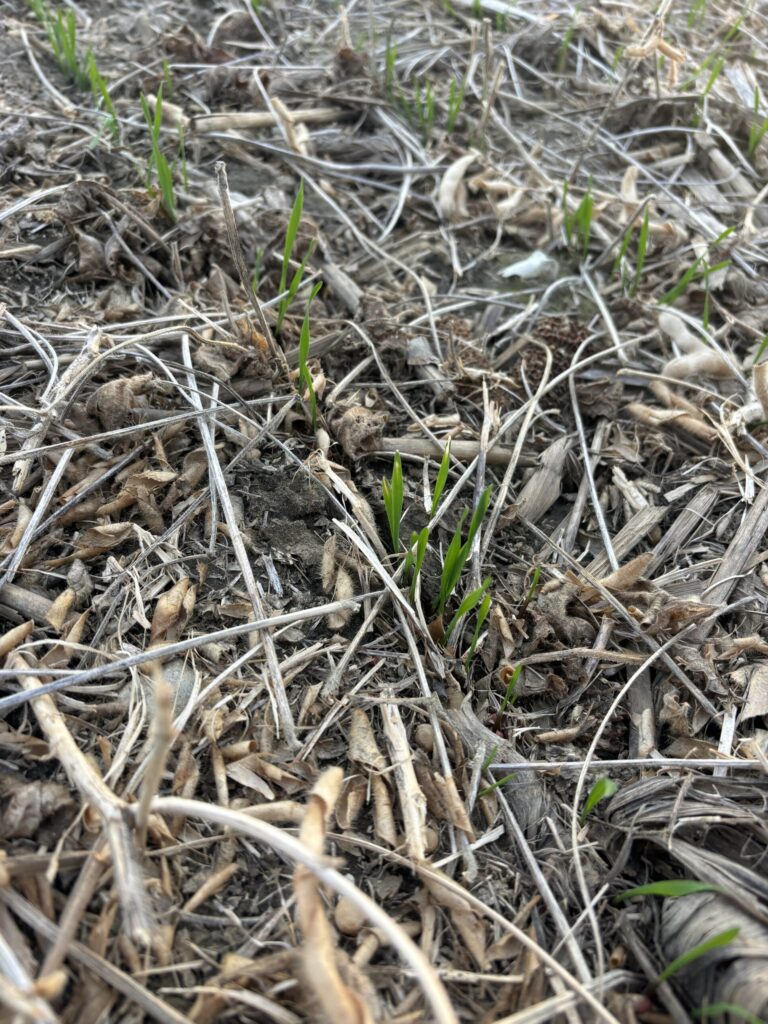
High-yielding winter wheat begins long before spring green-up. Ontario research consistently shows that the foundation of a profitable wheat crop is timely planting, strong fall establishment and adequate phosphorus at seeding. Success is rarely determined by one management decision alone. Instead, high-yielding wheat crops are built through a series of management practices that work together to maximize emergence, tillering, winter survival, and spring vigour.
Planting Date
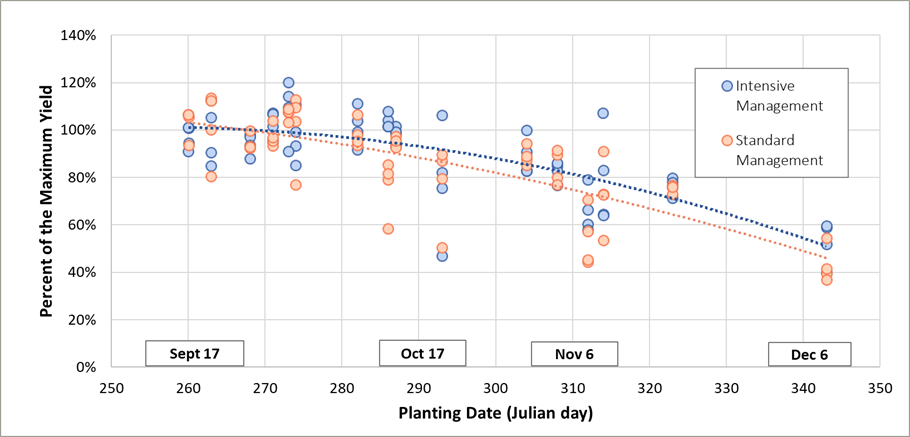
Planting date remains on of the single most important management factors influencing winter wheat yield. Ontario research has shown that yield potential declines by approximately 1.1 bu/ac for every day planting is delayed beyond the optimum planting date for a region (Figure 1). Timely planting allows wheat to establish roots, develop tillers, accumulate biomass more rapidly before going into winter.

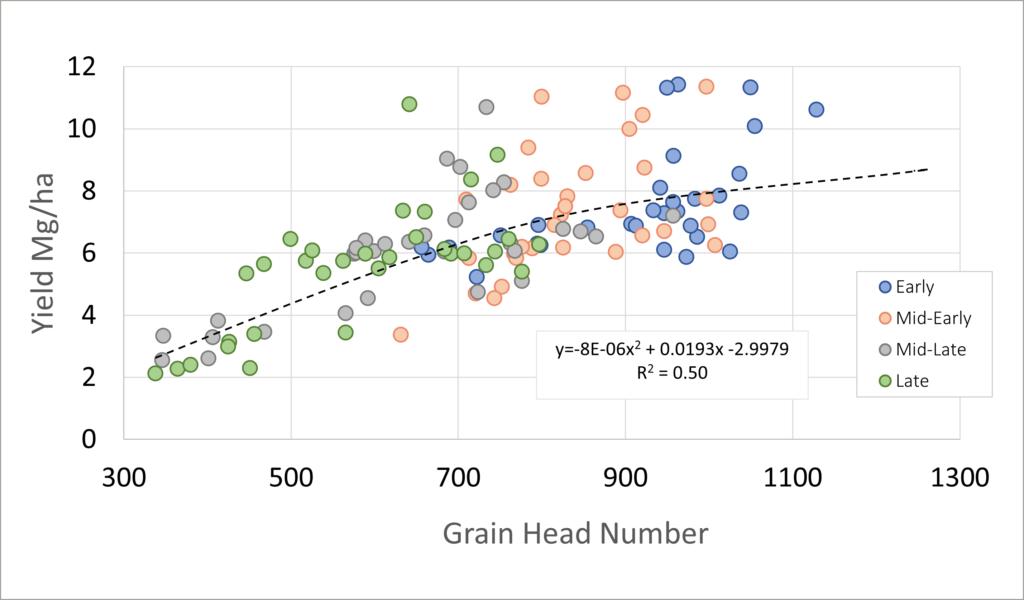
Research conducted by Emma Dieleman at the University of Guelph, Ridgetown Campus found that earlier-planted wheat produced significantly more productive heads per square metre (Figure 2), greater biomass accumulation, earlier canopy closure, and yield advantages ranging from 10.4 to 50.7 bu/ac (Figure 3) compared to later planting dates.
Variety Selection
Selecting the right variety is another important step toward maximizing yield potential. The Ontario Cereal Crop Committee 2026 data can be found in the tables under “winter wheat” and “winter barley” in the “performance trial results” tab at GoCrops.ca. The PDF report can be found here.
When considering decisions, it is best to use multi year data. Select varieties that perform well in your area across a number of sites and years. Many factors should be considered when choosing a variety, including: the farm location, winter survival, insect and disease resistance – including stripe rust and fusarium, lodging potential and yield. The Head to Head feature is an excellent way to compare and evaluate varieties side by side using the data points most important to you. Quality parameters such as DON, test weight and falling number should also be considered when making variety selections. For more information on falling number for a specific variety, please speak to your winter wheat distributor.
Seed-Placed Phosphorus
If there is one nutrient that consistently delivers a return in winter wheat, it is phosphorus. Previous Ontario research has shown that winter wheat responds strongly to seed-placed phosphorus, particularly on low-testing soils. Starter phosphorus promotes early root development, supports tillering, improves stand uniformity, and enhances winter survival.
In a 23-site Ontario trial conducted by Peter Johnson and Shane McClure, average yields increased by approximately 7 bu/ac when starter phosphorus was applied (Table 1), with responses exceeding 10 bu/ac on low-testing soils (data not shown).
Table 1: Winter Wheat Starter Yield Response (3 years, 23 sites)
| Treatment | Yield (bu/ac) | Gain over Check (bu/ac) | P2O5 Applied (lbs) | K2O Applied (lbs) |
| Check | 83.7 | – | 0 | 0 |
| 2.5 gal 6-24-6 IF | 86.3 | 2.6 | 7 | 1.7 |
| 5 gal 6-24-6 IF | 87.8 | 4.2 | 13 | 3.3 |
| 40lbs 7-34-20 IF | 88.5 | 4.8 | 14 | 8 |
| 10 gal 6-24-6 IF | 89.1 | 5.4 | 26 | 6.6 |
| 100lbs MESZ IF | 90.9 | 7.2 | 40 | 0 |
| 150lbs 7-34-20 IF | 90.9 | 7.2 | 51 | 30 |
| 100lbs MAP IF | 90.9 | 7.2 | 52 | 0 |
| 200lbs 7-34-20 Broadcast | 88.6 | 4.9 | 68 | 40 |
Additional Ontario research conducted by Dr. Dave Hooker found seed placed MAP increased wheat yields by approximately 15 bu/ac on low testing soils (<20 ppm) (Table 2).
Table 2: Wheat yield response to background fertility and starter fertilizer (21 site-years)
| Starter In-Furrow (per ac) | Background Treatment (soil test ppm) | Average Across Background | |||
| P – 20 K -120 | P +20 K -120 | P -20 K +120 | P +20 K +120 | ||
| bu/ac | |||||
| No fertilizer | 67 c | 84 d | 70 c | 91 ab | 78 c |
| 6-24-6 @ 3-5 gal | 75 b | 87 cd | 77 b | 92 ab | 83 b |
| MAP @ 80-100 lbs | 82 a | 89 bc | 88 a | 94 a | 88 a |
| 0-0-60 @ 70-80 lbs | 70 c | 90 ab | 71 c | 89 b | 80 c |
| 6-28-28 @ 90-225 lbs | 82 a | 92 a | 86 a | 93 a | 88 a |
Residue Management
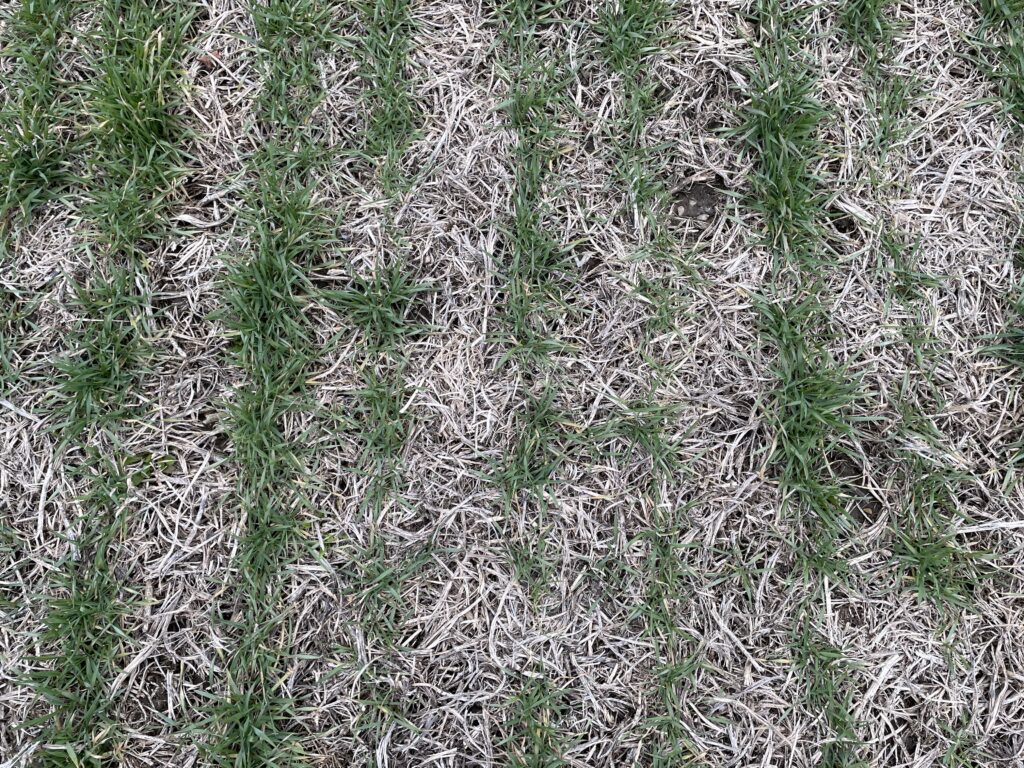
Residue management begins at soybean harvest. Evenly distributing residue across the full width of the combine is critical for successful wheat establishment, allowing for consistent seed placement, good seed-to-soil contact, and uniform emergence. Check residue spread patterns during harvest and make adjustments as needed to avoid heavy residue bands that can interfere with drill performance and stand uniformity. When planting wheat immediately after soybeans, attention to residue management can have a significant impact on crop establishment and overall success.
Fall Weed Control
Winter wheat provides an excellent opportunity to get ahead of challenging weeds before spring. Fall herbicide applications are particularly effective on difficult-to-control species such as annual bluegrass and Canada fleabane, especially where herbicide resistance is a concern. They also allow growers to target winter annuals and perennials such as bluegrass, fleabane, dandelion and chickweed, when weeds are small and actively growing, improving control while reducing competition the following season. [
Beyond improved weed control, fall applications can help simplify spring management. By removing weed control from the spring workload, growers can focus on timely nitrogen, fungicide, and plant growth regulator (PGR) applications while optimizing application timing for each input. A cleaner field entering spring also helps preserve the yield potential established through strong fall growth and establishment. For more information on herbicide selection, please visit the OMAFA Crop Protection Hub.
Consider a Seed Treatment
Seed treatments should be considered as a tool to help manage both seedborne diseases and insect pests during establishment. This is particularly important for managing Barley Yellow Dwarf Virus (BYDV) and Common or Dwarf Bunt.
Barley Yellow Dwarf Virus
BYDV continues to be an important concern in winter wheat. The virus is transmitted by aphids with fall infections being the most damaging and can result in underdeveloped root systems, reduced tillering, delayed maturity, and yield losses exceeding 30%.
While there is little that can be done once infection occurs, risk can be reduced through proper management. Fields seeded well before the optimum planting date are at greater risk because they are more attractive to migrating aphids in the fall. Where BYDV risk is a concern, insecticide seed treatments can provide an additional layer of protection by reducing aphid feeding during the establishment period. While seed treatments will not eliminate BYDV infection entirely, they can help reduce the likelihood of virus transmission during the vulnerable fall growth stages.
Common and Dwarf Bunts
Seed treatments play an important role in managing common bunt and dwarf bunt, two diseases that can significantly reduce grain quality and marketability. Infected kernels are replaced by dark spore masses, or “bunt balls,” that produce a characteristic fishy odour and can result in severe grade discounts. Prevention is the best management strategy: avoid planting infected seed and consider using certified, fungicide-treated seed to minimize disease risk. Proper seed treatment coverage is essential for effective control. While fungicide seed treatments can nearly eliminate infection, not all products are effective. Difenoconazole is currently the only active ingredient registered for dwarf bunt control and has proven highly effective. In fields with a history of bunt, variety selection, certified treated seed, proper seed treatment coverage, and planting within the recommended window can all help reduce risk and protect grain quality.
When combined with timely planting, proper seeding depth, and starter phosphorus, seed treatments help protect yield potential established in the fall. Selecting a seed treatment package that provides both fungicide protection against seedborne diseases such as bunts and insecticide activity against aphids can be a valuable part of an overall winter wheat establishment strategy.
The Bottom Line
Focus on three things this fall, to maximize yield potential and a successful wheat crop:
- Plant within the optimum planting window whenever possible.
- Use seed-placed phosphorus, MAP in particular, to promote strong root growth and tillering.
- Aim for vigorous fall establishment rather than relying on spring recovery.
Winter wheat rewards good establishment. Every extra day of growth in the fall increases the crop’s ability to tiller, intercept sunlight, survive winter, and ultimately achieve its yield potential.