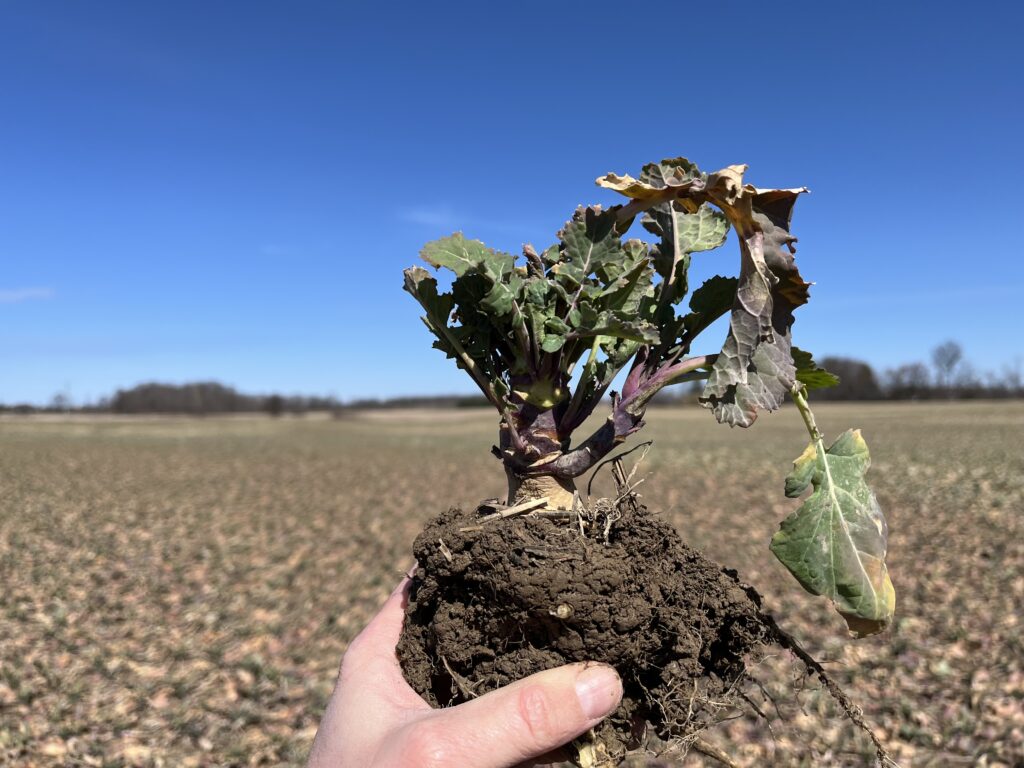
Dry Bean Tillage Options

Dry edible beans grow best in soils with excellent soil structure and good drainage. The seedbed requirements are similar to those for soybeans, including a firm seedbed to enhance a uniform planting depth and good seed-to-soil contact to promote rapid and uniform emergence. The best, highest-yielding stands come from beans that emerge within a week […]

Read More…

Corn Hybrid DON Screening Trials 2023 Report

Introduction Gibberella ear rot concerns the industry because of DON concentrations. It is well known that DON concentrations are highly dependent on interactions among hybrids, pathogens, and the environment. Starting in 2019, the Ontario Corn Committee (OCC) refined protocols for testing hybrid sensitivity to DON accumulation with confidence based on an assessed risk. This inaugural […]

Read More…

Why do I see nutrient deficiencies in my crops, even with moderate soil test levels?

Nutrient deficiencies occur regularly in Ontario and can be the cause of substantial yield loss depending on the type, severity and timing. Their presence is particularly frustrating when soil test levels show adequate levels of fertility. The simple answer Nutrient deficiencies can appear in soils testing moderate or high in plant nutrients given the right […]

Read More…

Which residual corn herbicides allow cover crops to be inter-seeded?

With a narrow window to establish cover crops after corn harvest, some farmers have experimented with inter-seeding cover crops when corn is at the 6-8 leaf stage. However, the sensitivity of different cover crops to residual corn herbicides is unknown and could negatively affect their establishment. A multi-year study looked at the sensitivity of six […]

Read More…

What can I do to my liquid manure storage to increase nutrient value and decrease application costs?

The soil fertility benefits of applying livestock manure are significant. But storage is key. Uncovered storage facilities result in manure with a high volume of water and low nutrient value being shipped to fields. Fortunately, changes to storage facilities can improve efficiency of nutrient transport. The simple answer By covering liquid manure storage and diverting […]

Read More…

Does ammonium sulphate (AMS) improve soybean yields on clay loam or silt loam soils?

Sulphur (S) is an essential nutrient necessary for plant growth. In the past it was assumed that soil sulphur supplies were adequate to meet soybeans full yield potential. Since air-borne sulphur emissions have been drastically reduced in the Great Lakes Basin, is it now necessary to feed soybeans sulphur? The simple answer In 2023 three […]

Read More…

Using Crop Heat Units

Crop Heat Units (CHU) are based on a principle similar to GDD. CHU accumulations are calculated on a daily basis, using the maximum and minimum temperatures, however, the equation that is used is quite different. The CHU model uses separate calculations for maximum and minimum temperatures. The maximum or daytime relationship uses 10°C as the […]

Read More…

Using Growing Degree Days

Growing Degree Days Growing degree days (GDD), an estimate of accumulated heat, are used to predict the growth and development of plants, insects and diseases during the growing season. Insect, disease and plant development are very dependent on temperature and the daily accumulation of heat. The amount of heat required to advance a plant or […]

Read More…